Univ. Bordeaux, IMN, UMR 5293, 33000, Bordeaux, France.
CNRS, IMN, UMR 5293, 33000, Bordeaux, France.
Brain Struct Funct. 2019 Mar;224(2):859-882. doi: 10.1007/s00429-018-1810-2. Epub 2018 Dec 7.
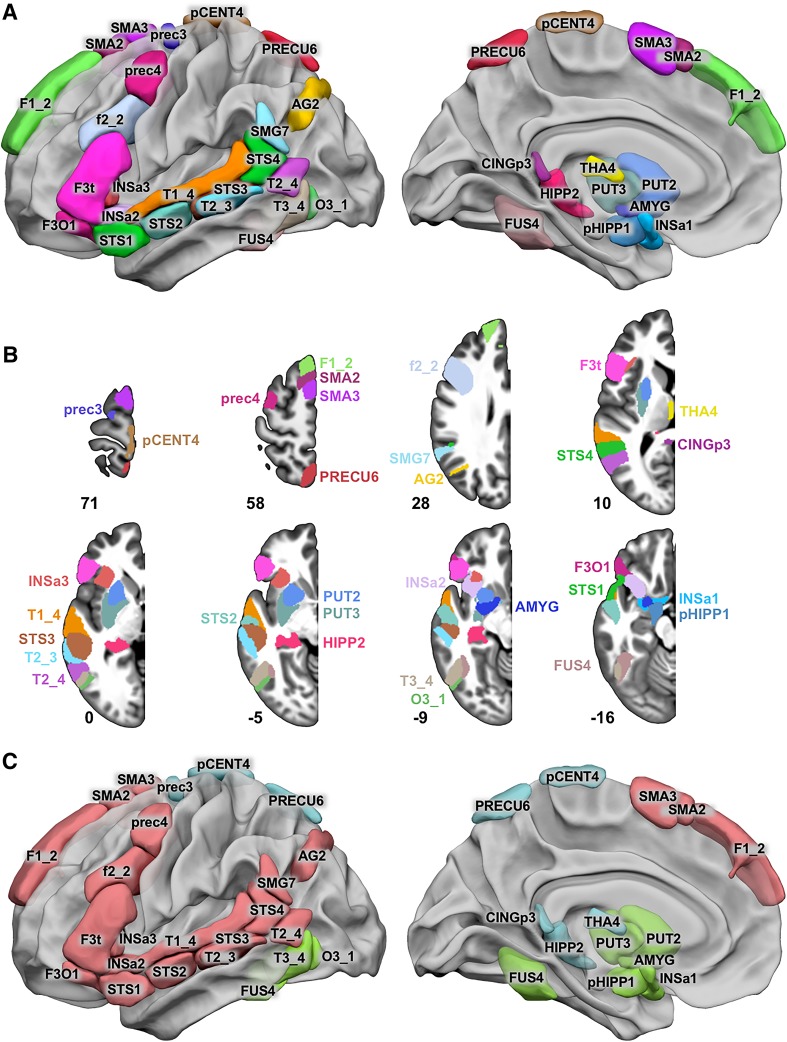
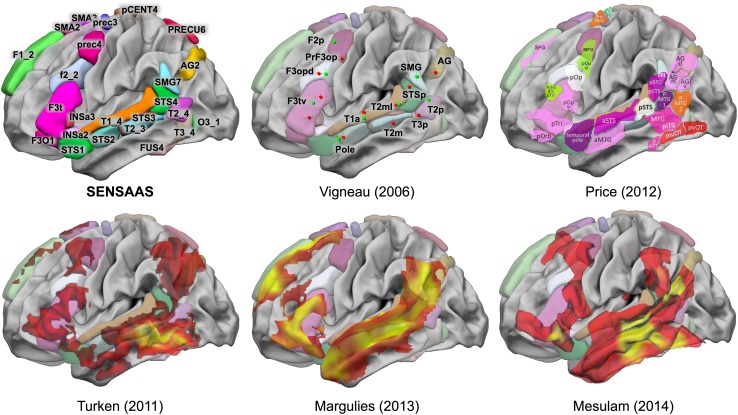
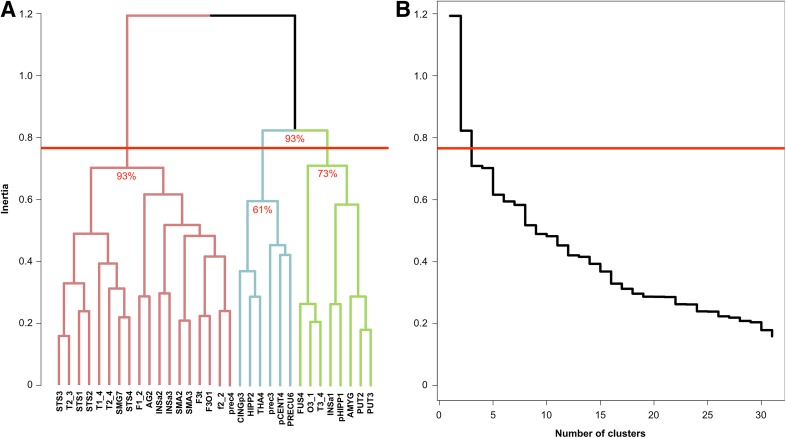
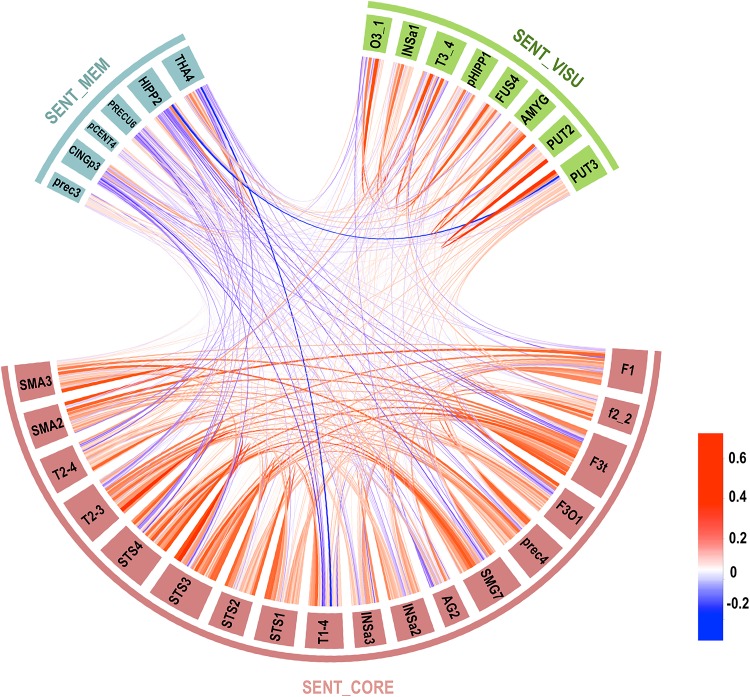
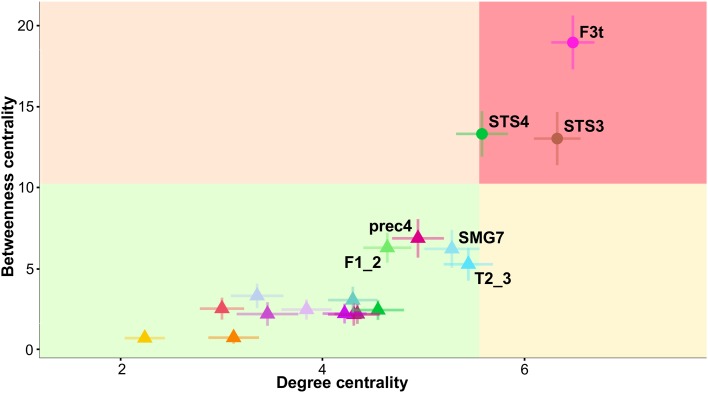
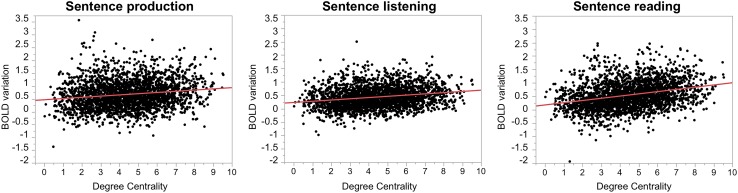
We herein propose an atlas of 32 sentence-related areas based on a 3-step method combining the analysis of activation and asymmetry during multiple language tasks with hierarchical clustering of resting-state connectivity and graph analyses. 144 healthy right-handers performed fMRI runs based on language production, reading and listening, both with sentences and lists of over-learned words. Sentence minus word-list BOLD contrast and left-minus-right BOLD asymmetry for each task were computed in pairs of homotopic regions of interest (hROIs) from the AICHA atlas. Thirty-two hROIs were identified that were conjointly activated and leftward asymmetrical in each of the three language contrasts. Analysis of resting-state temporal correlations of BOLD variations between these 32 hROIs allowed the segregation of a core network, SENT_CORE including 18 hROIs. Resting-state graph analysis applied to SENT_CORE hROIs revealed that the pars triangularis of the inferior frontal gyrus and the superior temporal sulcus were hubs based on their degree centrality (DC), betweenness, and participation values corresponding to epicentres of sentence processing. Positive correlations between DC and BOLD activation values for SENT_CORE hROIs were observed across individuals and across regions regardless of the task: the more a SENT_CORE area is connected at rest the stronger it is activated during sentence processing. DC measurements in SENT_CORE may thus be a valuable index for the evaluation of inter-individual variations in language areas functional activity in relation to anatomical or clinical patterns in large populations. SENSAAS (SENtence Supramodal Areas AtlaS), comprising the 32 supramodal sentence areas, including SENT_CORE network, can be downloaded at http://www.gin.cnrs.fr/en/tools/ .
我们在此提出了一个基于 3 步结合分析在多个语言任务期间的激活和不对称性与静息状态连接和图分析的层次聚类的 32 个与句子相关的区域图谱。144 名右利手健康人进行了基于语言产生、阅读和听力的 fMRI 运行,既有句子也有过学习单词列表。在语言任务中,对每对同源感兴趣区(hROI)的句子减去单词列表的 BOLD 对比和左减去右的 BOLD 不对称性进行计算。在三个语言对比中,每个任务中都共同激活和左侧不对称的 32 个 hROI 被识别出来。对这 32 个 hROI 之间静息状态 BOLD 变化的时间相关性的分析允许将核心网络 SENT_CORE 分离出来,包括 18 个 hROI。对 SENT_CORE hROI 进行静息状态图分析显示,下额前回的三角部和颞上回基于它们的度中心性(DC)、中间性和参与值是句子处理的中枢,对应于句子处理的中心。个体间和区域间都观察到 SENT_CORE hROI 的 DC 和 BOLD 激活值之间存在正相关,无论任务如何:SENT_CORE 区域在静息状态下连接得越多,在句子处理过程中激活得越强。因此,在 SENT_CORE 中的 DC 测量值可能是评估语言区域功能活动在大人群中的个体间变化与解剖或临床模式相关的有价值指标。SENSAAS(句子超模态区域图谱),包括 32 个超模态句子区域,包括 SENT_CORE 网络,可以在 http://www.gin.cnrs.fr/en/tools/ 上下载。