Department of Radiology, University Hospital Erlangen, Maximiliansplatz 3, 91054, Erlangen, Germany.
Siemens Healthcare GmbH, Siemensstr. 3, 91301, Forchheim, Germany.
J Med Syst. 2018 Dec 10;43(1):14. doi: 10.1007/s10916-018-1131-2.
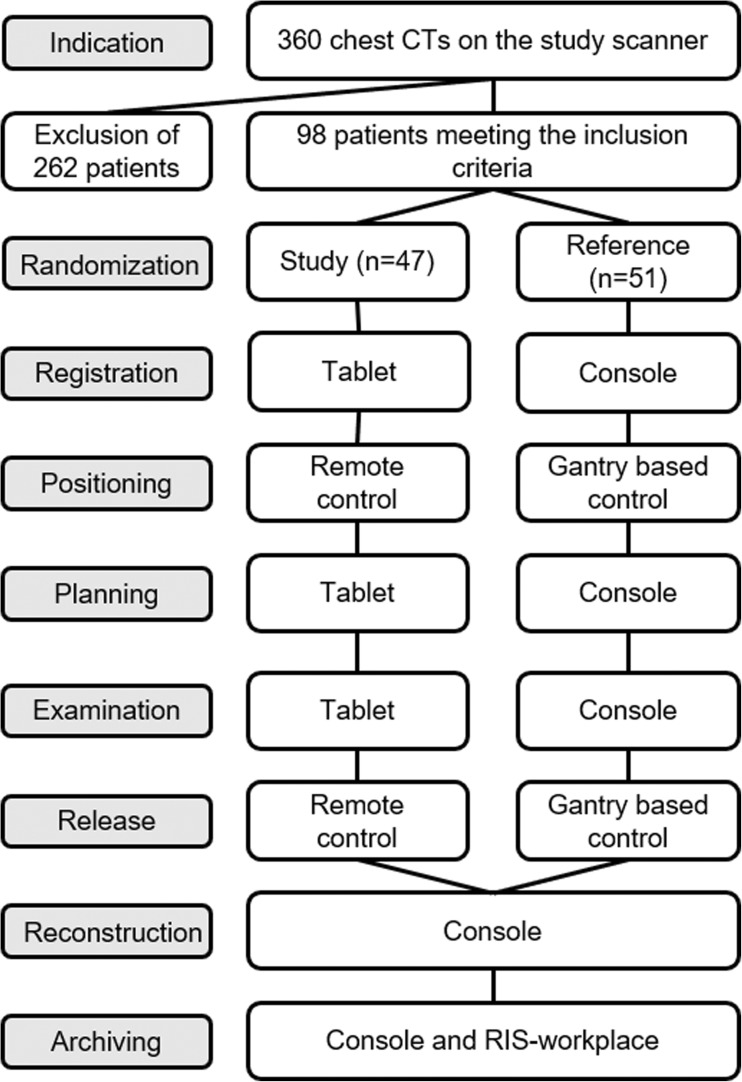
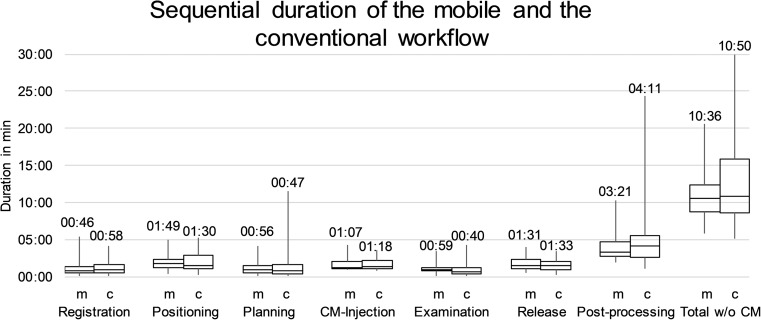
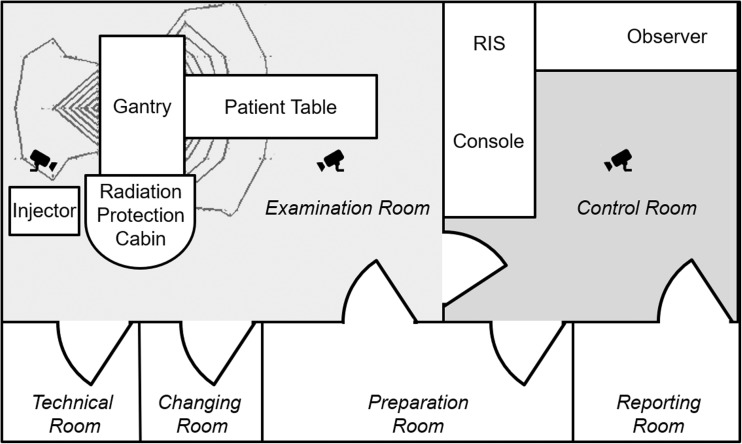
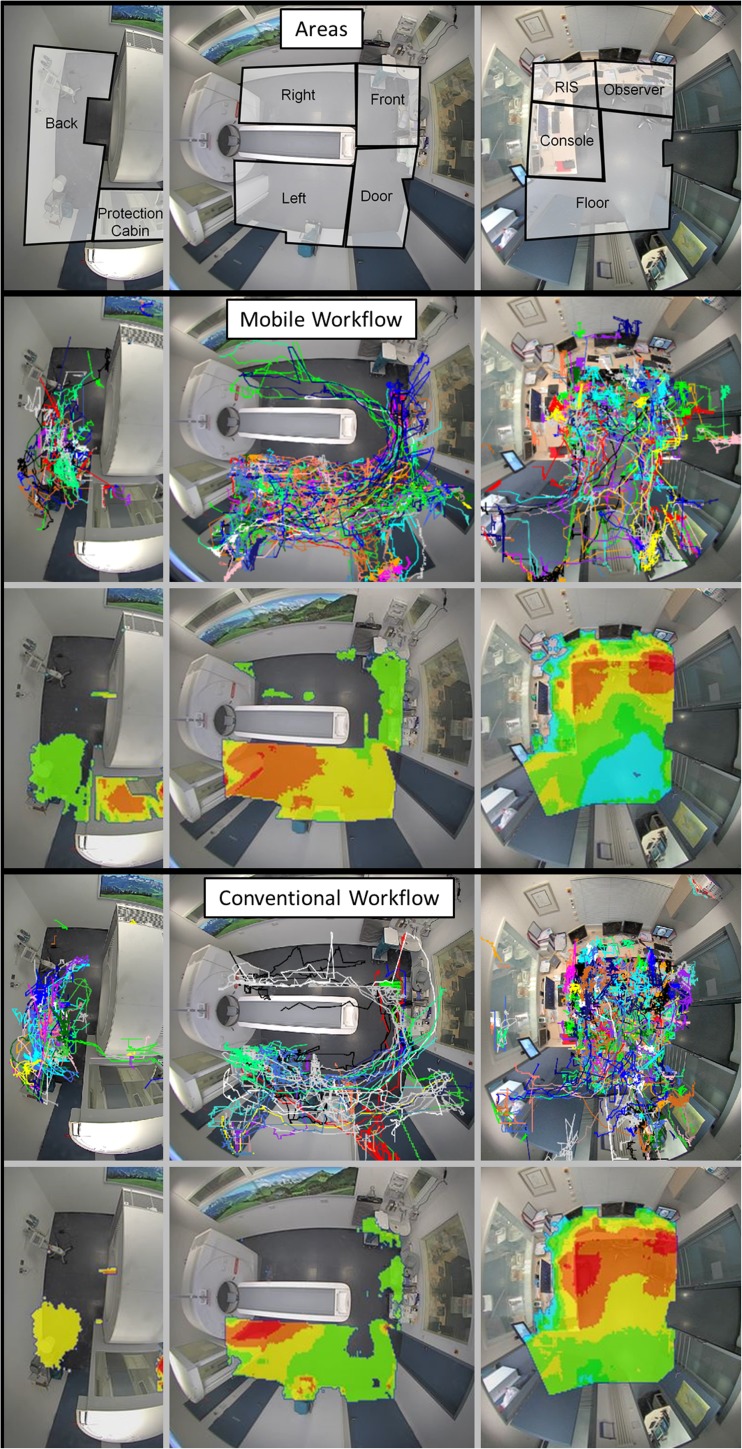
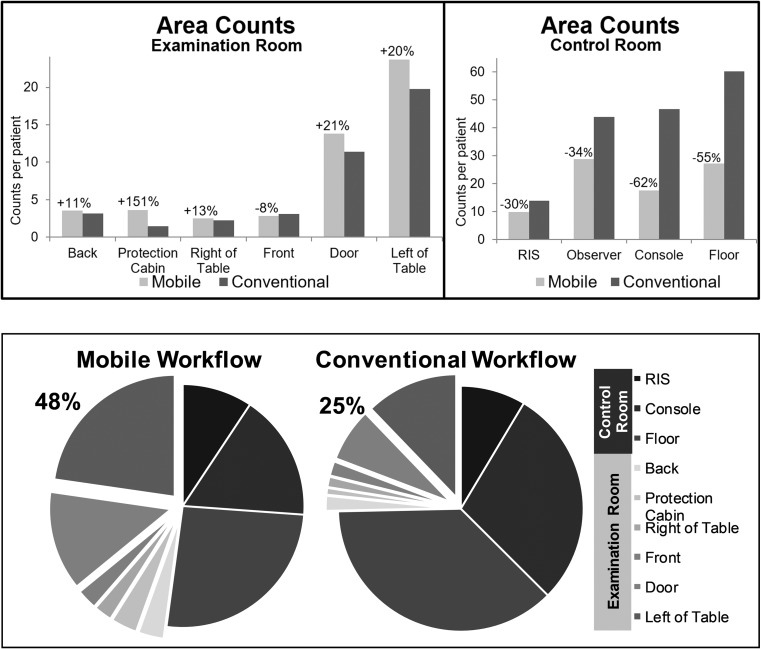
A CT system with a tablet as mobile user interface and a wireless remote control for positioning and radiation release has recently been presented. Our aim was to evaluate the effects of a mobile CT examination workflow on the radiographers' performance compared to conventional examinations. A prototype of a radiation protection cabin was installed besides the gantry of a CT system. The CT system was equipped with a simplified user interface on a portable tablet and a mobile remote control. 98 patients with an indication for CT of the chest were randomly assigned to examination using the mobile devices (study group, n = 47) or using the conventional stationary workflow on the console (reference group, n = 51). Three ceiling mounted fisheye cameras were used for motion tracking of the radiographers, two in the examination room and one in the control room. Relative density of detection heat-maps and area counts were assessed using a dedicated software tool to quantify radiographers' movements. Duration of each task of the examination was manually recorded using a stopwatch. In the reference group 25% of the area counts were located inside of the examination room, while it was 48% in the study group. The time spent in the same room with the patient increased from 3:06 min (29%) to 6:01 min (57%) using the mobile workflow (p < 0.05), thereof 0:59 min (9%) were spent in moderate separation with maintained voice and visual contact in the radiation protection cabin. Heat-maps showed an increase of the radiographer's working area, indicating a higher freedom of movement. Total duration of the examination was slightly less in the study group without statistical significance (median time: study 10:36, reference 10:50 min; p = 0.29). A mobile CT examination transfers the radiographers' interaction with the scanner from the control room into the examination room. There, radiographers' freedom of movement is higher, without any tradeoffs regarding the examination duration.
最近提出了一种带有平板电脑作为移动用户界面和无线遥控器的 CT 系统,用于定位和辐射释放。我们的目的是评估移动 CT 检查工作流程对放射技师表现的影响,与传统检查相比。在 CT 系统的龙门架旁边安装了一个辐射防护舱的原型。CT 系统在便携式平板电脑和移动遥控器上配备了简化的用户界面。98 名有胸部 CT 检查指征的患者被随机分配使用移动设备(研究组,n=47)或使用控制台的传统固定工作流程(对照组,n=51)进行检查。三个天花板安装的鱼眼摄像机用于跟踪放射技师的运动,两个在检查室,一个在控制室。使用专用软件工具评估检测热图和面积计数的相对密度,以量化放射技师的运动。使用秒表手动记录检查的每个任务的持续时间。在对照组中,25%的面积计数位于检查室内,而在研究组中则为 48%。使用移动工作流程,与患者在同一房间内的时间从 3:06 分钟(29%)增加到 6:01 分钟(57%)(p<0.05),其中 0:59 分钟(9%)在辐射防护舱中保持语音和视觉接触的中度分离中度过。热图显示放射技师工作区域增加,表明运动自由度更高。研究组的检查总持续时间略有减少,但无统计学意义(中位数时间:研究组 10:36 分钟,对照组 10:50 分钟;p=0.29)。移动 CT 检查将放射技师与扫描仪的交互从控制室转移到检查室。在那里,放射技师的行动自由度更高,而不会对检查持续时间产生任何影响。