Department of Life Science, Chung-Ang University, Seoul, Korea.
Genes Brain Behav. 2019 Jul;18(6):e12543. doi: 10.1111/gbb.12543. Epub 2019 Jan 9.
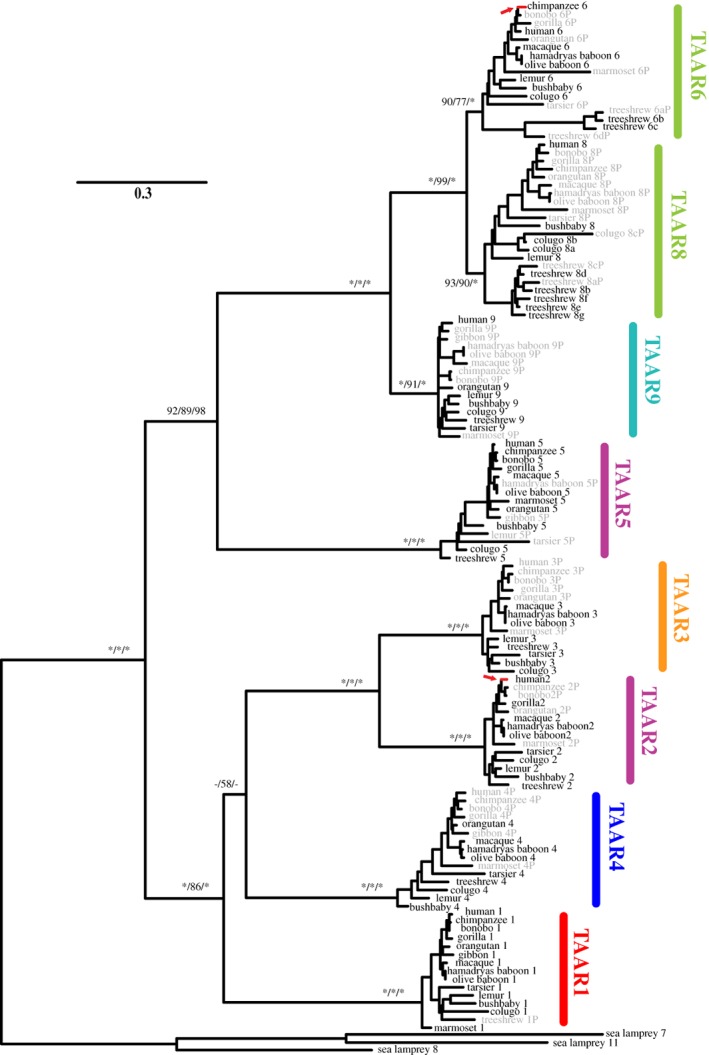
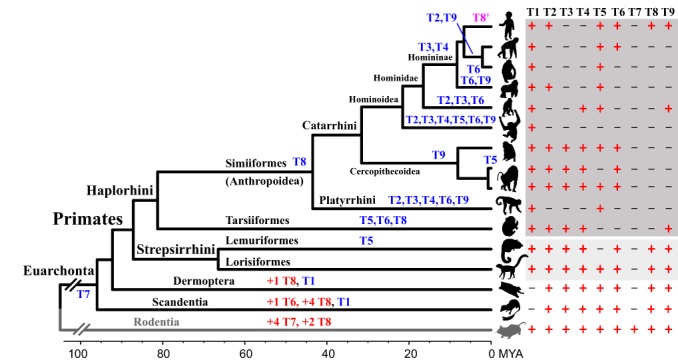
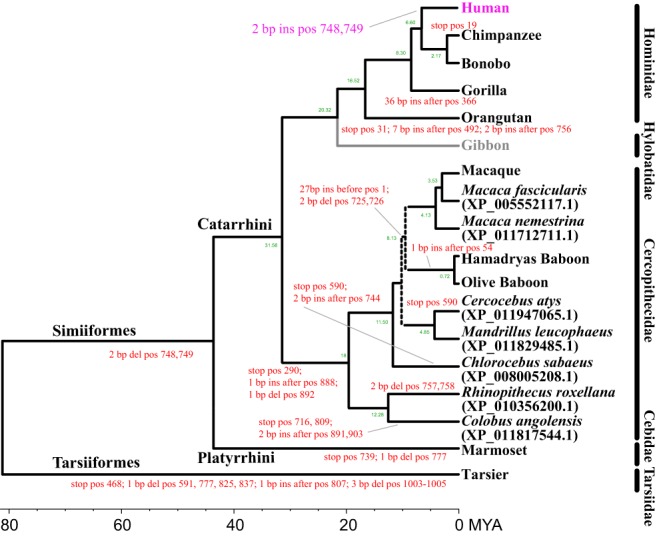
Trace amines (TAs) in the mammalian brain have been investigated for four decades. Trace amine-associated receptors (TAARs) were discovered during the search for receptors activated by TAs. TAARs are considered a second class of vertebrate olfactory receptors and successfully proliferated in conjunction with adaptation to living on the ground to detect carnivore odors. Thus, therian mammals have a high number of TAAR genes due to rapid species-specific gene duplications. In primate lineages, however, their genomes have significantly smaller numbers of TAAR genes than do other mammals. To elucidate the evolutionary force driving these patterns, exhaustive data mining of TAAR genes was performed for 13 primate genomes (covering all four infraorders) and two nonprimate euarchontan genomes. This study identified a large number of pseudogenes in many of these primate genomes and thus investigated the pseudogenization event process for the TAAR repertoires. The degeneration of TAARs is likely associated with arboreal inhabitants reducing their exposure to carnivores, and this was accelerated by the change in the nose shape of haplorhines after their divergence from strepsirrhines. Arboreal life may have decreased the reliance on the chemosensing of predators, suggestive of leading to the depauperation of TAAR subfamilies. The evolutionary deterioration of TAARs in primates has been reestablished in recently derived primates due to high selection pressure and probably functional diversity.
在哺乳动物大脑中,痕量胺(TAs)已经被研究了四十年。痕量胺相关受体(TAARs)是在寻找受 TAs 激活的受体的过程中发现的。TAARs 被认为是脊椎动物嗅觉受体的第二大类,并且成功地与适应在地面上探测食肉动物气味的能力一起增殖。因此,有袋动物由于快速的物种特异性基因复制,拥有大量的 TAAR 基因。然而,在灵长类动物的谱系中,它们的基因组中 TAAR 基因的数量明显少于其他哺乳动物。为了阐明驱动这些模式的进化力量,对 13 种灵长类动物基因组(涵盖所有四个亚目)和两种非灵长类合弓类动物基因组进行了 TAAR 基因的详尽数据挖掘。这项研究在许多灵长类动物基因组中发现了大量的假基因,因此研究了 TAAR 基因库的假基因化过程。TAAR 基因的退化可能与树栖居民减少与食肉动物的接触有关,而树栖合弓类动物在与树栖灵长类动物分化后鼻子形状的变化加速了这一过程。树栖生活可能减少了对捕食者化学感知的依赖,暗示着 TAAR 亚家族的匮乏。由于高选择压力和可能的功能多样性,在最近衍生的灵长类动物中,TAAR 基因在灵长类动物中的进化退化已经重新建立。