Flow Cytometry Core Facility, Instituto de Ciencias de la Salud, Universidad Veracruzana, Av. Luis, Dr. Castelazo Ayala s/n, 91190 Xalapa, Veracruz, Mexico.
Doctorado en Ciencias de la Salud, Instituto de Ciencias de la Salud, Universidad Veracruzana, Av. Luis, Dr. Castelazo Ayala s/n, 91190 Xalapa, Veracruz, Mexico.
Bioessays. 2019 Jan;41(1):e1800128. doi: 10.1002/bies.201800128. Epub 2018 Dec 10.
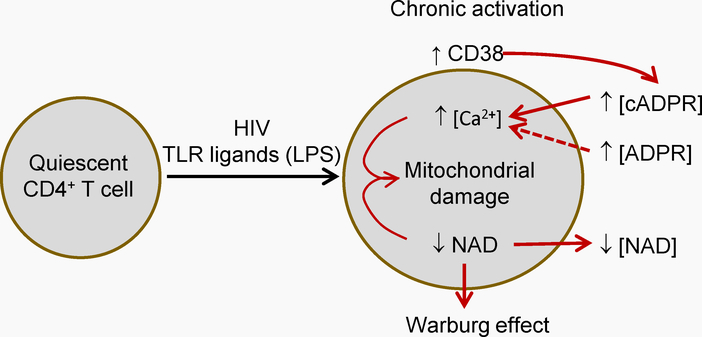
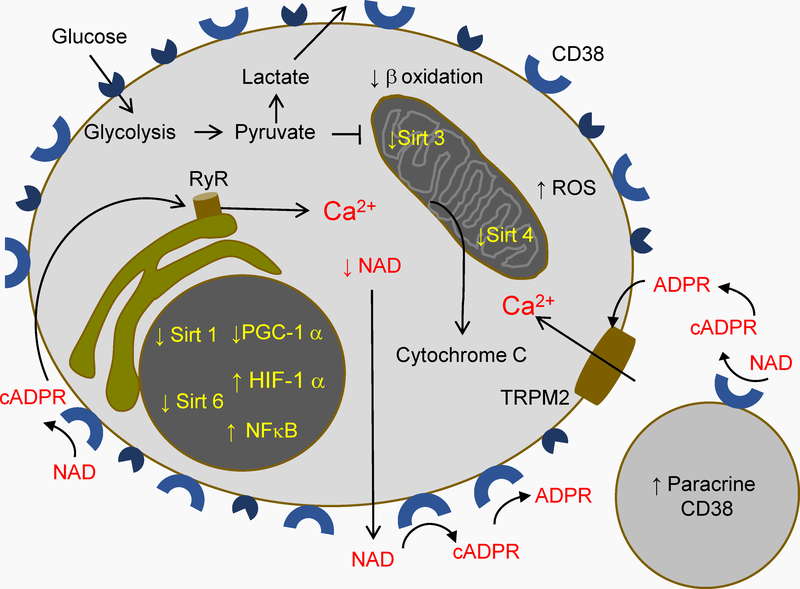
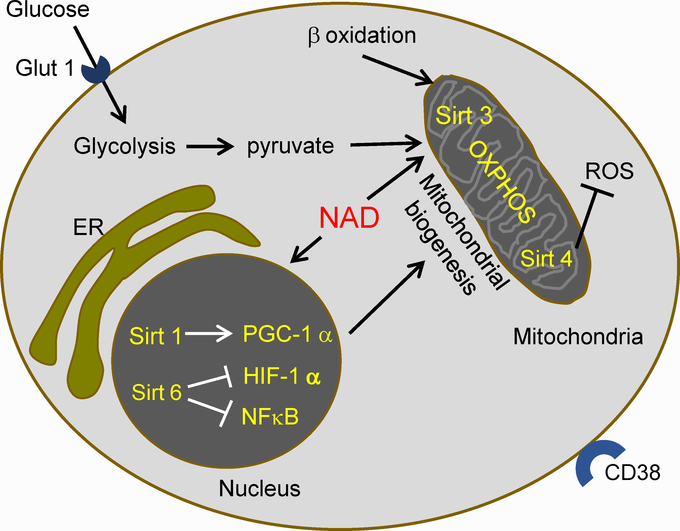
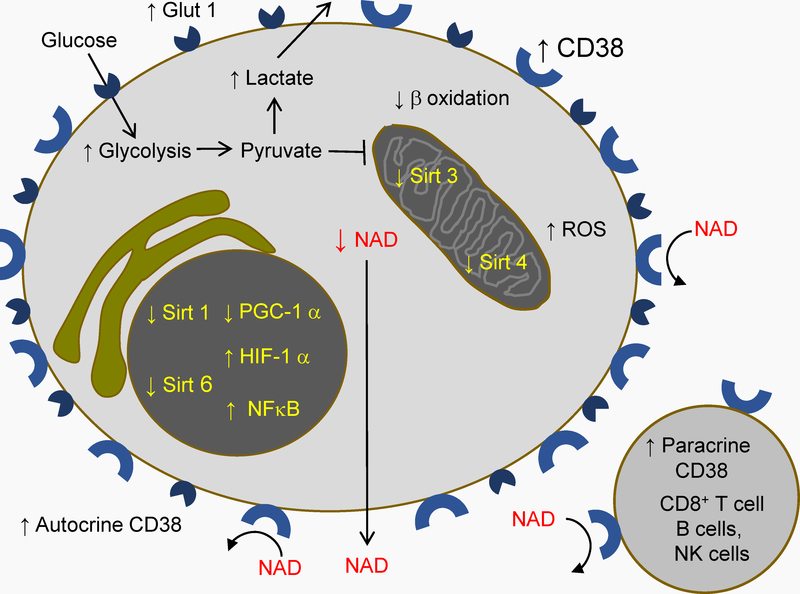
Despite abundant evidence associating CD38 overexpression and CD4 T cell depletion in HIV infection, no causal relation has been investigated. To address this issue, a series of mechanisms are proposed, supported by evidence from different fields, by which CD38 overexpression can facilitate CD4 T cell depletion in HIV infection. According to this model, increased catalytic activity of CD38 may reduce CD4 T cells' cytoplasmic nicotin-amide adenine dinucleotide (NAD), leading to a chronic Warburg effect. This will reduce mitochondrial function. Simultaneously, CD38's catalytic products ADPR and cADPR may be transported to the cytoplasm, where they can activate calcium channels and increase cytoplasmic Ca concentrations, further altering mitochondrial integrity. These mechanisms will decrease the viability and regenerative capacity of CD4 T cells. These hypotheses can be tested experimentally, and might reveal novel therapeutic targets. Also see the video abstract here https://youtu.be/k1LTyiTKPKs.
尽管有大量证据表明 CD38 表达过度与 HIV 感染中 CD4 T 细胞耗竭有关,但尚未研究其因果关系。为了解决这个问题,提出了一系列机制,这些机制得到了来自不同领域的证据的支持,表明 CD38 表达过度可促进 HIV 感染中 CD4 T 细胞耗竭。根据该模型,CD38 的催化活性增加可能会降低 CD4 T 细胞细胞质中的烟酰胺腺嘌呤二核苷酸(NAD),导致慢性瓦博格效应。这将降低线粒体功能。同时,CD38 的催化产物 ADPR 和 cADPR 可能被转运到细胞质中,在那里它们可以激活钙通道并增加细胞质 Ca 浓度,进一步改变线粒体完整性。这些机制会降低 CD4 T 细胞的活力和再生能力。这些假设可以通过实验来检验,并且可能揭示新的治疗靶点。也可在此处观看视频摘要 https://youtu.be/k1LTyiTKPKs。