Department of Surgery and Biochemistry, Weill Cornell Medical College, 1300 York Avenue, New York, NY 10065, USA.
Stem Cell Reports. 2018 Dec 11;11(6):1312-1323. doi: 10.1016/j.stemcr.2018.11.012.
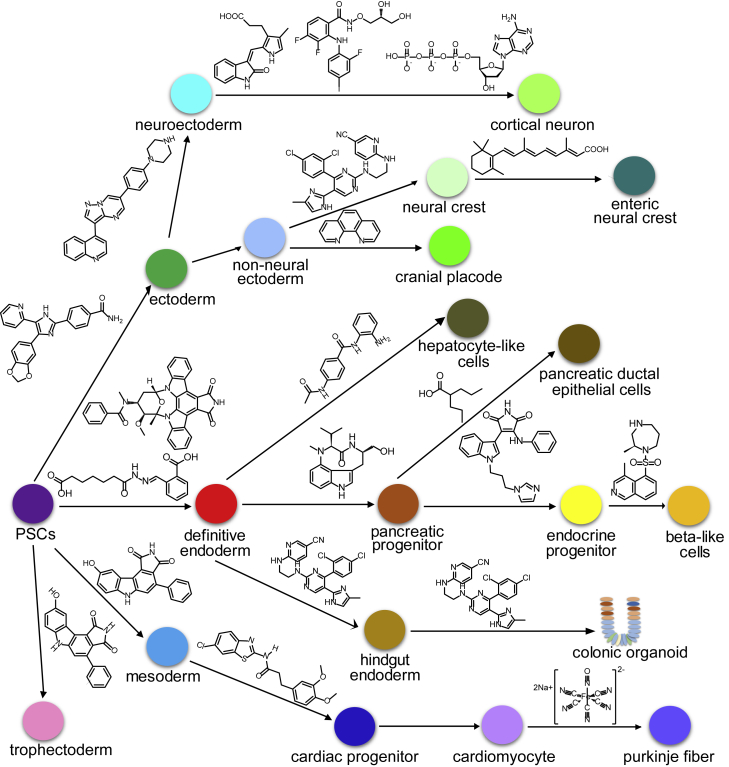
Cell-permeable compounds provide a convenient and efficient approach to manipulate biological processes. A number of compounds controlling stem cell self-renewal, survival, differentiation, and reprogramming have been identified through high-throughput/content screens. Using these powerful chemical tools, strategies have been developed to direct human pluripotent stem cell (hPSC) differentiation to functional cells. Recently, hPSC-derived cells and organoids are used to model human diseases, which can be adapted to a high-throughput/content platform for chemical screens. The identified compounds provide novel tools for decoding the signaling pathways regulating disease progression and candidates for facilitating future drug discovery. Moreover, humanized mouse models carrying hPSC-derived cells enable an innovative system to evaluate the long-term in vivo efficacy of drug candidates on human cells. In summary, screening-based chemical approaches not only expedite strategy development of controlling stem cell fates, but also provide powerful tools for dissecting the molecular mechanisms regulating disease progression.
细胞通透化合物为操纵生物过程提供了一种方便、高效的方法。通过高通量/内容筛选,已经鉴定出许多控制干细胞自我更新、存活、分化和重编程的化合物。利用这些强大的化学工具,已经开发出策略来指导人类多能干细胞(hPSC)分化为功能性细胞。最近,hPSC 衍生的细胞和类器官被用于模拟人类疾病,这些疾病可以适应高通量/内容筛选的平台。鉴定出的化合物为解码调节疾病进展的信号通路提供了新的工具,也为促进未来药物发现提供了候选药物。此外,携带 hPSC 衍生细胞的人源化小鼠模型为评估候选药物对人类细胞的长期体内疗效提供了一个创新系统。总之,基于筛选的化学方法不仅加速了控制干细胞命运的策略的发展,而且为剖析调节疾病进展的分子机制提供了有力的工具。