Departamento de Biología Molecular-IDIVAL Universidad de Cantabria, Santander 39011, Spain.
Instituto de Biomedicina y Biotecnología de Cantabria, Consejo Superior de Investigaciones Científicas-Universidad de Cantabria, Santander 39011, Spain.
Int J Mol Sci. 2018 Dec 7;19(12):3928. doi: 10.3390/ijms19123928.
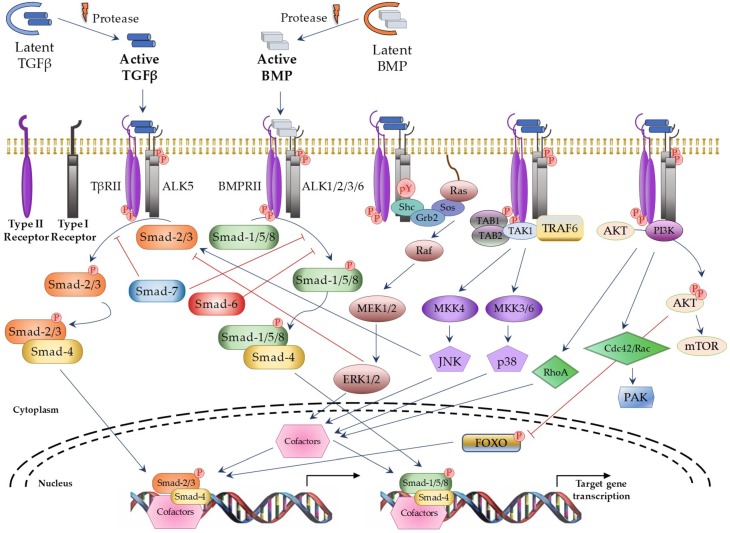
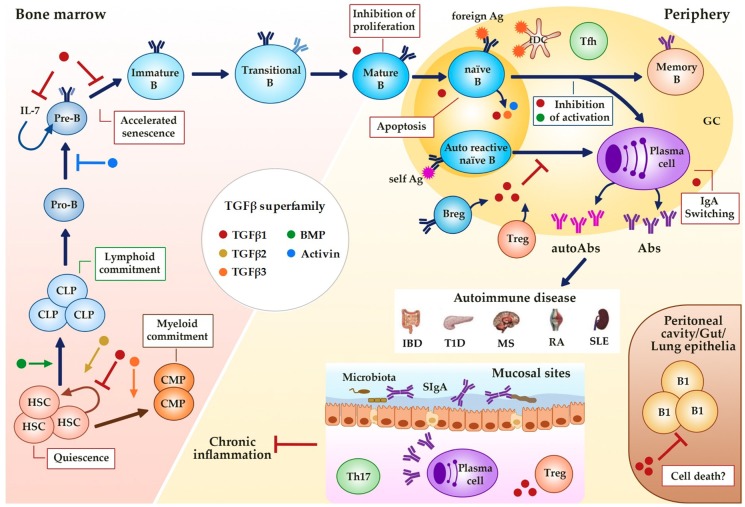
The TGFβ superfamily is composed of more than 33 growth and differentiation factors, including TGFβ1, β2, β3, BMPs, GDFs, nodal-related proteins, and activins. These members usually exert pleiotropic actions on several tissues and control multiple cellular processes, such as cell growth, cell survival, cell migration, cell fate specification, and differentiation, both during embryonic development and postnatal life. Although the effects of these factors on immune responses were elucidated long ago, most studies have been focused on the actions of TGFβs on T cells, as major regulators of adaptive immunity. In this review, we discuss new findings about the involvement of TGFβ superfamily members in the control of B cell development and function. Moreover, the potential contribution of TGFβ signaling to control B cell-mediated autoimmune diseases and its utility in the design of new therapies are also discussed.
TGFβ 超家族由超过 33 种生长和分化因子组成,包括 TGFβ1、β2、β3、BMPs、GDFs、 nodal 相关蛋白和激活素。这些成员通常对几种组织发挥多效作用,并控制多种细胞过程,如细胞生长、细胞存活、细胞迁移、细胞命运特化和分化,无论是在胚胎发育期间还是出生后。尽管很久以前就阐明了这些因子对免疫反应的影响,但大多数研究都集中在 TGFβs 对 T 细胞的作用上,因为 T 细胞是适应性免疫的主要调节剂。在这篇综述中,我们讨论了 TGFβ 超家族成员参与控制 B 细胞发育和功能的新发现。此外,还讨论了 TGFβ 信号在控制 B 细胞介导的自身免疫性疾病中的潜在贡献及其在设计新疗法中的应用。