Kelly Dervla, Yang Liying, Pei Zhiheng
Graduate Entry Medical School, University of Limerick, Limerick, Ireland.
Department of Pathology, New York University School of Medicine, New York, NY 10016, USA.
Diseases. 2018 Dec 11;6(4):109. doi: 10.3390/diseases6040109.
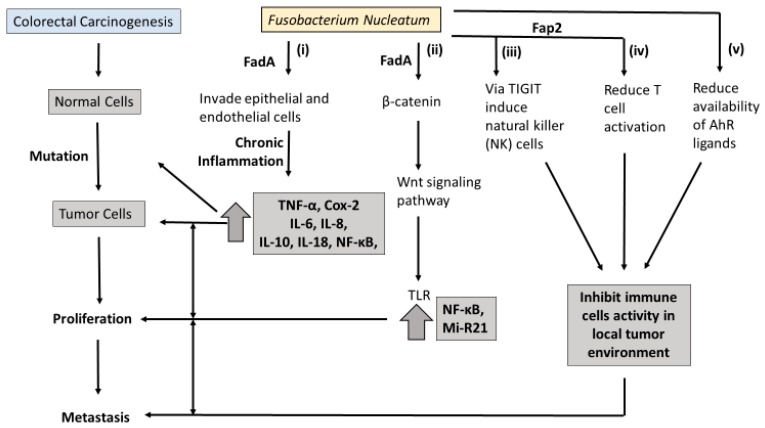
The gut microbiota has emerged as an environmental contributor to colorectal cancer (CRC) in both animal models and human studies. It is now generally accepted that bacteria are ubiquitous colonizers of all exposed human body surfaces, including the entire alimentary tract (5). Recently, the concept that a normal bacterial microbiota is essential for the development of inflammation-induced carcinoma has emerged from studies of well-known colonic bacterial microbiota. This review explores the evidence for a role of fusobacteria, an anaerobic gram-negative bacterium that has repeatedly been detected at colorectal tumor sites in higher abundance than surrounding histologically normal tissue. Mechanistic studies provide insight on the interplay between fusobacteria, other gut microbiota, barrier functions, and host responses. Studies have shown that fusobacteria activate host inflammatory responses designed to protect against pathogens that promote tumor growth. We discuss how future research identifying the pathophysiology underlying fusobacteria colon colonization during colorectal cancer may lead to new therapeutic targets for cancer. Furthermore, disease-protective strategies suppressing tumor development by targeting the local tumor environment via bacteria represent another exciting avenue for researchers and are highlighted in this review.
在动物模型和人体研究中,肠道微生物群已成为结直肠癌(CRC)的一个环境影响因素。现在人们普遍认为,细菌是所有暴露的人体表面的普遍定植菌,包括整个消化道(5)。最近,从对著名的结肠细菌微生物群的研究中出现了一种观点,即正常的细菌微生物群对于炎症诱导的癌症的发展至关重要。这篇综述探讨了梭杆菌作用的证据,梭杆菌是一种厌氧革兰氏阴性菌,在结直肠肿瘤部位反复被检测到,其丰度高于周围组织学正常的组织。机制研究为梭杆菌、其他肠道微生物群、屏障功能和宿主反应之间的相互作用提供了见解。研究表明,梭杆菌激活宿主的炎症反应,旨在抵御促进肿瘤生长的病原体。我们讨论了未来确定结直肠癌期间梭杆菌定植背后病理生理学的研究如何可能导致癌症的新治疗靶点。此外,通过细菌靶向局部肿瘤环境来抑制肿瘤发展的疾病保护策略是研究人员的另一个令人兴奋的途径,并在本综述中得到强调。