Schubert Christian, Hagen Carmen
Clinical Department of Medical Psychology, Medical University of Innsbruck, Innsbruck, Austria.
University Hospital Tulln, Tulln an der Donau, Austria.
Front Neurosci. 2018 Nov 28;12:848. doi: 10.3389/fnins.2018.00848. eCollection 2018.
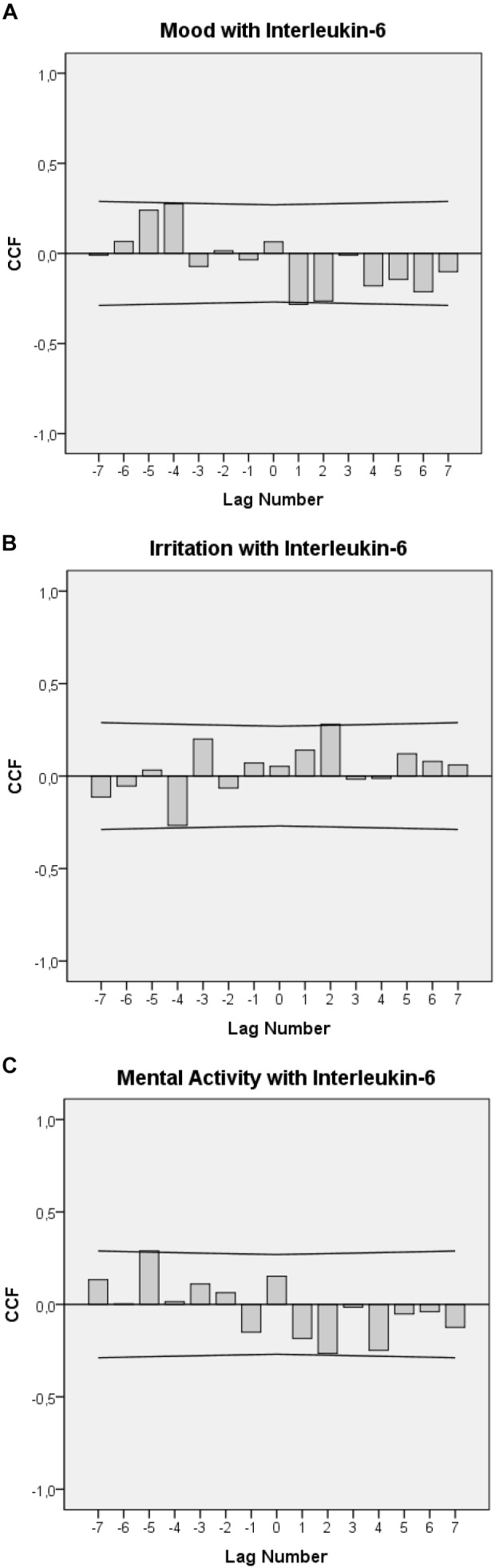
This "integrative single-case study" investigated the bidirectional cause and effect relations between various emotional states (i.e., mood, irritation, mental activity) and urinary IL-6 levels in a 49-year-old female breast cancer survivor (woman) under conditions of "life as it is lived." During a period of 28 days, the patient collected her entire urine in 12-h intervals for IL-6 measurement and completed each morning and evening a list of adjectives regarding mood, irritation, and mental activity (55 measurements in total). Autoregressive integrated moving average modeling revealed a 4-day (circasemiseptan) cycle in the IL-6 time series. Furthermore, cross-correlational analyses after controlling for serial dependencies (significance level: < 0.05) showed that worsening in mood and increases in irritation were followed by increases in urinary IL-6 levels with temporal delays between 12 and 36 h. In the opposite direction of effect, increases in urinary IL-6 levels were followed by elevations in mood and mental activity as well as decreases in irritation with temporal delays between 48 and 72 h. These results from cross-correlational analyses suggest that IL-6 may have a regulatory function in psychoneuroimmunological interplay and that, under certain conditions, IL-6 may be involved in health rather than sickness behavior. Moreover, the findings of this study are indicators of real-life negative feedback loops and are in line with psychoneuroimmunological research postulating complex brain-to-body-to-brain network-like structures.
这项“整合性单病例研究”在“实际生活”条件下,调查了一名49岁女性乳腺癌幸存者(女性)各种情绪状态(即情绪、易怒、精神活动)与尿白细胞介素-6(IL-6)水平之间的双向因果关系。在28天的时间里,患者每隔12小时收集一次全部尿液用于检测IL-6,并在每天早晚完成一份关于情绪、易怒和精神活动的形容词列表(总共55次测量)。自回归积分滑动平均模型显示IL-6时间序列存在4天(大约每七天半)的周期。此外,在控制序列依赖性后进行的交叉相关分析(显著性水平:<0.05)表明,情绪恶化和易怒增加之后,尿IL-6水平会在12至36小时的时间延迟后升高。在相反的效应方向上,尿IL-6水平升高之后,情绪和精神活动会在48至72小时的时间延迟后升高,易怒则会降低。这些交叉相关分析的结果表明,IL-6可能在心理神经免疫相互作用中具有调节功能,并且在某些情况下,IL-6可能与健康行为而非疾病行为有关。此外,本研究的结果是现实生活中负反馈回路的指标,与假设复杂的脑-体-脑网络样结构的心理神经免疫学研究一致。