Adjei Tricia, Xue Jingwen, Mandic Danilo P
Communications and Signal Processing, Department of Electrical and Electronic Engineering, Imperial College London, London, United Kingdom.
Front Physiol. 2018 Nov 28;9:1616. doi: 10.3389/fphys.2018.01616. eCollection 2018.
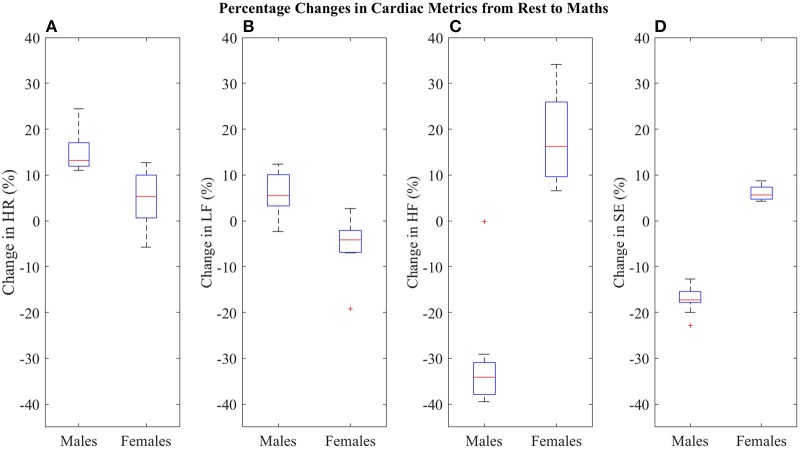
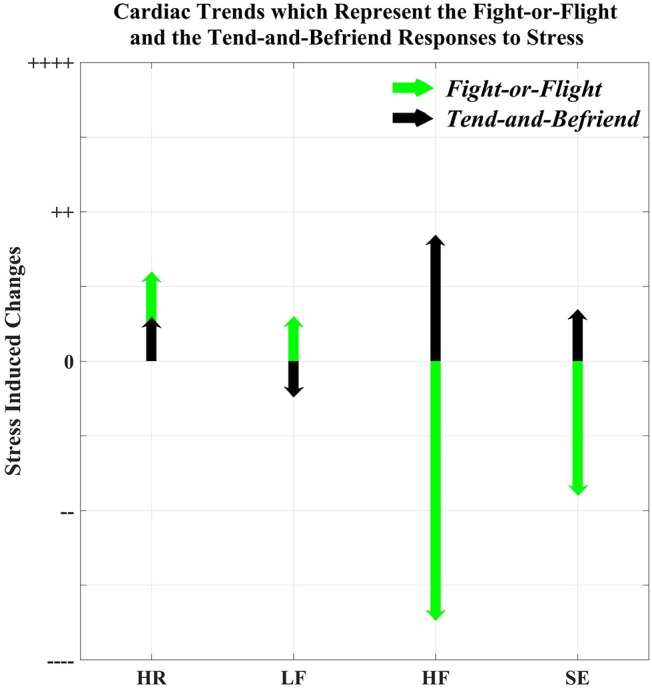
Sex differences in the study of the human physiological response to mental stress are often erroneously ignored. To this end, we set out to show that our understanding of the stress response is fundamentally altered once sex differences are taken into account. This is achieved by comparing the heart rate variability (HRV) signals acquired during mental maths tests from ten females and ten males of similar maths ability; all females were in the follicular phase of their menstrual cycle. For rigor, the HRV signals from this pilot study were analyzed using temporal, spectral and nonlinear signal processing techniques, which all revealed significant statistical differences between the sexes, with the stress-induced increases in the heart rates from the males being significantly larger than those from the females (-value = 4.4 × 10). In addition, mental stress produced an overall increase in the power of the low frequency component of HRV in the males, but caused an overall decrease in the females. The stress-induced changes in the power of the high frequency component were even more profound; it greatly decreased in the males, but increased in the females. We also show that mental stress was followed by the expected decrease in sample entropy, a nonlinear measure of signal regularity, computed from the males' HRV signals, while overall, stress manifested in an increase in the sample entropy computed from the females' HRV signals. This finding is significant, since mental stress is commonly understood to be manifested in the decreased entropy of HRV signals. The significant difference (-value = 2.1 × 10) between the changes in the entropies from the males and females highlights the pitfalls in ignoring sex in the formation of a physiological hypothesis. Furthermore, it has been argued that estrogen attenuates the effect of catecholamine stress hormones; the findings from this investigation suggest for the first time that the conventionally cited cardiac changes, attributed to the fight-or-flight stress response, are not universally applicable to females. Instead, this pilot study provides an alternative interpretation of cardiac responses to stress in females, which indicates a closer alignment to the evolutionary tend-and-befriend response.
在对人类心理应激生理反应的研究中,性别差异常常被错误地忽视。为此,我们着手证明,一旦考虑到性别差异,我们对应激反应的理解将发生根本性的改变。这是通过比较在心算测试中,从十名数学能力相似的女性和十名男性身上采集的心率变异性(HRV)信号来实现的;所有女性均处于月经周期的卵泡期。为确保严谨性,本初步研究的HRV信号采用了时域、频域和非线性信号处理技术进行分析,所有这些技术均揭示了性别之间存在显著的统计学差异,应激导致男性心率增加的幅度显著大于女性(p值 = 4.4 × 10⁻⁴)。此外,心理应激使男性HRV低频成分的功率总体增加,但女性则总体下降。应激引起的高频成分功率变化更为显著;男性大幅下降,而女性则上升。我们还表明,心理应激后,从男性HRV信号计算得出的样本熵(一种信号规律性的非线性度量)出现预期的下降,而总体而言,应激表现为从女性HRV信号计算得出的样本熵增加。这一发现意义重大,因为通常认为心理应激表现为HRV信号熵的降低。男性和女性熵变化之间的显著差异(p值 = 2.1 × 10⁻³)凸显了在形成生理假设时忽视性别的缺陷。此外,有人认为雌激素会减弱儿茶酚胺应激激素的作用;本研究结果首次表明,传统上归因于战斗或逃跑应激反应的心脏变化并非普遍适用于女性。相反,这项初步研究为女性心脏对应激的反应提供了另一种解释,表明其更符合进化中的照料与结盟反应。