Chuberre Coralie, Plancot Barbara, Driouich Azeddine, Moore John P, Bardor Muriel, Gügi Bruno, Vicré Maïté
Normandie Univ, UNIROUEN, Laboratoire Glycobiologie et Matrice Extracellulaire Végétale EA4358, Rouen, France.
Fédération de Recherche "NORVEGE"- FED 4277, Rouen, France.
Front Plant Sci. 2018 Nov 28;9:1692. doi: 10.3389/fpls.2018.01692. eCollection 2018.
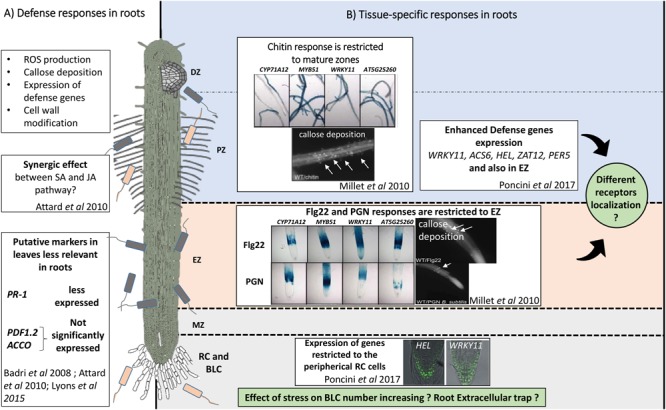
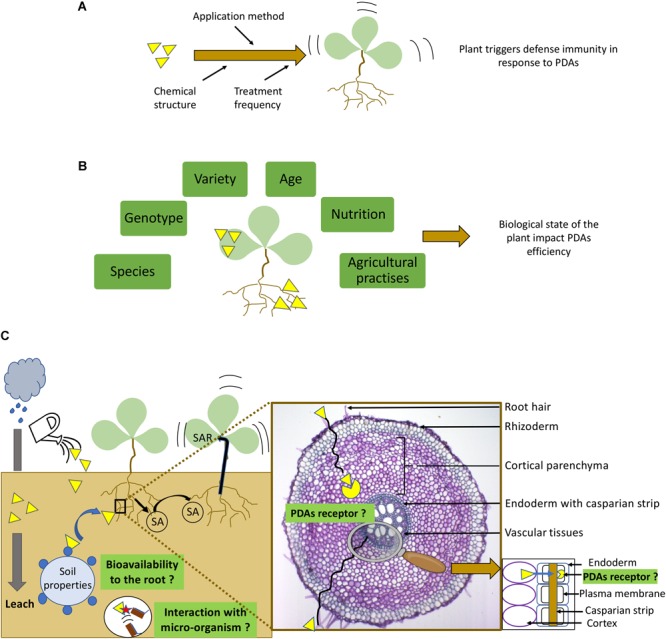
Roots are important organs for plant survival. In recent years, clear differences between roots and shoots in their respective plant defense strategies have been highlighted. Some putative gene markers of defense responses usually used in leaves are less relevant in roots and are sometimes not even expressed. Immune responses in roots appear to be tissue-specific suggesting a compartmentalization of defense mechanisms in root systems. Furthermore, roots are able to activate specific defense mechanisms in response to various elicitors including Molecular/Pathogen Associated Molecular Patterns, (MAMPs/PAMPs), signal compounds (e.g., hormones) and plant defense activator (e.g., β-aminobutyric acid, BABA). This review discusses recent findings in root defense mechanisms and illustrates the necessity to discover new root specific biomarkers. The development of new strategies to control root disease and improve crop quality will also be reviewed.
根是植物生存的重要器官。近年来,根和地上部分在各自的植物防御策略上的明显差异已被凸显。一些通常在叶片中使用的防御反应推定基因标记在根中相关性较低,有时甚至不表达。根中的免疫反应似乎具有组织特异性,这表明根系中防御机制存在分区化。此外,根能够响应各种诱导物激活特定的防御机制,这些诱导物包括分子/病原体相关分子模式(MAMPs/PAMPs)、信号化合物(如激素)和植物防御激活剂(如β-氨基丁酸,BABA)。本综述讨论了根防御机制的最新发现,并说明了发现新的根特异性生物标志物的必要性。还将综述控制根病和提高作物品质的新策略的发展。