MSF-Switzerland, Myanmar Project, #101 Dhama Zedi Road, Kamayut Tsp, Yangon, Myanmar.
Medecins Sans Frontiers, 333 7th Avenue, 2nd Floor, New York, NY, 10001, USA.
BMC Infect Dis. 2018 Dec 14;18(1):657. doi: 10.1186/s12879-018-3558-y.
In Southeast Asia, though fishermen are known to be a key population at high risk of HIV, little is known about their co-infection rates with Hepatitis C virus (HCV), or how illness and risk behaviors vary by occupation or type of fishermen. In Myanmar, this lack of knowledge is particularly acute, despite the fact that much of the country's border is coastline.
We conducted a retrospective analysis to assess clinical, demographic, and risk characteristics of HIV-infected, ≥15-year-old males under HIV care from 2004 to 2014. Subgroups of fishermen were categorized according to the location of fishing activities, boat ownership, and length of time at sea. Generalized linear models assessed odds of high risk behaviors, including MSM (men who have sex with men), transactional sex, injection drug use (IDU), and HCV co-infection among international, local subsistence, and national migrant fishermen.
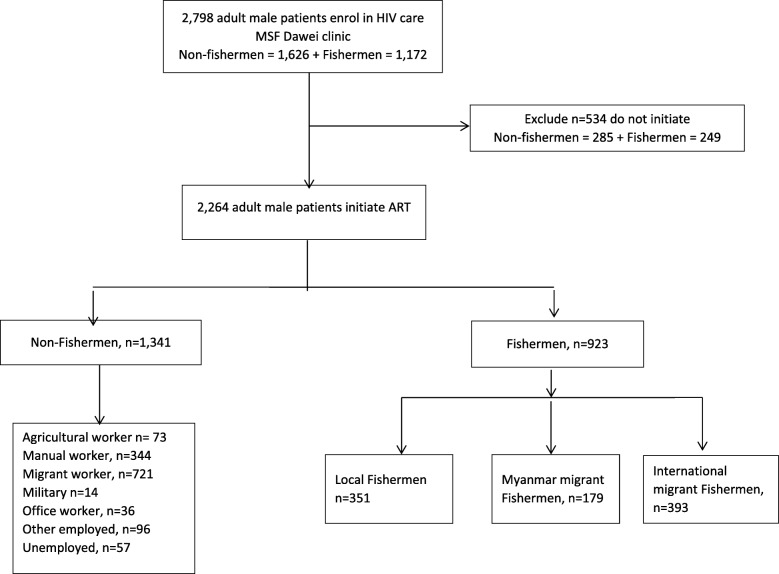
Of 2798 adult males who enrolled in HIV care between 2004 and 2014, 41.9% (n = 1172) were fishermen. Among these, migrants had the highest odds of engaging in risk behaviors such as sex work (Myanmar national migrants: OR 3.26 95% CI: 2.20 to 4.83), and injecting drugs (international migrants: OR 2.93, 95% CI: 1.22 to 3.87) when compared to the general male HIV clinic population. 15.9% of all fishermen reported past or current IDU (23.0% of international migrants). 22.8% of all fishermen were also co-infected with HCV, and though predictably injectors had the highest odds (OR 20.1, 95% CI: 13.7 to 29.5), even after controlling for other risk factors, fishermen retained higher odds (OR 2.37 95% CI: 1.70 to 3.32).
HIV positive fishermen in Myanmar had higher odds of HCV co-infection. They also disproportionally injected drugs and engaged in transactional sex more than other patients. This is especially pronounced among international migrant fishermen. HIV-infected fishermen should be counseled on high risk activities, screened for HCV, and targeted by harm reduction programs.
在东南亚,尽管渔民已知是艾滋病毒感染的高危人群,但对他们丙型肝炎病毒(HCV)的合并感染率知之甚少,也不知道疾病和风险行为如何因职业或渔民类型而异。在缅甸,尽管该国大部分边境线都在沿海地区,但这种知识的缺乏尤为严重。
我们进行了回顾性分析,以评估 2004 年至 2014 年间接受艾滋病毒护理的、年龄在 15 岁及以上的 HIV 感染男性的临床、人口统计学和风险特征。根据捕鱼活动地点、船只所有权和出海时间,将渔民分为不同亚组。广义线性模型评估了国际、当地自给性和国家移民渔民中包括男男性行为者(MSM)、性交易、注射吸毒(IDU)和 HCV 合并感染在内的高危行为的可能性。
在 2004 年至 2014 年间登记参加艾滋病毒护理的 2798 名成年男性中,41.9%(n=1172)是渔民。在这些渔民中,移民从事性工作(缅甸国家移民:OR 3.26,95%CI:2.20 至 4.83)和注射毒品(国际移民:OR 2.93,95%CI:1.22 至 3.87)的可能性最高,与普通男性艾滋病毒诊所人群相比。所有渔民中,15.9%报告过去或现在有过 IDU(国际移民中为 23.0%)。所有渔民中有 22.8%也合并感染 HCV,虽然可预见的是,注射者感染 HCV 的几率最高(OR 20.1,95%CI:13.7 至 29.5),但即使在控制了其他风险因素后,渔民感染 HCV 的几率仍然更高(OR 2.37,95%CI:1.70 至 3.32)。
缅甸艾滋病毒阳性渔民合并感染 HCV 的几率更高。他们也比其他患者更有可能注射毒品和从事性交易。这在国际移民渔民中尤为明显。感染 HIV 的渔民应接受关于高危活动的咨询,筛查 HCV,并作为减少伤害方案的目标人群。