Khatib Ahmed, Matiko Eva, Khalid Farhat, Welty Susie, Ali Ameir, Othman Asha, Haji Shaaban, Dahoma Mohammed, Rutherford George
Zanzibar AIDS Control Program, Ministry of Health, Zanzibar, United Republic of Tanzania.
Division of Global HIV/AIDS, US Centers for Disease Control and Prevention, Dar es Salaam, United Republic of Tanzania.
BMC Public Health. 2017 Nov 28;17(1):917. doi: 10.1186/s12889-017-4933-0.
People who inject drugs are at high risk of acquiring hepatitis B (HBV), hepatitis C (HCV), and human immunodeficiency virus (HIV) due to risky injection and sexual practices. The objective of this study is to investigate the epidemiology of HIV, hepatitis B, and hepatitis C, and co-infection of these viruses among people who inject drugs in Zanzibar, Tanzania.
We used respondent-driven sampling to identify 408 participants, from whom we collected demographic data, information on sexual behaviours and injection drug practices, and blood samples for biological testing.
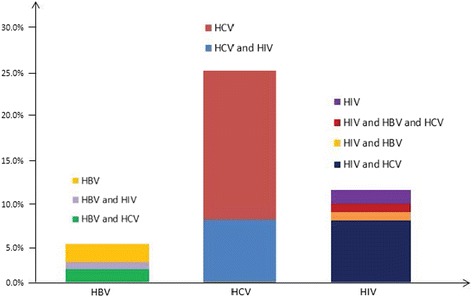
Prevalence of hepatitis B surface antigenaemia, HCV, and HIV infection were 5.9, 25.4, and 11.3%, respectively. Of the participants who were hepatitis B surface antigen (HBsAg) positive, 33.5% were infected with HCV and 18.8% were infected with HIV. Of the HCV-infected participants, 29.3% were infected with HIV. Of the participants who were infected with HIV, 9.0% were HBsAg positive, 66.6% had HCV and 8.5% had both. None of the potential risk factors we measured were associated with HBsAg positivity. In contrast, older age and longer duration of injection drug use were independently associated with HCV infection. HCV infection among people who inject drugs is lower in Zanzibar than in other countries, but could rise without proper interventions.
These findings underscore the importance of screening people who inject drugs for HIV, HBsAg, and HCV; providing HBV vaccination to those who are eligible; initiating antiretroviral therapy for those who are co-infected with HIV/HBV and HIV/HCV; and introducing interventions that have high impact on reducing needle sharing.
由于危险的注射和性行为,注射毒品者感染乙型肝炎病毒(HBV)、丙型肝炎病毒(HCV)和人类免疫缺陷病毒(HIV)的风险很高。本研究的目的是调查坦桑尼亚桑给巴尔岛注射毒品者中HIV、乙型肝炎和丙型肝炎的流行病学情况以及这些病毒的合并感染情况。
我们采用应答者驱动抽样法确定了408名参与者,收集了他们的人口统计学数据、性行为和注射毒品行为信息,并采集血样进行生物学检测。
乙型肝炎表面抗原血症、HCV和HIV感染的患病率分别为5.9%、25.4%和11.3%。在乙型肝炎表面抗原(HBsAg)阳性的参与者中,33.5%感染了HCV,18.8%感染了HIV。在感染HCV的参与者中,29.3%感染了HIV。在感染HIV的参与者中,9.0% HBsAg阳性,66.6%感染了HCV,8.5%同时感染了这两种病毒。我们所测量的潜在风险因素均与HBsAg阳性无关。相比之下,年龄较大和注射毒品时间较长与HCV感染独立相关。桑给巴尔岛注射毒品者中的HCV感染率低于其他国家,但如果不采取适当干预措施,感染率可能会上升。
这些发现强调了对注射毒品者进行HIV、HBsAg和HCV筛查的重要性;为符合条件者提供HBV疫苗接种;为HIV/HBV和HIV/HCV合并感染者启动抗逆转录病毒治疗;以及引入对减少共用针头有显著影响的干预措施。