Department of Family Medicine, Faculty of Medicine and Health Sciences, Universiti Putra Malaysia, 43400, Serdang, Malaysia.
Malaysian Research Institute on Ageing, Universiti Putra Malaysia, 43400, Serdang, Malaysia.
BMC Pregnancy Childbirth. 2018 Dec 14;18(1):494. doi: 10.1186/s12884-018-2131-4.
Gestational diabetes mellitus (GDM) is a of the major public health issues in Asia. The present study aimed to determine the prevalence of, and risk factors for GDM in Asia via a systematic review and meta-analysis.
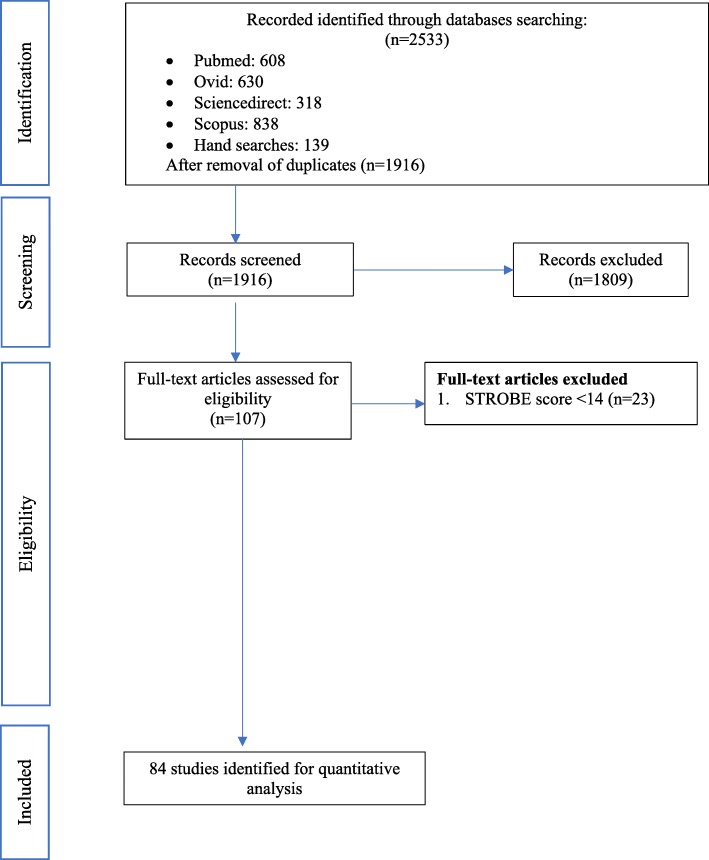
We systematically searched PubMed, Ovid, Scopus and ScienceDirect for observational studies in Asia from inception to August 2017. We selected cross sectional studies reporting the prevalence and risk factors for GDM. A random effects model was used to estimate the pooled prevalence of GDM and odds ratio (OR) with 95% confidence interval (CI).
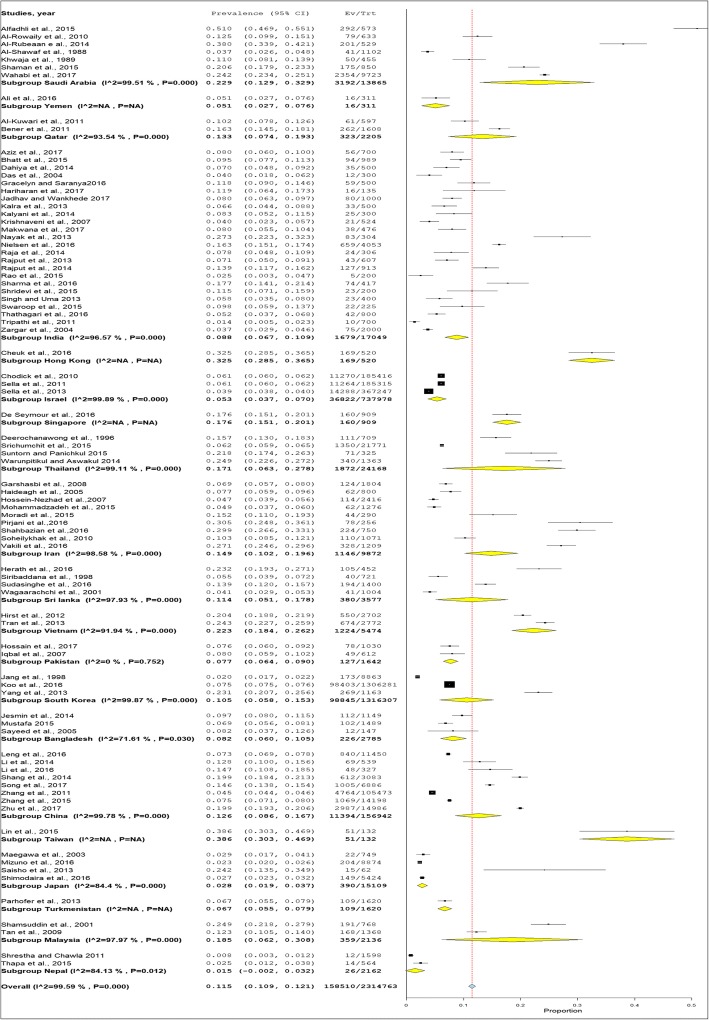
Eighty-four studies with STROBE score ≥ 14 were included in our analysis. The pooled prevalence of GDM in Asia was 11.5% (95% CI 10.9-12.1). There was considerable heterogeneity (I > 95%) in the prevalence of GDM in Asia, which is likely due to differences in diagnostic criteria, screening methods and study setting. Meta-analysis demonstrated that the risk factors of GDM include history of previous GDM (OR 8.42, 95% CI 5.35-13.23); macrosomia (OR 4.41, 95% CI 3.09-6.31); and congenital anomalies (OR 4.25, 95% CI 1.52-11.88). Other risk factors include a BMI ≥25 kg/m (OR 3.27, 95% CI 2.81-3.80); pregnancy-induced hypertension (OR 3.20, 95% CI 2.19-4.68); family history of diabetes (OR 2.77, 2.22-3.47); history of stillbirth (OR 2.39, 95% CI 1.68-3.40); polycystic ovary syndrome (OR 2.33, 95% CI1.72-3.17); history of abortion (OR 2.25, 95% CI 1.54-3.29); age ≥ 25 (OR 2.17, 95% CI 1.96-2.41); multiparity ≥2 (OR 1.37, 95% CI 1.24-1.52); and history of preterm delivery (OR 1.93, 95% CI 1.21-3.07).
We found a high prevalence of GDM among the Asian population. Asian women with common risk factors especially among those with history of previous GDM, congenital anomalies or macrosomia should receive additional attention from physician as high-risk cases for GDM in pregnancy.
PROSPERO (2017: CRD42017070104 ).
妊娠糖尿病(GDM)是亚洲主要的公共卫生问题之一。本研究旨在通过系统评价和荟萃分析来确定亚洲地区 GDM 的患病率和危险因素。
我们系统地检索了从成立到 2017 年 8 月在亚洲发表的 PubMed、Ovid、Scopus 和 ScienceDirect 观察性研究。我们选择了报告 GDM 患病率和危险因素的横断面研究。使用随机效应模型来估计 GDM 的汇总患病率和比值比(OR)及其 95%置信区间(CI)。
共有 84 项 STROBE 评分≥14 的研究纳入我们的分析。亚洲 GDM 的总体患病率为 11.5%(95%CI 10.9-12.1)。亚洲 GDM 的患病率存在较大的异质性(I>95%),这可能是由于诊断标准、筛查方法和研究环境的差异所致。荟萃分析表明,GDM 的危险因素包括既往 GDM 史(OR 8.42,95%CI 5.35-13.23);巨大儿(OR 4.41,95%CI 3.09-6.31);先天性异常(OR 4.25,95%CI 1.52-11.88)。其他危险因素包括 BMI≥25kg/m(OR 3.27,95%CI 2.81-3.80);妊娠高血压(OR 3.20,95%CI 2.19-4.68);糖尿病家族史(OR 2.77,95%CI 2.22-3.47);死胎史(OR 2.39,95%CI 1.68-3.40);多囊卵巢综合征(OR 2.33,95%CI1.72-3.17);流产史(OR 2.25,95%CI 1.54-3.29);年龄≥25 岁(OR 2.17,95%CI 1.96-2.41);多胎≥2 次(OR 1.37,95%CI 1.24-1.52);和早产史(OR 1.93,95%CI 1.21-3.07)。
我们发现亚洲人群中 GDM 的患病率较高。亚洲妇女有常见的危险因素,尤其是有既往 GDM、先天性异常或巨大儿史的妇女,应作为妊娠 GDM 的高危病例,引起医生的重视。
PROSPERO(2017:CRD42017070104)。