Student Research Committee, School of Health, Kermanshah University of Medical Sciences, Kermanshah, Iran.
Infectious Diseases Research Center, Kermanshah University of Medical Sciences, Kermanshah, Iran.
J Prev Med Hyg. 2022 Jan 31;62(4):E885-E891. doi: 10.15167/2421-4248/jpmh2021.62.4.1788. eCollection 2021 Dec.
Gestational diabetes mellitus (GDM) is one of the most common metabolic disorders during pregnancy that significantly affects perinatal outcomes.
The aim of this study was to determine the prevalence of GDM and its relation with the incidence of stillbirth, preterm birth, macrosomia, abortion and cesarean section (C-section) delivery in pregnant women.
This cross-sectional study was conducted on 3675 pregnant women in 11 provinces across Iran. Cluster sampling was used to select samples from mothers covered by health plans in 11 provinces of Iran. Prevalence of adverse pregnancy outcomes, including preterm delivery, type of delivery, macrosomic preterm birth, miscarriage, stillbirth, infant death, and birth weight were measured, using family record and face-to-face interviews. Data were analyzed by logistic regression, using STATA14.2 software.
About four percent of Iranian pregnant women had GDM during pregnancy. Prevalence of C-section was significantly higher in diabetic women than in the non-diabetic ones (53.19 vs 46.81, respectively, P < 0.001). Abortion in diabetic mothers was more than twice that of the non-diabetic mothers (P < 0.001). In the adjusted logistic regression model, the odds of stillbirth in mothers with GDM were 1.8 (95% CI: 1.11, 2.91, P = 0.018) times higher than that of the non-diabetics. The odds of macrosomia in diabetic women was about 7 times higher than the non-diabetic women (95% CI: 2.81, 17.14, P < 0.001). The odds of GDM had an increasing trend according to the BMI (p < 0.001). The risk of GDM were significantly lower, according to the daily physical activity (PA) (p < 0.001).
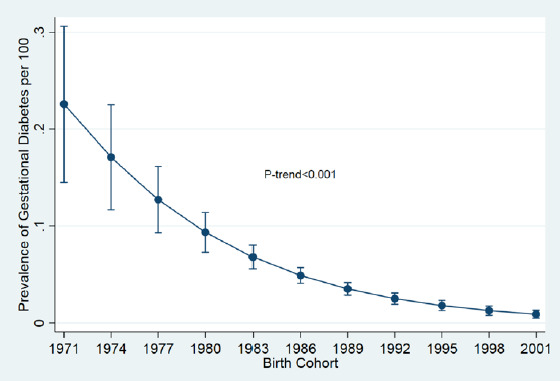
The GDM prevalence has a decreasing trend in Iran. It increases the adverse pregnancy outcomes such as stillbirth, neonatal deaths, macrosomia, preterm birth, abortion and C-section delivery. As, some of these consequences like macrosomia are not treatable, thus early prevention is very crucial.
妊娠期糖尿病(GDM)是妊娠期间最常见的代谢紊乱之一,对围产期结局有显著影响。
本研究旨在确定 GDM 的患病率及其与死胎、早产、巨大儿、流产和剖宫产(C -section)分娩发生率的关系。
这是一项在伊朗 11 个省份的 3675 名孕妇中进行的横断面研究。采用聚类抽样从伊朗 11 个省份参加健康计划的母亲中抽取样本。采用家庭记录和面对面访谈测量不良妊娠结局的发生率,包括早产、分娩方式、巨大儿早产、流产、死胎、婴儿死亡和出生体重。使用 STATA14.2 软件进行逻辑回归分析。
约 4%的伊朗孕妇在孕期患有 GDM。糖尿病孕妇的剖宫产率明显高于非糖尿病孕妇(分别为 53.19%和 46.81%,P<0.001)。糖尿病母亲的流产率是非糖尿病母亲的两倍多(P<0.001)。在调整后的逻辑回归模型中,GDM 母亲的死胎风险是未患糖尿病母亲的 1.8 倍(95%CI:1.11,2.91,P=0.018)。糖尿病妇女巨大儿的风险约是非糖尿病妇女的 7 倍(95%CI:2.81,17.14,P<0.001)。GDM 的风险与 BMI 呈正相关(p<0.001)。GDM 的风险随着每日体力活动(PA)的增加而增加(p<0.001)。
伊朗的 GDM 患病率呈下降趋势。它增加了不良妊娠结局的发生,如死胎、新生儿死亡、巨大儿、早产、流产和剖宫产分娩。由于一些后果,如巨大儿,是不可治疗的,因此早期预防非常关键。