Mizumi Saiko, Goda Ayumi, Takeuchi Kaori, Kikuchi Hanako, Inami Takumi, Soejima Kyoko, Satoh Toru
Division of Cardiology, Department of Medicine, Kyorin University Hospital, Mitaka, Tokyo, Japan.
Physiol Rep. 2018 Dec;6(23):e13945. doi: 10.14814/phy2.13945.
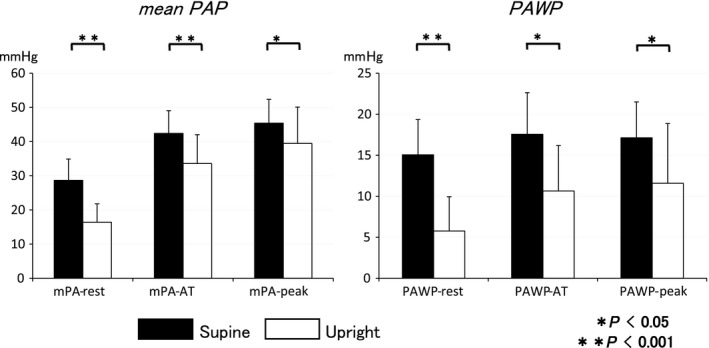
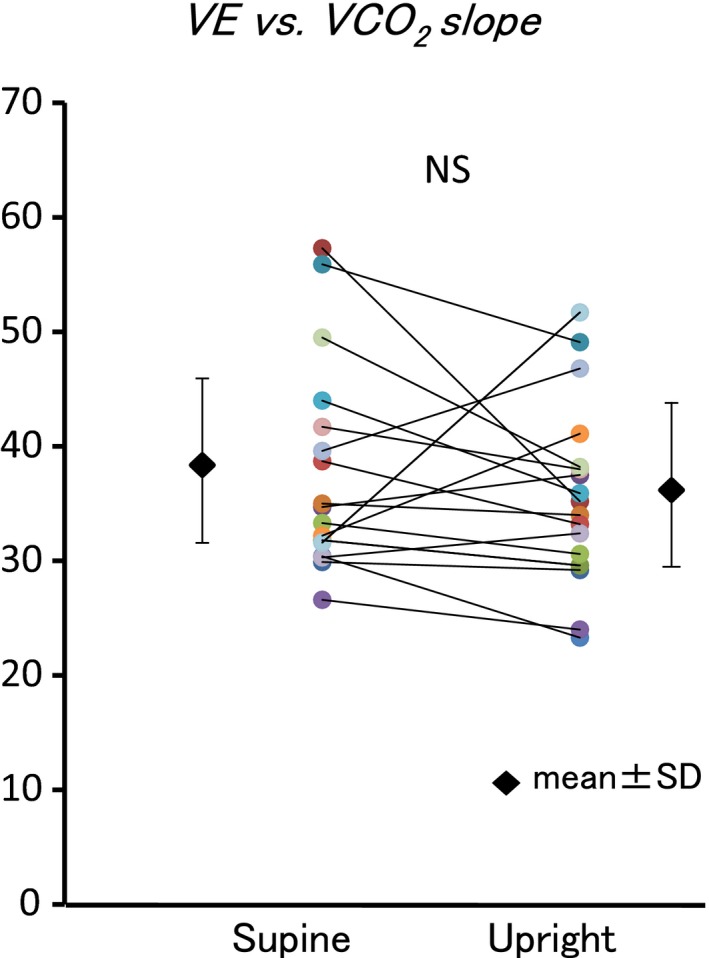
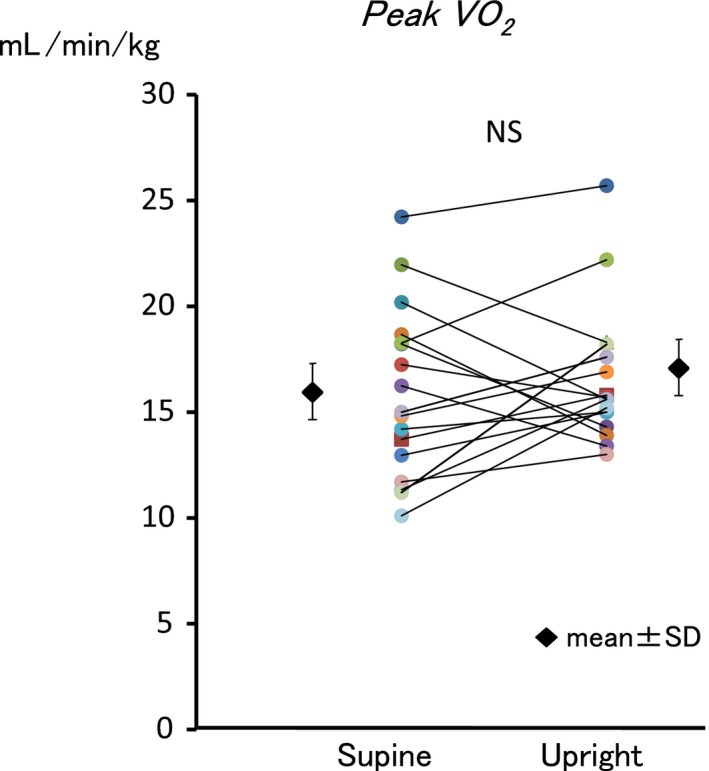
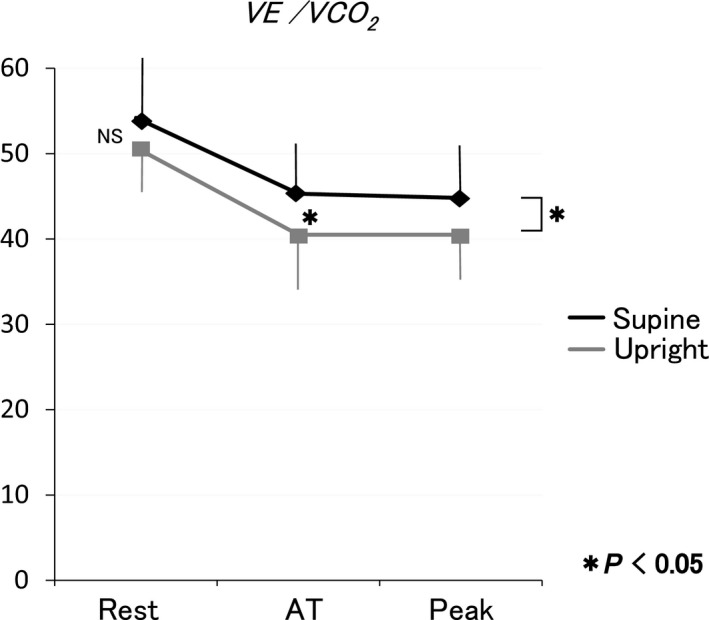
Cardiopulmonary exercise testing (CPX) with right heart catheterization (RHC) widely used for early diagnosis and evaluation of pulmonary vascular disease in patients with pulmonary arterial hypertension and early stage heart failure with preserved ejection fraction, who display normal hemodynamics at rest. The aim of this study was to investigate that whether body position affects pulmonary hemodynamics, pulmonary arterial wedge pressure (PAWP), and CPX parameters during invasive CPX. Seventeen patients (58 ± 14 years; 5/12 male/female) with chronic thromboembolic pulmonary hypertension treated with percutaneous transluminal pulmonary angioplasty and near-normal pulmonary artery pressure (PAP) underwent invasive CPX twice in supine and upright position using a cycle ergometer with 6 months interval. The mean PAP (peak: 45 ± 7 vs. 40 ± 11 mmHg, P = 0.006) and PAWP (peak: 17 ± 4 vs. 11 ± 7 mmHg, P = 0.008, supine vs. upright, respectively) throughout the test in supine position were significantly higher compared with in upright position, because of preload increase. However, transpulmonary pressure gradient, pulmonary vascular resistance, and mPA-Q slope during exercise were of no significant difference between two positions. There were no differences between the results of two positions in peak VO (15.9 ± 4.0 vs. 16.6 ± 3.2 mL/min per kg, P = 0.456), the VE versus VCO slope (37.8 ± 9.2 vs. 35.9 ± 8.0, P = 0.397), or the peak work-rate (79 ± 29 vs. 84 ± 27W, P = 0.118). Body position had a significant influence on PAP and PAWP during exercise, but no influence on the pulmonary circulation, or peak VO , or VE vs.VCO slope.
心肺运动试验(CPX)联合右心导管检查(RHC)广泛用于肺动脉高压患者和射血分数保留的早期心力衰竭患者的肺血管疾病的早期诊断和评估,这些患者静息时血流动力学正常。本研究的目的是调查体位是否会影响有创CPX期间的肺血流动力学、肺动脉楔压(PAWP)和CPX参数。17例(58±14岁;男/女比例为5/12)经皮腔内肺血管成形术治疗且肺动脉压力(PAP)接近正常的慢性血栓栓塞性肺动脉高压患者,使用功率自行车,分别在仰卧位和直立位进行两次有创CPX,间隔6个月。由于前负荷增加,仰卧位整个试验过程中的平均PAP(峰值:45±7 vs. 40±11 mmHg,P = 0.006)和PAWP(峰值:17±4 vs. 11±7 mmHg,P = 0.008,仰卧位与直立位相比)显著高于直立位。然而,运动期间的跨肺压梯度、肺血管阻力和mPA-Q斜率在两个体位之间无显著差异。两个体位的峰值VO(15.9±4.0 vs. 16.6±3.2 mL/min per kg,P = 0.456)、VE与VCO斜率(37.8±9.2 vs. 35.9±8.0,P = 0.397)或峰值工作率(79±29 vs. 84±27W,P = 0.118)结果无差异。体位对运动期间的PAP和PAWP有显著影响,但对肺循环、峰值VO或VE与VCO斜率无影响。