From the ‡Department of Entomology, Cornell University, Ithaca, New York.
Department of Molecular Biology and Genetics, Cornell University, Ithaca, New York.
Mol Cell Proteomics. 2019 Mar 15;18(Suppl 1):S6-S22. doi: 10.1074/mcp.RA118.001067. Epub 2018 Dec 14.
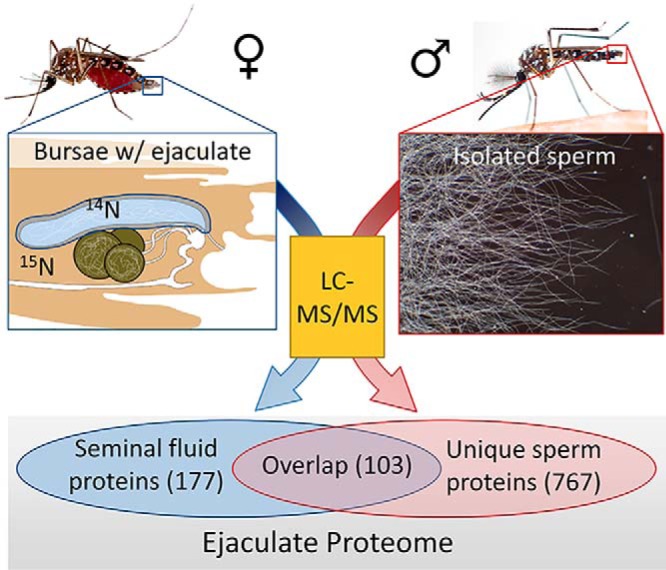
The yellow fever mosquito, , transmits several viruses causative of serious diseases, including dengue, Zika, and chikungunya. Some proposed efforts to control this vector involve manipulating reproduction to suppress wild populations or to replace them with disease-resistant mosquitoes. The design of such strategies requires an intimate knowledge of reproductive processes, yet our basic understanding of reproductive genetics in this vector remains largely incomplete. To accelerate future investigations, we have comprehensively catalogued sperm and seminal fluid proteins (SFPs) transferred to females in the ejaculate using tandem mass spectrometry. By excluding female-derived proteins using an isotopic labeling approach, we identified 870 sperm proteins and 280 SFPs. Functional composition analysis revealed parallels with known aspects of sperm biology and SFP function in other insects. To corroborate our proteome characterization, we also generated transcriptomes for testes and the male accessory glands-the primary contributors to , sperm and seminal fluid, respectively. Differential gene expression of accessory glands from virgin and mated males suggests that transcripts encoding proteins involved in protein translation are upregulated post-mating. Several SFP transcripts were also modulated after mating, but >90% remained unchanged. Finally, a significant enrichment of SFPs was observed on chromosome 1, which harbors the male sex determining locus in this species. Our study provides a comprehensive proteomic and transcriptomic characterization of ejaculate production and composition and thus provides a foundation for future investigations of , reproductive biology, from functional analysis of individual proteins to broader examination of reproductive processes.
埃及伊蚊,可传播多种病毒,导致包括登革热、寨卡病毒和基孔肯雅热在内的严重疾病。一些控制这种媒介的方法包括操纵繁殖以抑制野生种群或用抗疾病的蚊子来取代它们。设计这种策略需要对生殖过程有深入的了解,但我们对这种媒介的生殖遗传学的基本理解在很大程度上仍然不完整。为了加速未来的研究,我们使用串联质谱法全面编目了在精液中转移到雌性的精子和精液蛋白(SFPs)。通过使用同位素标记方法排除雌性衍生的蛋白质,我们鉴定了 870 种精子蛋白和 280 种 SFPs。功能组成分析显示与已知的精子生物学方面和其他昆虫中 SFP 功能的平行。为了证实我们的蛋白质组学特征,我们还分别为睾丸和雄性附腺生成了转录组,这两个器官分别是埃及伊蚊精子和精液的主要贡献者。未交配和交配雄性的附属腺的差异基因表达表明,参与蛋白质翻译的蛋白质编码转录本在交配后上调。交配后也有几个 SFP 转录本被调节,但超过 90%的转录本没有变化。最后,在第 1 号染色体上观察到 SFPs 的显著富集,该染色体在该物种中携带雄性性别决定基因座。我们的研究提供了对精液产生和组成的全面蛋白质组学和转录组学特征,从而为未来对埃及伊蚊生殖生物学的研究提供了基础,从对单个蛋白质的功能分析到对生殖过程的更广泛研究。