Department of Public Health Science, Graduate School of Public Health, Seoul National University, Seoul, Korea.
Institute of Health and Environment, Seoul National University, Seoul, Korea.
Tob Control. 2020 Jan;29(1):96-102. doi: 10.1136/tobaccocontrol-2018-054536. Epub 2018 Dec 15.
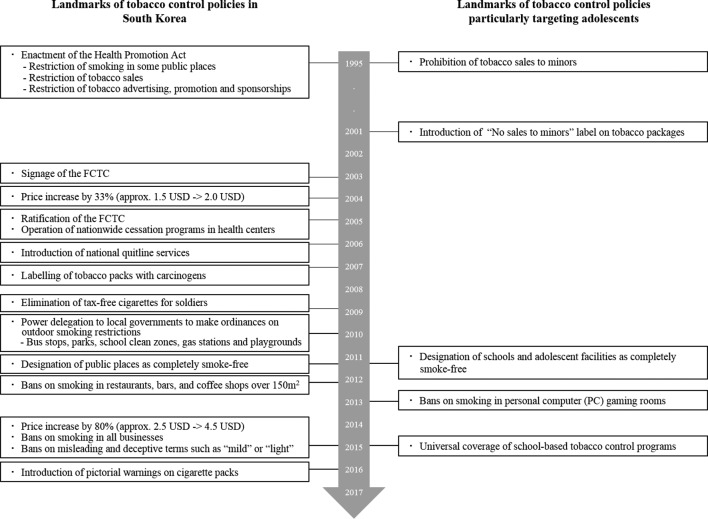
The prevalence of cigarette smoking among South Korean adolescents has decreased markedly over the past decade, which may indicate a norm shift between generations of adolescents. The present study aims to identify the effect of banning smoking in public places and increasing cigarette prices on current adolescent smoking, and to determine whether these policies additionally resulted in cohort effects.
Repeated cross-sectional survey data, nationally representative of South Korean adolescents, were used. A total of 853 441 adolescents ranging in age from 12 to 18 years (mean age, 15 years) were identified. Models applied were segmented regression model to detect changes in smoking trends and age-period-cohort model to determine the cohort effects on the trends.
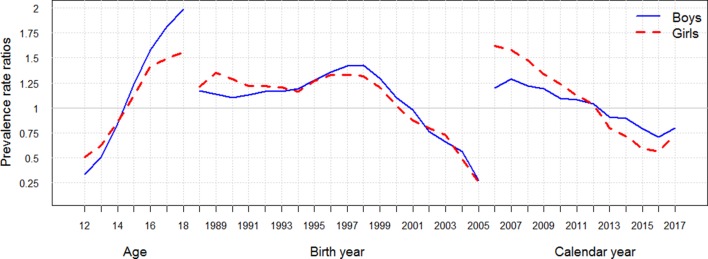
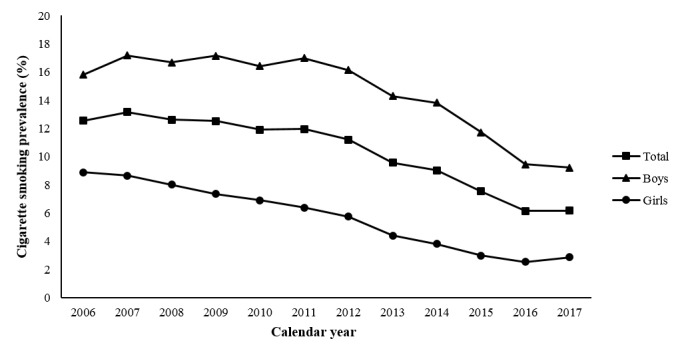
Between 2006 and 2017, smoking decreased from 16% to 9% in boys and from 9% to 3% in girls. After a complete ban on smoking in public places, there were significantly negative trends in the prevalence of smoking for both boys (β=-1.1; 95% CI: -1.9 to -0.2) and girls (β=-0.4; 95% CI: -0.6 to -0.1). Immediate decrease among girls was found after cigarette prices increased (β=-0.8; 95% CI: -1.5 to -0.2). For the cohort effect, the risk of smoking decreased with every consecutive year for boys born after 1998 and girls born after 1997.
Our results indicate the presence of cohort effects in the reduction of adolescent smoking. The cohort effect was induced by smoke-free legislation. Research on cohort effects, and methods to denormalise tobacco, will contribute to preventing adolescents from ever trying a cigarette.
在过去的十年中,韩国青少年的吸烟率显著下降,这可能表明青少年代际之间的规范发生了转变。本研究旨在确定在公共场所禁烟和提高香烟价格对当前青少年吸烟的影响,并确定这些政策是否还产生了队列效应。
使用了全国代表性的韩国青少年重复横断面调查数据。共确定了 853441 名年龄在 12 至 18 岁(平均年龄为 15 岁)的青少年。应用的模型为分段回归模型,以检测吸烟趋势的变化,以及年龄-时期-队列模型,以确定对趋势的队列效应。
2006 年至 2017 年间,男孩的吸烟率从 16%降至 9%,女孩的吸烟率从 9%降至 3%。在公共场所全面禁烟后,男孩(β=-1.1;95%置信区间:-1.9 至-0.2)和女孩(β=-0.4;95%置信区间:-0.6 至-0.1)的吸烟率均呈显著下降趋势。香烟价格上涨后,女孩的吸烟率立即下降(β=-0.8;95%置信区间:-1.5 至-0.2)。就队列效应而言,对于 1998 年后出生的男孩和 1997 年后出生的女孩,每过一年,吸烟的风险就会降低。
我们的研究结果表明,青少年吸烟率的下降存在队列效应。这种队列效应是由无烟立法引起的。关于队列效应的研究以及使烟草去正常化的方法,将有助于防止青少年尝试吸烟。