National Cancer Control Institute, National Cancer Center, Goyang, Korea.
Graduate School of Cancer Science and Policy, National Cancer Center, Goyang, Korea.
Epidemiol Health. 2022;44:e2022068. doi: 10.4178/epih.e2022068. Epub 2022 Aug 26.
This study reports data regarding the awareness and practice of cancer prevention among Koreans in 2021 and behavioral changes during the coronavirus disease 2019 (COVID-19) pandemic.
We collected Cancer Prevention Awareness and Practice Survey data through face-to-face interview surveys using a structured questionnaire completed by 4,000 randomly selected men and women aged between 20 years and 74 years in 17 provinces. We examined the awareness and practice of 10 cancer prevention recommendations and evaluated their associations with potential risk factors through multiple logistic regression analysis adjusted for age, gender, residence, marital status, education, and income.
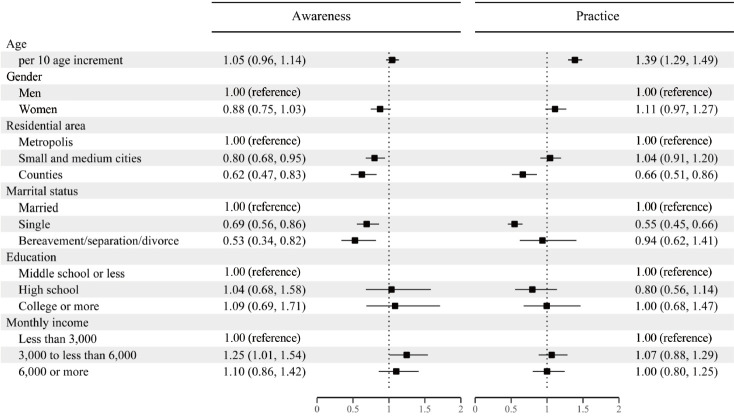
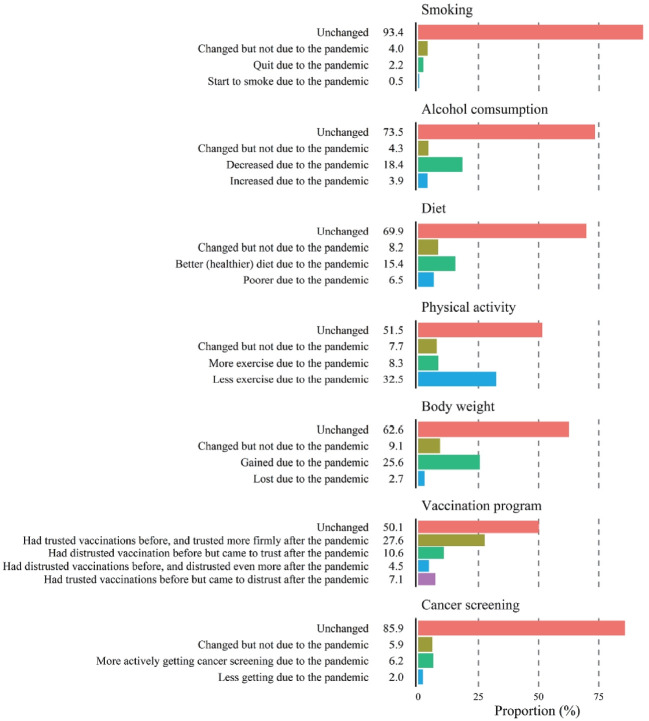
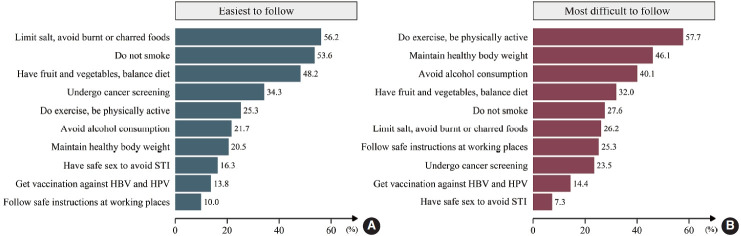
Eighty percent of participants knew that cancer is preventable, while 45% practiced cancer prevention. Cancer prevention practice tended to be more common among older participants (adjusted odds ratio [aOR], 1.39 per 10-year increment; 95% confidence interval [CI], 1.29 to 1.49) and less common among rural inhabitants (aOR, 0.66; 95% CI, 0.51 to 0.86) than among urban residents and among single people (aOR, 0.55; 95% CI, 0.45 to 0.66) than among married people. Practices were the highest for avoiding burned or charred foods (87.6%) and lowest for vaccination against human papillomavirus (14.5%). Refusal to follow recommendations was most common for avoiding alcohol consumption (7.9%). The most difficult recommendations to follow were (1) regular exercise (57.7%); (2) maintaining a healthy body weight (46.1%); and (3) avoiding alcohol (40.1%). The most significant COVID-19-related changes were less exercise (32.5%) and increased body weight (25.6%).
The awareness of cancer prevention was high, but the practice was low. Recommendations targeting awareness and practice need to be further promoted.
本研究报告了 2021 年韩国人对癌症预防的认知和实践情况,以及在 2019 年冠状病毒病(COVID-19)大流行期间的行为变化。
我们通过面对面访谈调查,使用结构化问卷收集了 4000 名随机选择的 20 至 74 岁男性和女性的癌症预防意识和实践调查数据。我们通过多因素逻辑回归分析,根据年龄、性别、居住地、婚姻状况、教育程度和收入等因素,对 10 项癌症预防建议的认知和实践情况进行了评估,并分析了它们之间的相关性。
80%的参与者知道癌症是可以预防的,而 45%的人则采取了癌症预防措施。与城市居民相比,年龄较大的参与者(调整后的优势比[aOR],每增加 10 岁增加 1.39;95%置信区间[CI],1.29 至 1.49)和农村居民(aOR,0.66;95%CI,0.51 至 0.86)采取癌症预防措施的可能性较小,而单身人士(aOR,0.55;95%CI,0.45 至 0.66)比已婚人士较少。避免食用烧焦或烧焦的食物(87.6%)的做法最高,而接种人乳头瘤病毒疫苗(HPV)(14.5%)的做法最低。拒绝遵循建议的情况最常见的是避免饮酒(7.9%)。最难遵循的建议是(1)定期锻炼(57.7%);(2)保持健康的体重(46.1%);和(3)避免饮酒(40.1%)。与 COVID-19 相关的最大变化是运动减少(32.5%)和体重增加(25.6%)。
人们对癌症预防的认识很高,但实践水平较低。需要进一步推广针对认知和实践的建议。