Department of Microbiology and Immunology, The Norris Cotton Cancer Center, Geisel School of Medicine at Dartmouth, Lebanon, NH, United States.
Front Immunol. 2018 Nov 29;9:2810. doi: 10.3389/fimmu.2018.02810. eCollection 2018.
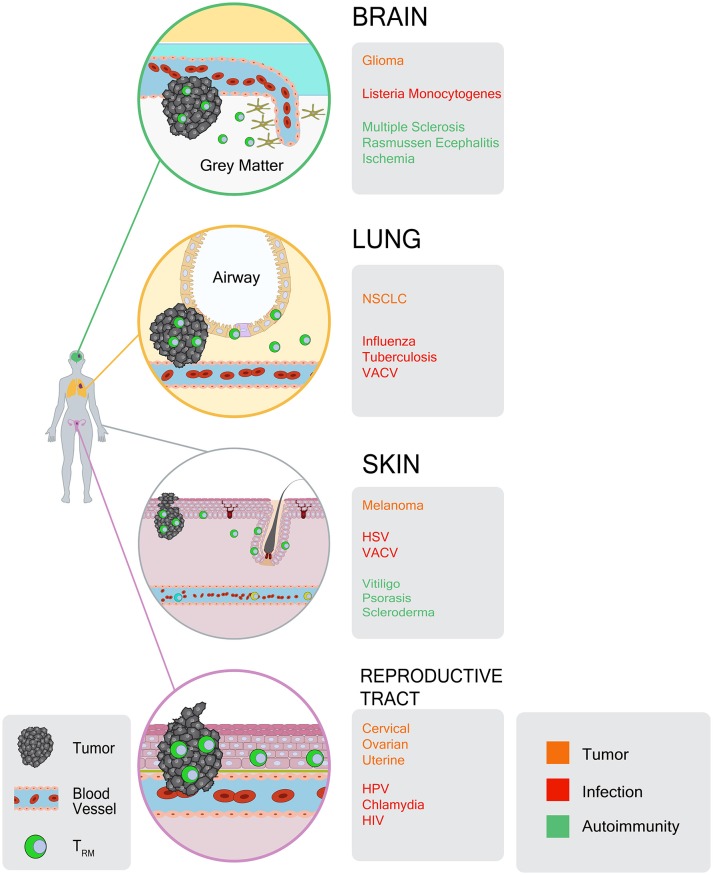
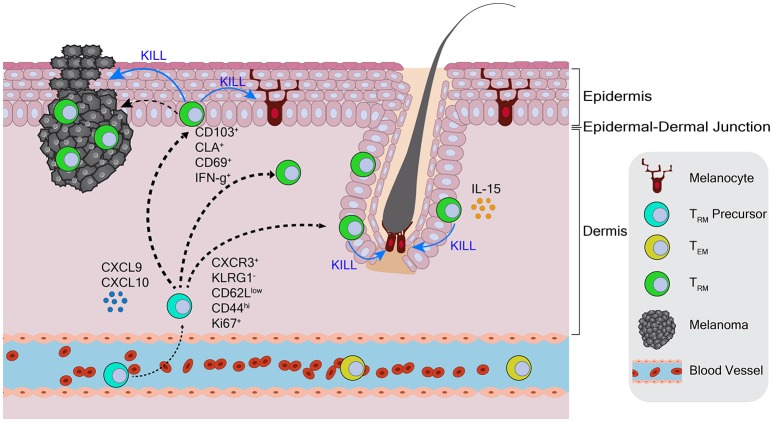
Resident memory (T) cells are a distinct tissue-localized T cell lineage that is crucial for protective immunity in peripheral tissues. While a great deal of effort has focused on defining their role in immunity to infections, studies now reveal T cells as a vital component of the host immune response to cancer. Characterized by cell-surface molecules including CD103, CD69, and CD49a, T-like tumor-infiltrating lymphocytes (TILs) can be found in a wide range of human cancers, where they portend improved prognosis. Recent studies in mouse tumor models have shown that T cells are induced by cancer vaccines delivered in peripheral tissue sites, or by the depletion of regulatory T cells. Such tumor-specific T cells are recognized as both necessary and sufficient for long-lived protection against tumors in peripheral tissue locations. T responses against tumor/self-antigens can concurrently result in the development of pathogenic T responses to self, with a growing number of autoimmune diseases and inflammatory pathologies being attributed to T responses. This review will recount the path to discovering the importance of resident memory CD8 T cells as they pertain to cancer immunity. In addition to highlighting key studies that directly implicate T cells in anti-tumor immunity, we will highlight earlier work that implicitly suggested their importance. Informed by studies in infectious disease models, and instructed by a clear role for T cells in autoimmunity, we will discuss strategies for therapeutically promoting T responses in settings where they don't naturally occur.
驻留记忆 (T) 细胞是一种独特的组织定位 T 细胞谱系,对于外周组织的保护性免疫至关重要。尽管人们已经投入大量精力来定义它们在感染免疫中的作用,但目前的研究揭示了 T 细胞是宿主对癌症免疫反应的重要组成部分。具有包括 CD103、CD69 和 CD49a 在内的细胞表面分子的 T 样肿瘤浸润淋巴细胞 (TIL) 可以在广泛的人类癌症中找到,它们预示着预后改善。最近在小鼠肿瘤模型中的研究表明,T 细胞可以通过在周围组织部位递送癌症疫苗或耗尽调节性 T 细胞而被诱导。这种肿瘤特异性 T 细胞被认为是对周围组织部位肿瘤的长期保护所必需且充分的。针对肿瘤/自身抗原的 T 反应可能同时导致针对自身的致病性 T 反应的发展,越来越多的自身免疫疾病和炎症性病理被归因于 T 反应。这篇综述将回顾发现驻留记忆 CD8 T 细胞在癌症免疫中的重要性的历程。除了强调直接涉及 T 细胞抗肿瘤免疫的关键研究外,我们还将强调早期暗示其重要性的工作。在传染病模型研究的基础上,并根据 T 细胞在自身免疫中的明确作用,我们将讨论在自然发生 T 反应的情况下促进 T 反应的治疗策略。