Faculty of Health, University of Applied Sciences Leiden, Leiden, The Netherlands.
Clinical Neurodevelopmental Sciences, Faculty of Social Sciences, Leiden University, Leiden, The Netherlands.
PLoS One. 2018 Dec 17;13(12):e0208716. doi: 10.1371/journal.pone.0208716. eCollection 2018.
Anxiety disorders are one of the most diagnosed mental health disorders. Common treatment consists of cognitive behavioral therapy and pharmacotherapy. In clinical practice, also art therapy is additionally provided to patients with anxiety (disorders), among others because treatment as usual is not sufficiently effective for a large group of patients. There is no clarity on the effectiveness of art therapy (AT) on the reduction of anxiety symptoms in adults and there is no overview of the intervention characteristics and working mechanisms.
A systematic review of (non-)randomised controlled trials on AT for anxiety in adults to evaluate the effects on anxiety symptom severity and to explore intervention characteristics, benefitting populations and working mechanisms. Thirteen databases and two journals were searched for the period 1997 -October 2017. The study was registered at PROSPERO (CRD42017080733) and performed according to the Cochrane recommendations. PRISMA Guidelines were used for reporting.
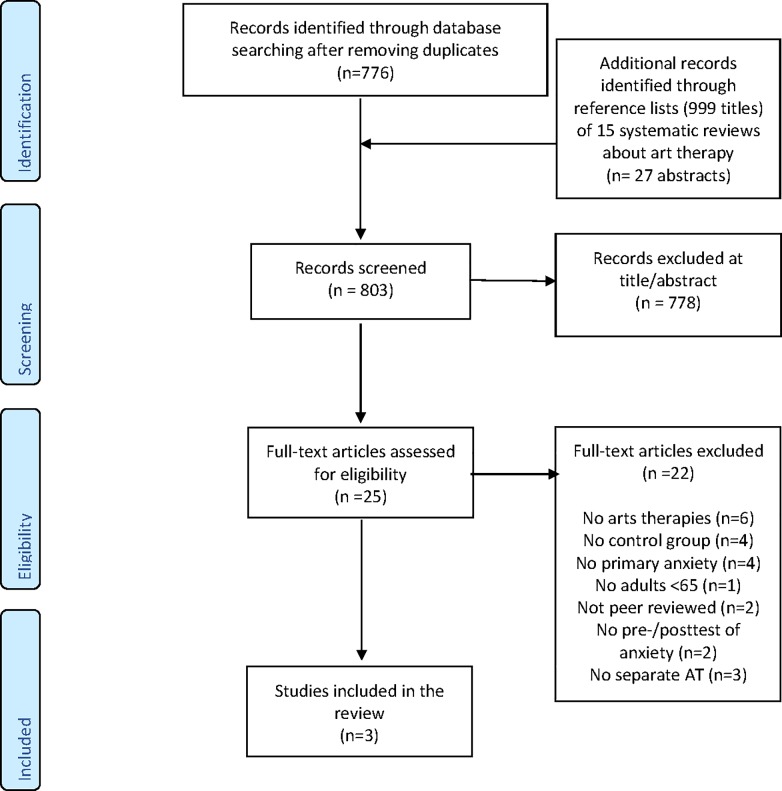
Only three publications out of 776 hits from the search fulfilled the inclusion criteria: three RCTs with 162 patients in total. All studies have a high risk of bias. Study populations were: students with PTSD symptoms, students with exam anxiety and prisoners with prelease anxiety. Visual art techniques varied: trauma-related mandala design, collage making, free painting, clay work, still life drawing and house-tree-person drawing. There is some evidence of effectiveness of AT for pre-exam anxiety in undergraduate students. AT is possibly effective in reducing pre-release anxiety in prisoners. The AT characteristics varied and narrative synthesis led to hypothesized working mechanisms of AT: induce relaxation; gain access to unconscious traumatic memories, thereby creating possibilities to investigate cognitions; and improve emotion regulation.
Effectiveness of AT on anxiety has hardly been studied, so no strong conclusions can be drawn. This emphasizes the need for high quality trials studying the effectiveness of AT on anxiety.
焦虑症是最常见的精神健康障碍之一。常见的治疗方法包括认知行为疗法和药物治疗。在临床实践中,也会为焦虑症(障碍)患者提供艺术治疗,部分原因是常规治疗对一大群患者效果不佳。目前尚不清楚艺术治疗(AT)对减轻成年人焦虑症状的有效性,也没有对干预措施的特点和作用机制进行综述。
对成人焦虑症的非随机对照试验进行系统评价,以评估对焦虑症状严重程度的影响,并探讨干预措施的特点、受益人群和作用机制。从 1997 年至 2017 年 10 月,在 13 个数据库和两份期刊中进行了检索。该研究在 PROSPERO(CRD42017080733)上进行了注册,并按照 Cochrane 建议进行了实施。PRISMA 指南用于报告。
从搜索中得到的 776 篇文献中,只有 3 篇符合纳入标准:总共 162 名患者的 3 项 RCT。所有研究的偏倚风险都很高。研究人群包括创伤后应激障碍症状的学生、考试焦虑的学生和即将出狱的囚犯。视觉艺术技术各不相同:与创伤相关的曼陀罗设计、拼贴制作、自由绘画、粘土工作、静物画和房屋树木人物画。艺术治疗可能对减轻大学生考试前的焦虑有一定效果。艺术治疗可能对减轻囚犯出狱前的焦虑有效。艺术治疗的特点各不相同,叙述性综合导致了艺术治疗的假设作用机制:诱导放松;接触无意识的创伤记忆,从而有机会调查认知;改善情绪调节。
艺术治疗对焦虑的有效性几乎没有研究,因此不能得出强有力的结论。这强调了需要进行高质量的试验来研究艺术治疗对焦虑的有效性。