Computer Science, College of Engineering, Mathematics and Physical Sciences, University of Exeter, Exeter EX4 4QE, UK.
The Alan Turing Institute, 96 Euston Road, London NW1 2DB, UK.
Sensors (Basel). 2018 Dec 14;18(12):4434. doi: 10.3390/s18124434.
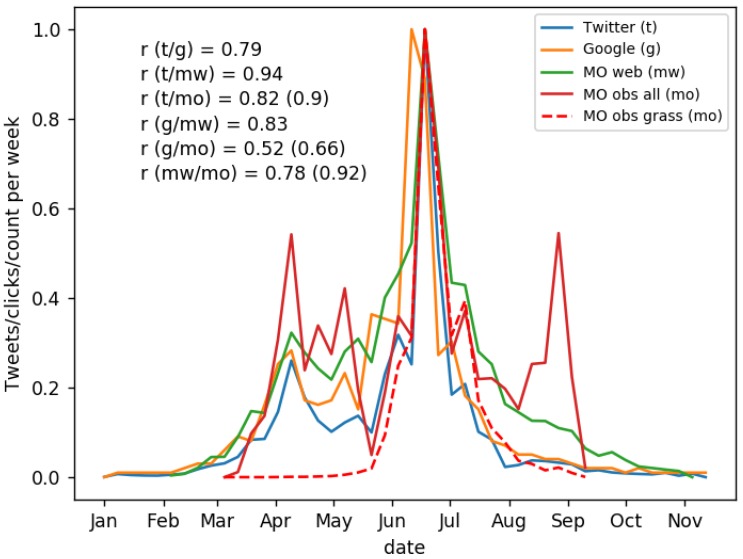
Allergic rhinitis (hayfever) affects a large proportion of the population in the United Kingdom. Although relatively easily treated with medication, symptoms nonetheless have a substantial adverse effect on wellbeing during the summer pollen season. Provision of accurate pollen forecasts can help sufferers to manage their condition and minimise adverse effects. Current pollen forecasts in the UK are based on a sparse network of pollen monitoring stations. Here, we explore the use of "social sensing" (analysis of unsolicited social media content) as an alternative source of pollen and hayfever observations. We use data from the Twitter platform to generate a dynamic spatial map of pollen levels based on user reports of hayfever symptoms. We show that social sensing alone creates a spatiotemporal pollen measurement with remarkable similarity to measurements taken from the established physical pollen monitoring network. This demonstrates that social sensing of pollen can be accurate, relative to current methods, and suggests a variety of future applications of this method to help hayfever sufferers manage their condition.
过敏性鼻炎(花粉症)影响了英国很大一部分人口。尽管用药物治疗相对容易,但在夏季花粉季节,症状仍然对健康有很大的不利影响。提供准确的花粉预报可以帮助患者控制病情并减少不良反应。目前英国的花粉预报基于一个稀疏的花粉监测站网络。在这里,我们探索了“社会感知”(对非请求的社交媒体内容的分析)作为花粉和花粉热观察的替代来源。我们使用来自 Twitter 平台的数据根据用户报告的花粉热症状生成花粉水平的动态空间图。我们表明,仅通过社会感知即可创建与从现有物理花粉监测网络获得的测量值具有惊人相似性的时空花粉测量值。这表明,与当前方法相比,花粉的社会感知可以是准确的,并表明该方法在帮助花粉热患者控制病情方面的各种未来应用。