Kim June-Sung, Kim Youn-Jung, Ryoo Seung Mok, Sohn Chang Hwan, Seo Dong Woo, Ahn Shin, Lim Kyoung Soo, Kim Won Young
Department of Emergency Medicine, Asan Medical Center, University of Ulsan College of Medicine, Seoul 05505, Korea.
J Clin Med. 2018 Dec 15;7(12):554. doi: 10.3390/jcm7120554.
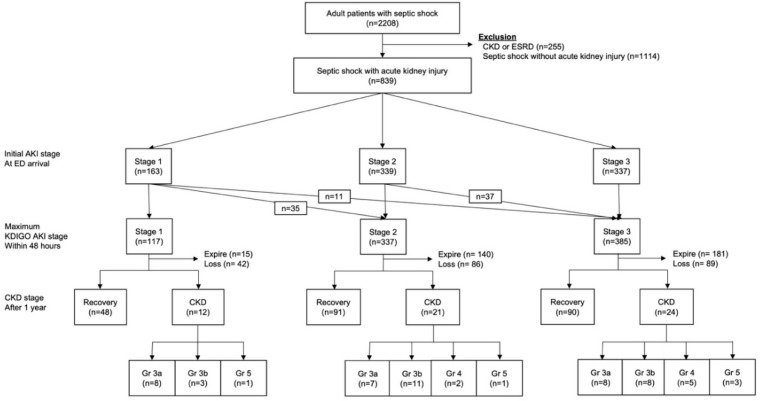
(1) Background: Sepsis-associated acute kidney injury (AKI) can lead to permanent kidney damage, although the long-term prognosis in patients with septic shock remains unclear. This study aimed to identify risk factors for the development of chronic kidney disease (CKD) in septic shock patients with AKI. (2) Methods: A single-site, retrospective cohort study was conducted using a registry of adult septic shock patients. Data from patients who had developed AKI between January 2011 and April 2017 were extracted, and 1-year follow-up data were analysed to identify patients who developed CKD. (3) Results: Among 2208 patients with septic shock, 839 (38%) had AKI on admission (stage 1: 163 (19%), stage 2: 339 (40%), stage 3: 337 (40%)). After one year, kidney function had recovered in 27% of patients, and 6% had progressed to CKD. In patients with stage 1 AKI, 10% developed CKD, and mortality was 13% at one year; in patients with stage 2 and 3 AKI, the CKD rate was 6%, and the mortality rate was 42% and 47%, respectively. Old age, female, diabetes, low haemoglobin levels and a high creatinine level at discharge were seen to be risk factors for the development of CKD. (4) Conclusions: AKI severity correlated with mortality, but it did not correlate with the development of CKD, and patients progressed to CKD, even when initial AKI stage was not severe. Physicians should focus on the recovery of renal function, and ensure the careful follow-up of patients with risk factors for the development of CKD.
(1)背景:脓毒症相关急性肾损伤(AKI)可导致永久性肾损害,尽管脓毒性休克患者的长期预后仍不明确。本研究旨在确定脓毒性休克合并AKI患者发生慢性肾脏病(CKD)的危险因素。(2)方法:采用成人脓毒性休克患者登记册进行单中心回顾性队列研究。提取2011年1月至2017年4月期间发生AKI的患者数据,并分析1年随访数据以确定发生CKD的患者。(3)结果:在2208例脓毒性休克患者中,839例(38%)入院时存在AKI(1期:163例(19%),2期:339例(40%),3期:337例(40%))。1年后,27%的患者肾功能恢复,6%进展为CKD。1期AKI患者中,10%发生CKD,1年死亡率为13%;2期和3期AKI患者中,CKD发生率为6%,死亡率分别为42%和47%。老年、女性、糖尿病、出院时血红蛋白水平低和肌酐水平高被视为发生CKD的危险因素。(4)结论:AKI严重程度与死亡率相关,但与CKD的发生无关,即使初始AKI阶段不严重,患者也会进展为CKD。医生应关注肾功能的恢复,并确保对有CKD发生危险因素的患者进行仔细随访。