Kim Won Ho, Shin Kyung Won, Ji Sang-Hwan, Jang Young-Eun, Lee Ji-Hyun, Jeong Chang Wook, Kwak Cheol, Lim Young-Jin
Department of Anesthesiology and Pain Medicine, Seoul National University Hospital, Seoul National University College of Medicine, Seoul 03080, Korea.
Department of Urology, Seoul National University Hospital, Seoul National University College of Medicine, Seoul, 03080, Korea.
J Clin Med. 2020 Feb 25;9(3):619. doi: 10.3390/jcm9030619.
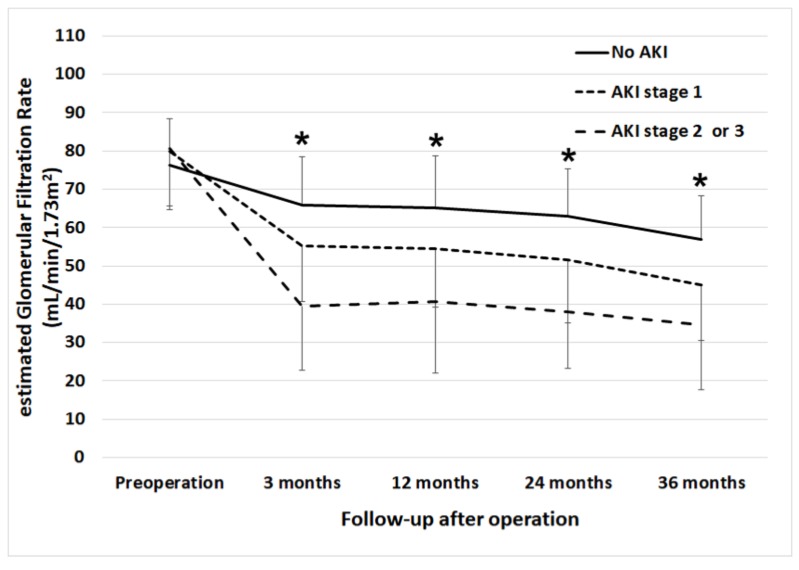
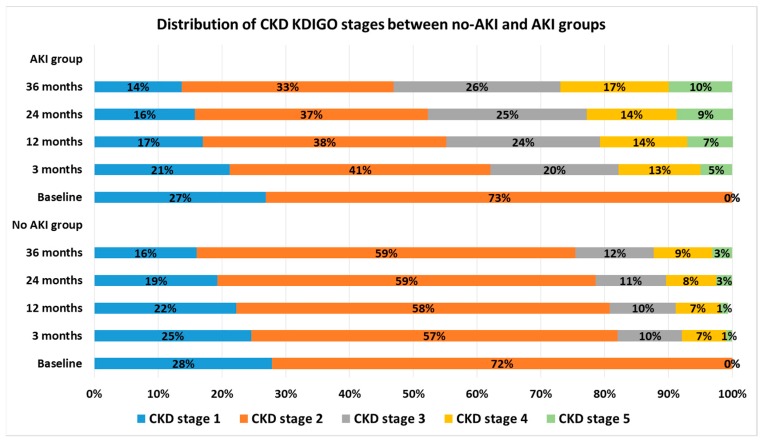
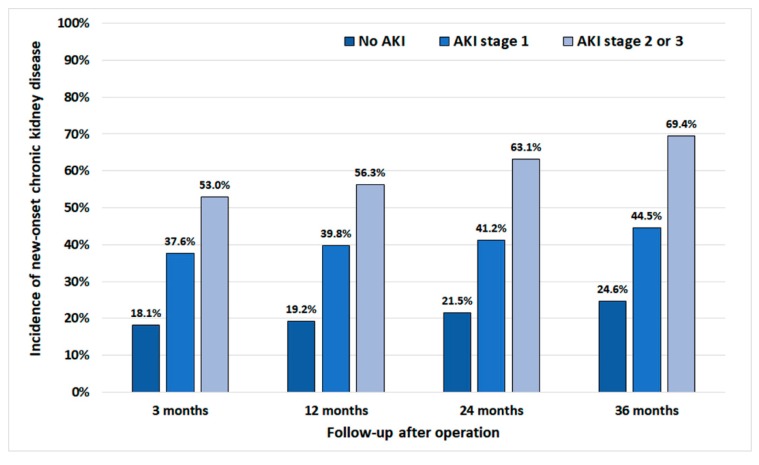
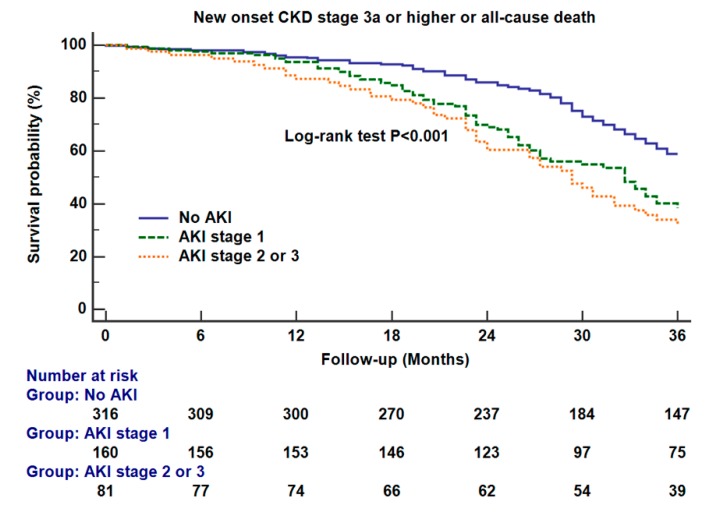
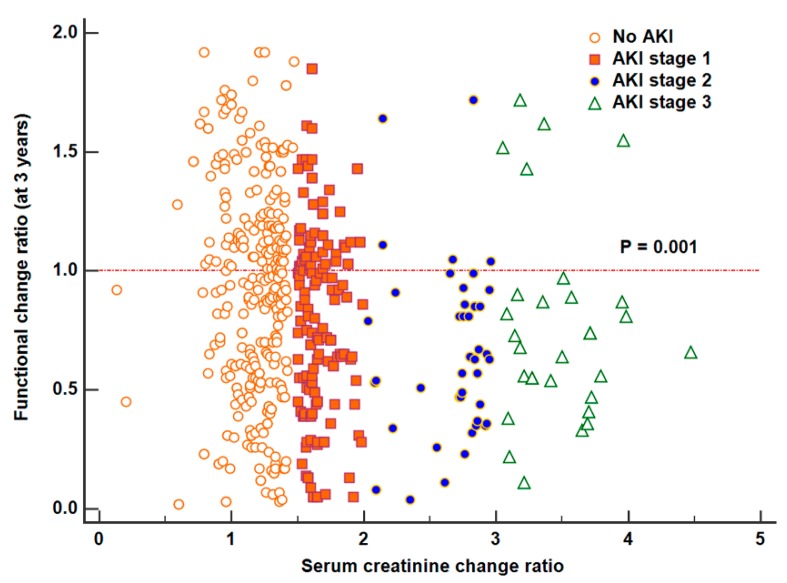
The association between acute kidney injury (AKI) and long-term renal function after radical nephrectomy has not been evaluated fully. We reviewed 558 cases of radical nephrectomy. Postoperative AKI was defined by the Kidney Disease: Improving Global Outcomes (KDIGO) serum creatinine criteria. Values of estimated glomerular filtration rate (eGFR) were collected up to 36 months (median 35 months) after surgery. The primary outcome was new-onset chronic kidney disease (CKD) stage 3a or higher or all-cause mortality within three years after nephrectomy. The functional change ratio (FCR) of eGFR was defined as the ratio of the most recent GFR (24-36 months after surgery) to the new baseline during 3-12 months. A multivariable Cox proportional hazard regression analysis for new-onset CKD and a multivariable linear regression analysis for FCR were performed to evaluate the association between AKI and long-term renal outcomes. A correlation analysis was performed with the serum creatinine ratio and used to determine AKI and FCR. AKI occurred in 43.2% ( = 241/558) and our primary outcome developed in 40.5% ( = 226/558) of patients. The incidence of new-onset CKD was significantly higher in patients with AKI than those without at all follow-up time points after surgery. The Cox regression analysis showed a graded association between AKI and our primary outcome (AKI stage 1: Hazard ratio 1.71, 95% confidence interval 1.25-2.32; AKI stage 2 or 3: Hazard ratio 2.72, 95% confidence interval 1.78-4.10). The linear regression analysis for FCR showed that AKI was significantly associated with FCR (β = -0.168 ± 0.322, = 0.011). There was a significant negative correlation between the serum creatinine ratio and FCR. In conclusion, our analysis demonstrated a robust and graded association between AKI after radical nephrectomy and long-term renal functional deterioration.
根治性肾切除术后急性肾损伤(AKI)与长期肾功能之间的关联尚未得到充分评估。我们回顾了558例根治性肾切除术病例。术后AKI根据肾脏病:改善全球预后(KDIGO)血清肌酐标准定义。收集术后长达36个月(中位时间35个月)的估计肾小球滤过率(eGFR)值。主要结局是肾切除术后三年内新发慢性肾脏病(CKD)3a期或更高分期或全因死亡率。eGFR的功能变化率(FCR)定义为最近的肾小球滤过率(术后24 - 36个月)与术后3 - 12个月新基线的比值。进行了关于新发CKD的多变量Cox比例风险回归分析以及关于FCR的多变量线性回归分析,以评估AKI与长期肾脏结局之间的关联。对血清肌酐比值进行了相关性分析,并用于确定AKI和FCR。43.2%(n = 241/558)的患者发生了AKI,40.5%(n = 226/558)的患者出现了我们的主要结局。术后所有随访时间点,发生AKI的患者中新发CKD的发生率显著高于未发生AKI的患者。Cox回归分析显示AKI与我们的主要结局之间存在分级关联(AKI 1期:风险比1.71,95%置信区间1.25 - 2.32;AKI 2期或3期:风险比2.72,95%置信区间1.78 - 4.10)。FCR的线性回归分析表明AKI与FCR显著相关(β = -0.168 ± 0.322,P = 0.011)。血清肌酐比值与FCR之间存在显著负相关。总之,我们的分析表明根治性肾切除术后AKI与长期肾功能恶化之间存在密切且分级的关联。