Berntsen David A, Cox Stephanie M, Bickle Katherine M, Mathew Jessica H, Powell Daniel R, Seidman Scott H, Little Borm Kim, Lorenz Kathrine Osborn, Nichols Jason J
The Ocular Surface Institute (D.A.B., D.R.P.), University of Houston College of Optometry, Houston, TX; University of Alabama at Birmingham School of Optometry (S.M.C., J.J.N.), Birmingham, AL; The Ohio State University College of Optometry (K.M.B.), Columbus, OH; Alcon Laboratories (J.H.M.), Fort Worth, TX; Department of Biomedical Engineering (S.H.S.), University of Rochester, Rochester, NY; and Johnson & Johnson Vision Care, Inc (B.K.L., K.O.L.), Jacksonville, FL.
Eye Contact Lens. 2019 Jan;45(1):28-33. doi: 10.1097/ICL.0000000000000528.
To compare the effect of toric versus spherical soft contact lenses on objective measures of visual performance using visual acuity and electromyography of the orbicularis oculi muscle.
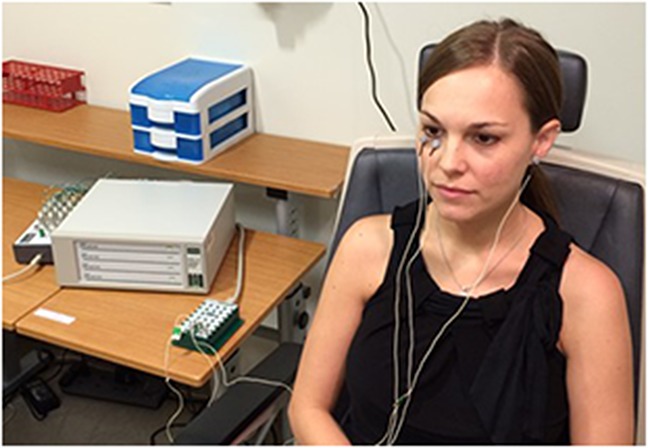
Current soft contact lens wearers with -0.75 to -1.75 D astigmatism in each eye were binocularly fitted with toric (1-Day ACUVUE MOIST for astigmatism) and spherical (1-Day ACUVUE MOIST) contact lenses in random order. After each fitting and at 1-week follow-up, high- and low-contrast visual acuities were measured. Electromyography was used to objectively evaluate eyestrain. Linear mixed models were used to assess differences between toric and spherical contact lenses.
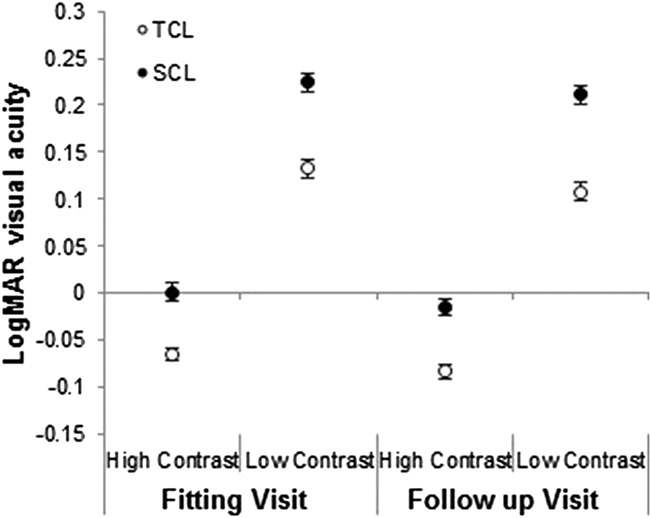
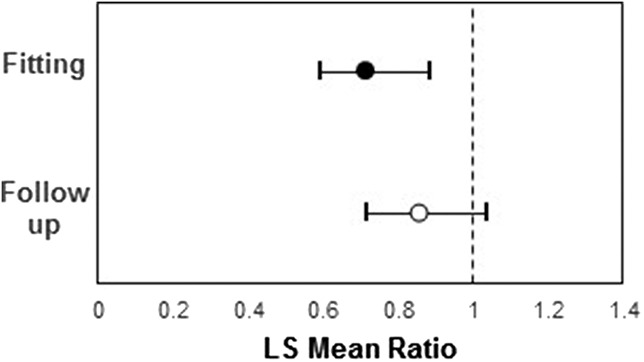
The mean age (±SD) of the 60 participants was 27.5±5.0 years, spherical refractive error was -3.68±2.01 D, and cylinder was -1.28±0.36 D. High- and low-contrast visual acuities with toric lenses were better than with spherical lenses at both fitting (toric high-contrast: -0.065±0.078 and low-contrast: 0.133±0.103 vs. spherical high-contrast: 0.001±0.104 and low-contrast: 0.224±0.107) and follow-up (toric high-contrast: -0.083±0.087 and low-contrast: 0.108±0.107 vs. spherical high-contrast: -0.015±0.095 and low-contrast: 0.211±0.104) (all P<0.0001). Electromyography-measured eyestrain was less with toric versus spherical contact lenses at fitting (least-square ratio of toric over spherical=0.72; P=0.0019) but not at follow-up (ratio=0.86; P=0.11).
These results suggest that toric contact lenses provided improved objective measures of vision in a low-to-moderate astigmatic population.
使用视力和眼轮匝肌肌电图比较散光软性接触镜与球面软性接触镜对视觉性能客观指标的影响。
双眼散光度数在-0.75至-1.75 D之间的现用软性接触镜佩戴者,随机顺序双眼佩戴散光软性接触镜(1-Day ACUVUE MOIST散光型)和球面软性接触镜(1-Day ACUVUE MOIST)。每次配镜后及1周随访时,测量高对比度和低对比度视力。使用肌电图客观评估眼疲劳。采用线性混合模型评估散光软性接触镜和球面软性接触镜之间的差异。
60名参与者的平均年龄(±标准差)为27.5±5.0岁,球面屈光不正为-3.68±2.01 D,柱镜度数为-1.28±0.36 D。在配镜时(散光软性接触镜高对比度:-0.065±0.078,低对比度:0.133±0.103;球面软性接触镜高对比度:0.001±0.104,低对比度:0.224±0.107)和随访时(散光软性接触镜高对比度:-0.083±0.087,低对比度:0.108±0.107;球面软性接触镜高对比度:-0.015±0.095,低对比度:0.211±0.104),散光软性接触镜的高对比度和低对比度视力均优于球面软性接触镜(所有P<0.0001)。配镜时,肌电图测量的散光软性接触镜眼疲劳低于球面软性接触镜(散光软性接触镜与球面软性接触镜的最小二乘比=0.72;P=0.0019),但随访时无差异(比=0.86;P=0.11)。
这些结果表明,散光软性接触镜在中低度散光人群中能提供更好的客观视力指标。