College of Medicine and Public Health, Flinders University, GPO Box 2100, Adelaide 5001, Australia.
Flinders Human Behaviour and Health Research Unit, Flinders University, GPO Box 2100, Adelaide 5001, Australia.
Int J Environ Res Public Health. 2018 Dec 6;15(12):2763. doi: 10.3390/ijerph15122763.
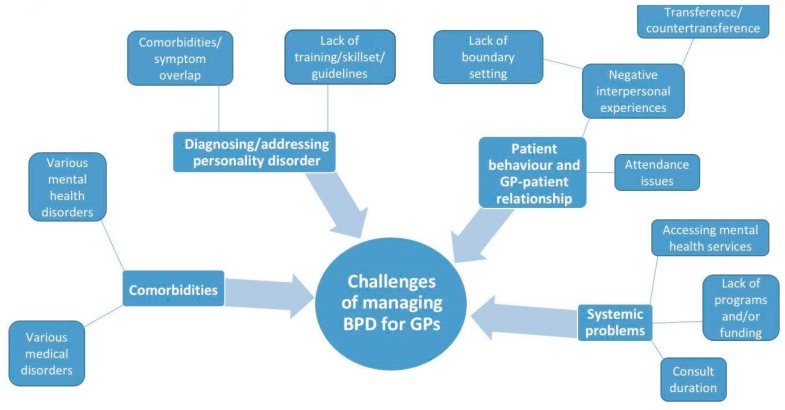
The prevalence of people seeking care for Borderline Personality Disorder (BPD) in primary care is four to five times higher than in the general population. Therefore, general practitioners (GPs) are important sources of assessment, diagnosis, treatment, and care for these patients, as well as important providers of early intervention and long-term management for mental health and associated comorbidities. A thematic analysis of two focus groups with 12 GPs in South Australia (in discussion with 10 academic, clinical, and lived experience stakeholders) highlighted many challenges faced by GPs providing care to patients with BPD. Major themes were: (1) Challenges Surrounding Diagnosis of BPD; (2) Comorbidities and Clinical Complexity; (3) Difficulties with Patient Behaviour and the GP⁻Patient Relationship; and (4) Finding and Navigating Systems for Support. Health service pathways for this high-risk/high-need patient group are dependent on the quality of care that GPs provide, which is dependent on GPs' capacity to identify and understand BPD. GPs also need to be supported sufficiently in order to develop the skills that are necessary to provide effective care for BPD patients. Systemic barriers and healthcare policy, to the extent that they dictate the organisation of primary care, are prominent structural factors obstructing GPs' attempts to address multiple comorbidities for patients with BPD. Several strategies are suggested to support GPs supporting patients with BPD.
在初级保健中寻求边缘型人格障碍 (BPD) 治疗的人群患病率比普通人群高四到五倍。因此,全科医生 (GP) 是评估、诊断、治疗和照顾这些患者的重要来源,也是心理健康和相关共病的早期干预和长期管理的重要提供者。对南澳大利亚的两个由 12 名全科医生组成的焦点小组(与 10 名学术、临床和生活经验利益相关者进行了讨论)进行的主题分析突出了全科医生在为 BPD 患者提供护理时面临的许多挑战。主要主题包括:(1) BPD 诊断面临的挑战;(2) 共病和临床复杂性;(3) 患者行为和医患关系的困难;以及 (4) 寻找和驾驭支持系统。这群高风险/高需求患者的卫生服务途径取决于 GP 提供的护理质量,而这又取决于 GP 识别和理解 BPD 的能力。为了发展为 BPD 患者提供有效护理所需的技能,还需要充分支持全科医生。系统障碍和医疗保健政策,在一定程度上决定了初级保健的组织方式,是阻碍全科医生为 BPD 患者解决多种共病的突出结构性因素。提出了几种策略来支持支持 BPD 患者的全科医生。