Center for Translational Research in Neurodegenerative Disease, University of Florida, Gainesville, Florida, USA.
Department of Neuroscience, University of Florida, Gainesville, Florida, USA.
Acta Neuropathol Commun. 2018 Dec 19;6(1):137. doi: 10.1186/s40478-018-0631-0.
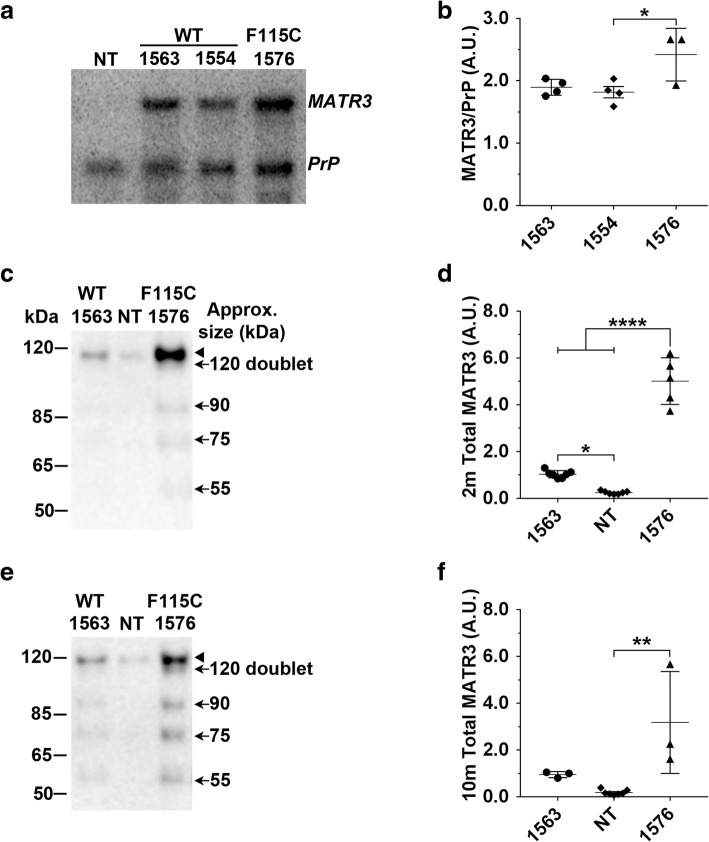
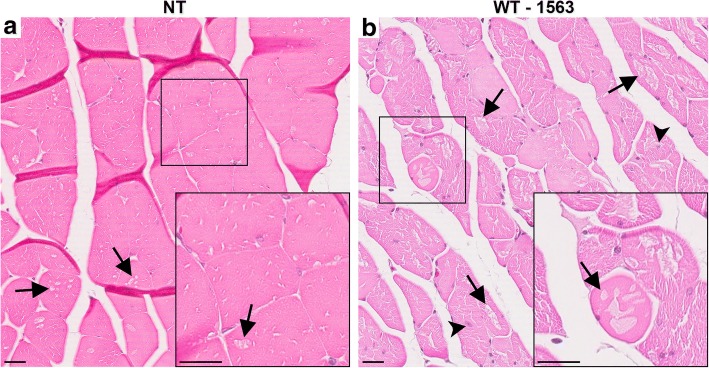
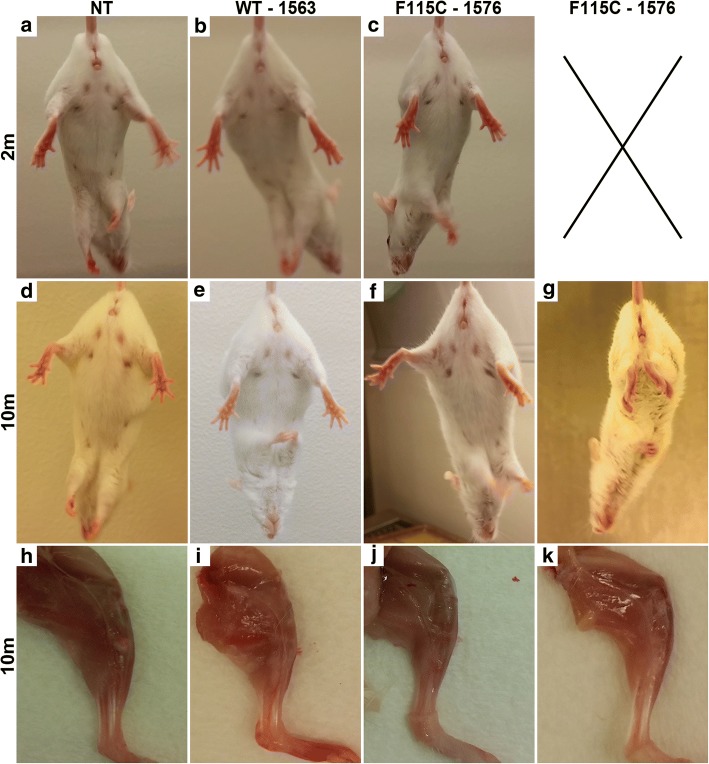
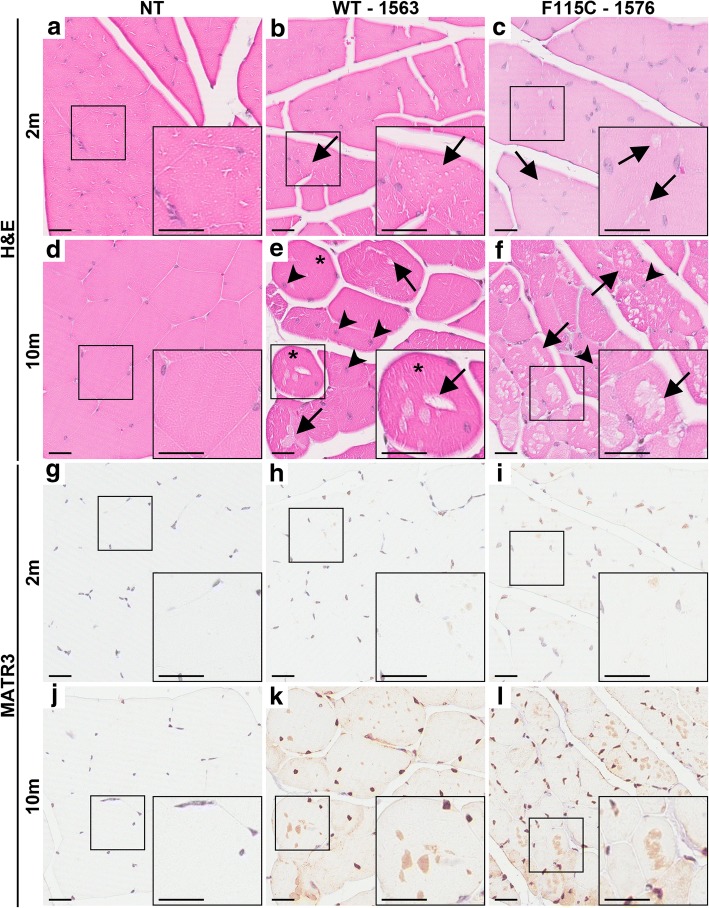
Mutations in MATR3 have been associated with amyotrophic lateral sclerosis (ALS) as well as a form of distal myopathy termed vocal cord pharyngeal distal myopathy (VCPDM). To begin to understand how mutations in MATR3 may cause disease, here we provide initial characterization of transgenic (Tg) mice expressing human wild-type (WT) MATR3 (MATR3) and ALS-mutant F115C MATR3 (MATR3) proteins under the control of the mouse prion promoter (MoPrP). For each construct, we established multiple independent lines of mice that stably transmitted the transgene. Unexpectedly, for all stably-transmitting lines examined, MATR3 transgenic mRNA expression was more robust in muscle, with minimal expression in spinal cord. The levels of transgenic mRNA in muscle did not differ between mice from our lead MATR3 line and lead MATR3 line, but mice from the lead MATR3 line had significantly higher levels of MATR3 protein in muscle over the lead MATR3 line. Mice from the three independent, established lines of MATR3 mice developed weakness in both fore- and hind-limbs as early as < 1 months of age; whereas, MATR3 mice aged to > 20 months were not overtly distinguishable from non-transgenic (NT) littermates based on basic motor phenotype. Muscle of both MATR3 and MATR3 mice showed vacuoles by 2 months of age which worsened by ~ 10 months, but vacuolation was noticeably more severe in MATR3 mice. Overall, our results indicate that increasing the levels of MATR3 in muscle can cause pathologic changes associated with myopathy, with MATR3 expression causing overt muscle atrophy and a profound motor phenotype. The findings suggest that analysis of muscle pathology in individuals harboring ALS-linked MATR3 mutations should be routinely considered.
MATR3 中的突变与肌萎缩侧索硬化症(ALS)以及一种称为声带咽远端肌病(VCPDM)的远端肌病有关。为了开始了解 MATR3 中的突变如何引起疾病,我们在此提供了在小鼠朊病毒启动子(MoPrP)控制下表达人野生型(WT)MATR3(MATR3)和 ALS 突变 F115C MATR3(MATR3)蛋白的转基因(Tg)小鼠的初步特征。对于每种构建体,我们建立了多个独立的表达稳定传递转基因的小鼠系。出乎意料的是,对于所有检查的稳定传递系,MATR3 转基因 mRNA 在肌肉中的表达更为强劲,在脊髓中的表达最小。我们的主导 MATR3 系和主导 MATR3 系之间的肌肉中的转基因 mRNA 水平没有差异,但主导 MATR3 系的小鼠的肌肉中的 MATR3 蛋白水平明显高于主导 MATR3 系。来自三个独立建立的 MATR3 小鼠系的小鼠早在 <1 个月龄时就出现前肢和后肢无力;然而,主导 MATR3 系的小鼠在 >20 个月龄时在基本运动表型上与非转基因(NT)同窝仔鼠没有明显区别。MATR3 和 MATR3 小鼠的肌肉在 2 个月龄时出现空泡,到 10 个月时恶化,但 MATR3 小鼠的空泡化明显更严重。总体而言,我们的结果表明,增加肌肉中的 MATR3 水平会导致与肌病相关的病理变化,MATR3 表达导致明显的肌肉萎缩和严重的运动表型。这些发现表明,应常规考虑对携带 ALS 相关 MATR3 突变的个体的肌肉病理学分析。