Donnelly Rachel, Marteleto Leticia J
University of Texas at Austin, Austin, TX, USA.
Socius. 2018 Jan-Dec;4. doi: 10.1177/2378023118804688. Epub 2018 Oct 24.
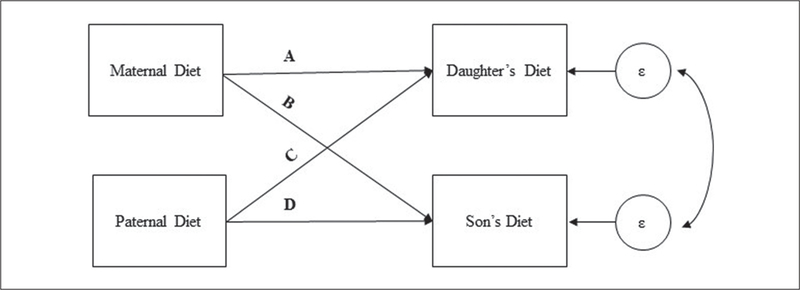
Existing literature documents the key role that parents play in transmitting diet behaviors to their children; however, less is known about differences by parent and child gender within families, especially with attention to household socioeconomic status (SES). We use nationally representative household data from Brazil and ask how parent-child associations of diet behavior differ by gender within lower- and higher-SES households. Results indicate that both maternal and paternal diet behaviors are associated with sons' and daughters' diet behaviors, but the strength of these associations differs depending on the gender of both the parent and the child. Moreover, gender differences in parent-child diet resemblance exist primarily in lower-, but not in higher-SES households. These findings are important for understanding health processes that occur within families and lead to disparities across generations, especially in a middle-income country undergoing sharp economic and nutritional changes.
现有文献记载了父母在向子女传递饮食行为方面所起的关键作用;然而,关于家庭中父母与子女性别差异的情况,尤其是考虑到家庭社会经济地位(SES)时,我们了解得较少。我们使用来自巴西具有全国代表性的家庭数据,探究在低社会经济地位和高社会经济地位家庭中,亲子饮食行为关联如何因性别而有所不同。结果表明,母亲和父亲的饮食行为都与儿子和女儿的饮食行为有关联,但这些关联的强度因父母和子女的性别而异。此外,亲子饮食相似性的性别差异主要存在于低社会经济地位家庭,而在高社会经济地位家庭中则不存在。这些发现对于理解家庭内部发生的健康过程以及导致代际差异的情况非常重要,尤其是在一个正在经历急剧经济和营养变化的中等收入国家。