From the Department of Cardiology, Cardiovascular Key Laboratory of Zhejiang Province, Second Affiliated Hospital, Zhejiang University School of Medicine, Hangzhou, China (F.Y., Y.W., J.W.).
Saha Cardiovascular Research Center (F.Y., Y.W., C.W., D.A.H., A.B., A.D., H.S.L.) University of Kentucky, Lexington.
Arterioscler Thromb Vasc Biol. 2019 Feb;39(2):150-155. doi: 10.1161/ATVBAHA.118.311817.
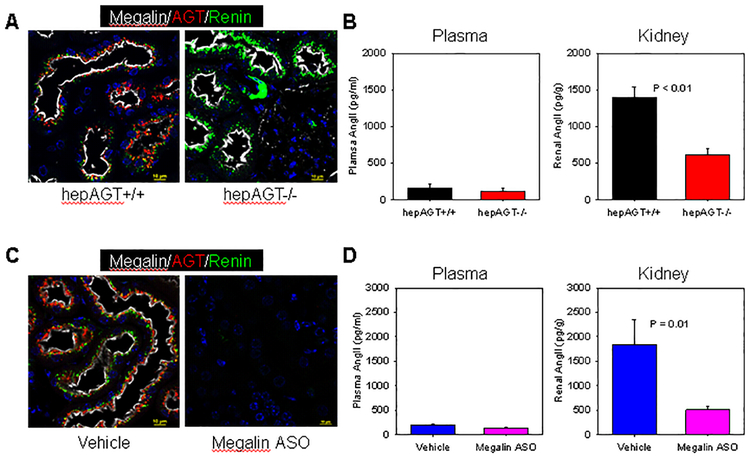
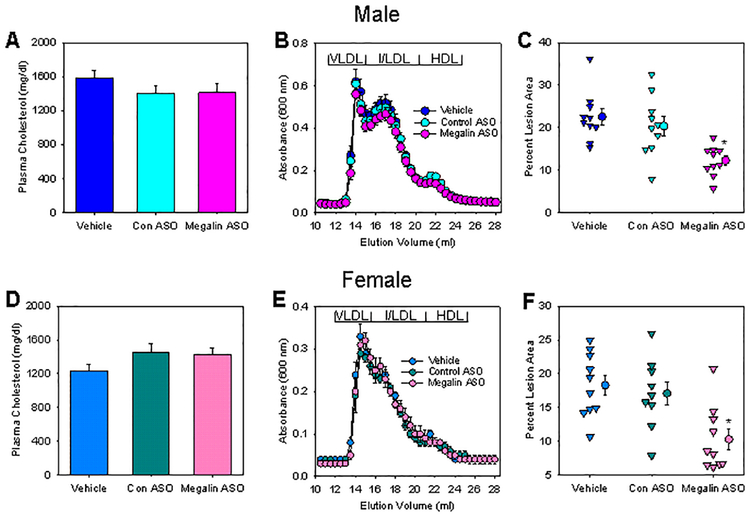
Objective- AGT (Angiotensinogen) is the unique precursor of the renin-angiotensin system that is sequentially cleaved by renin and ACE (angiotensin-converting enzyme) to produce Ang II (angiotensin II). In this study, we determined how these renin-angiotensin components interact with megalin in kidney to promote atherosclerosis. Approach and Results- AGT, renin, ACE, and megalin were present in the renal proximal convoluted tubules of wild-type mice. Hepatocyte-specific AGT deficiency abolished AGT protein accumulation in proximal tubules and diminished Ang II concentrations in kidney, while renin was increased. Megalin was most abundant in kidney and exclusively present on the apical side of proximal tubules. Inhibition of megalin by antisense oligonucleotides (ASOs) led to ablation of AGT and renin proteins in proximal tubules, while leading to striking increases of urine AGT and renin concentrations, and 70% reduction of renal Ang II concentrations. However, plasma Ang II concentrations were unaffected. To determine whether AGT and megalin interaction contributes to atherosclerosis, we used both male and female low-density lipoprotein receptor mice fed a saturated fat-enriched diet and administered vehicles (PBS or control ASO) or megalin ASO. Inhibition of megalin did not affect plasma cholesterol concentrations, but profoundly reduced atherosclerotic lesion size in both male and female mice. Conclusions- These results reveal a regulatory role of megalin in the intrarenal renin-angiotensin homeostasis and atherogenesis, positing renal Ang II to be an important contributor to atherosclerosis that is mediated through AGT and megalin interactions.
目的-AGT(血管紧张素原)是肾素-血管紧张素系统的唯一前体,它依次被肾素和 ACE(血管紧张素转换酶)切割,产生 Ang II(血管紧张素 II)。在这项研究中,我们确定了这些肾素-血管紧张素成分如何与肾脏中的 megalin 相互作用,以促进动脉粥样硬化。
方法和结果-在野生型小鼠的肾脏近端曲管中存在 AGT、肾素、ACE 和 megalin。肝特异性 AGT 缺乏会消除近端小管中 AGT 蛋白的积累,并降低肾脏中的 Ang II 浓度,而肾素则增加。Megalin 在肾脏中最为丰富,仅存在于近端小管的顶端侧。用反义寡核苷酸(ASO)抑制 megalin 会导致近端小管中 AGT 和肾素蛋白的消融,同时导致尿 AGT 和肾素浓度显著增加,肾脏 Ang II 浓度降低 70%。然而,血浆 Ang II 浓度不受影响。为了确定 AGT 和 megalin 相互作用是否有助于动脉粥样硬化,我们使用了雄性和雌性低密度脂蛋白受体小鼠,给予富含饱和脂肪的饮食,并给予载体(PBS 或对照 ASO)或 megalin ASO。抑制 megalin 不会影响血浆胆固醇浓度,但会显著减少雄性和雌性小鼠的动脉粥样硬化病变大小。
结论-这些结果揭示了 megalin 在肾内肾素-血管紧张素平衡和动脉粥样硬化发生中的调节作用,提出肾脏 Ang II 是通过 AGT 和 megalin 相互作用介导的动脉粥样硬化的重要贡献者。