Gore Maria Odette, Krantz Mori J, Albright Karen, Beaty Brenda, Coronel-Mockler Stephanie, Bull Sheana, Estacio Raymond O
Colorado Prevention Center, Community Health Department, Aurora, CO, United States of America.
Department of Medicine, University of Colorado Anschutz Medical Campus, Aurora, CO, United States of America.
Prev Med Rep. 2018 Nov 30;13:126-131. doi: 10.1016/j.pmedr.2018.11.021. eCollection 2019 Mar.
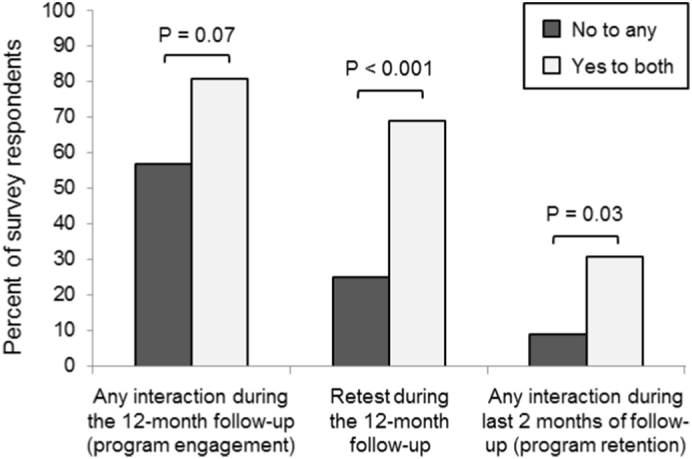
The statewide Colorado Healthy Heart Solutions (CHHS) program provides cardiovascular disease (CVD) risk factor screening and education to the medically underserved and has been shown to improve CVD risk profiles. We aimed to enhance its effectiveness through addition of a mobile health (mHealth) intervention using SMS messaging (termed Cardio SMS). We conducted a prospective, non-randomized controlled pilot trial of this intervention implemented at 5 rural program sites (number of participants = 204) compared with a contemporaneous propensity-score matched control group from 14 CHHS sites not receiving the intervention ( = 408) between 2012 and 2014. All participants were free of CVD at baseline, and follow-up time was 12-months. The primary outcome was program engagement, defined as the number of completed interactions with the program during the entire follow-up period. Secondary outcomes were program retention, defined as any interaction during the last two months of the study; change in self-reported healthy behaviors (physical activity, weight loss, smoking cessation, fat intake); and change in CVD risk factors. There were trends for differences between groups across multiple outcomes, but most did not reach statistical significance, except for a greater decrease in self-reported fat intake in the intervention vs. control groups (26.3% vs 10.6%, = 0.001). In addition, a subset of surveyed participants who viewed the SMS messages as motivating showed greater program retention ( = 0.03). Given the relative ease and scalability of SMS interventions in rural underserved communities, further study of SMS as part of multicomponent strategies for CVD prevention is warranted.
科罗拉多州全州范围的“健康心脏解决方案”(CHHS)项目为医疗服务不足的人群提供心血管疾病(CVD)风险因素筛查和教育,并且已被证明能改善心血管疾病风险状况。我们旨在通过添加使用短信的移动健康(mHealth)干预措施(称为“心脏短信”)来提高其有效性。我们在5个农村项目地点开展了这项干预措施的前瞻性、非随机对照试验(参与者数量 = 204),并与2012年至2014年期间来自14个未接受该干预措施的CHHS地点的同期倾向得分匹配对照组( = 408)进行比较。所有参与者在基线时均无心血管疾病,随访时间为12个月。主要结局是项目参与度,定义为整个随访期间与该项目完成互动的次数。次要结局包括项目留存率,定义为研究最后两个月内的任何互动;自我报告的健康行为(身体活动、体重减轻、戒烟、脂肪摄入)的变化;以及心血管疾病风险因素的变化。在多个结局指标上,两组之间存在差异趋势,但大多数未达到统计学显著性,不过干预组自我报告的脂肪摄入量下降幅度大于对照组(26.3% 对10.6%, = 0.001)。此外,一部分将短信视为有激励作用的受调查参与者表现出更高的项目留存率( = 0.03)。鉴于短信干预措施在农村医疗服务不足社区相对简便且可扩展,有必要进一步研究将短信作为心血管疾病预防多组分策略的一部分。