The Third Department of Breast Cancer, Tianjin Medical University Cancer Institute and Hospital, National Clinical Research Center for Cancer, Tianjin 300060, P.R. China.
Mol Med Rep. 2019 Feb;19(2):861-868. doi: 10.3892/mmr.2018.9763. Epub 2018 Dec 14.
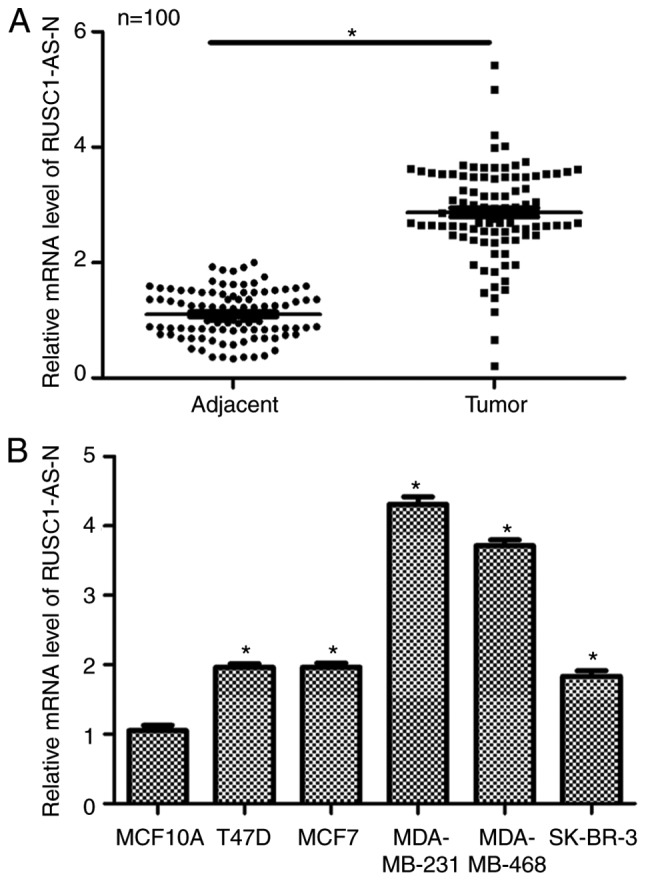
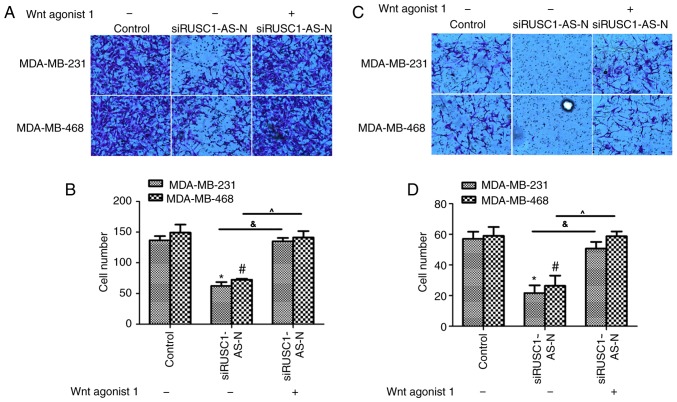
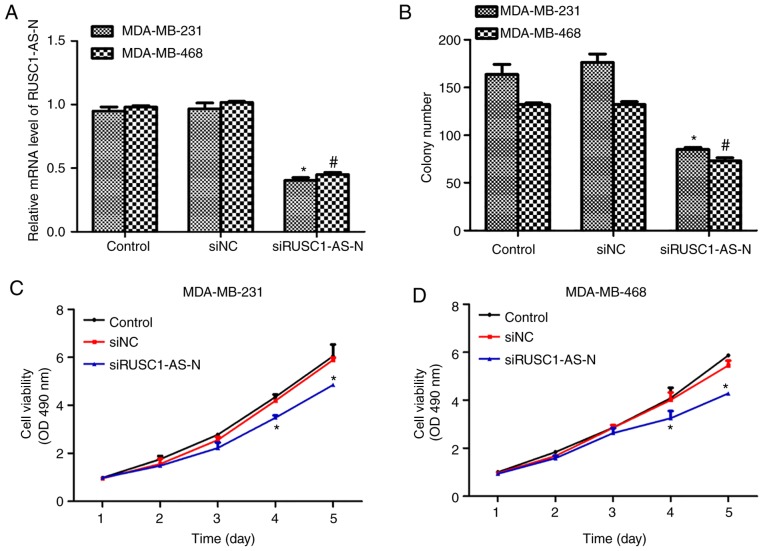
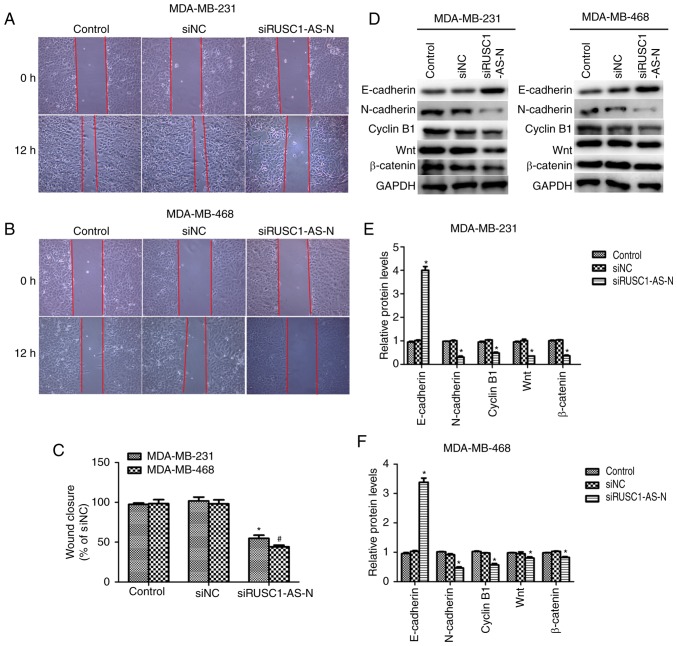
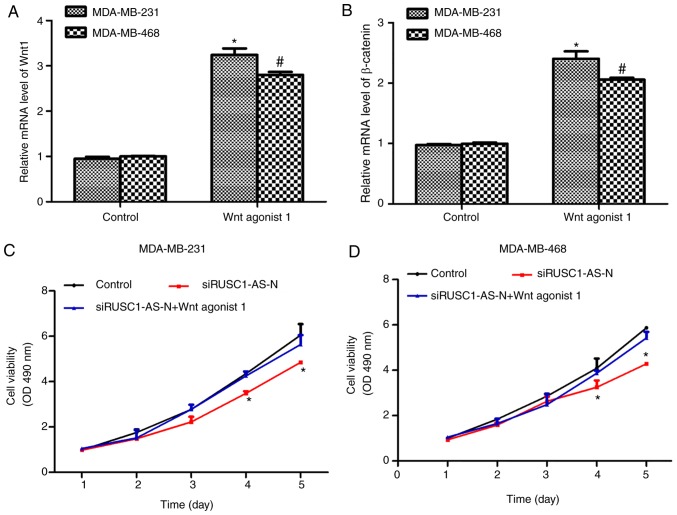
Breast cancer is one of the most frequently diagnosed cancers among females worldwide. Long noncoding RNAs (lncRNAs) have been revealed to serve significant roles in diagnosis and treatment of breast cancer. In the present study, the novel lncRNA RUSC1‑AS‑N was demonstrated to promote cell viability and metastasis. A total of 100 patients with breast cancer were recruited for this study and it was revealed that RUSC1‑AS‑N was upregulated in tumor tissues compared with in adjacent non‑cancerous counterparts. In addition, using several breast cancer cell lines, it was demonstrated that the mRNA levels of RUSC1‑AS‑N were highest in the notably metastatic cell lines MDA‑MB‑231 and MDA‑MB‑468. Knockdown of RUSC1‑AS‑N in breast cancer cells inhibited cell proliferation in the colony formation and cell proliferation assays. Furthermore, depletion of RUSC1‑AS‑N suppressed cell metastasis, as revealed by wound‑healing and western blot assays. In addition, the protein levels of Wnt1 and β‑catenin were significantly decreased when RUSC1‑AS‑N was knocked down. However, Wnt signaling pathway activator Wnt agonist 1 reversed the effects of RUSC1‑AS‑N knockdown on cell proliferation and metastasis. The present study demonstrated that lncRNA RUSC1‑AS‑N promoted cell viability and metastasis via Wnt/β‑catenin signaling in human breast cancer, which may indicate novel targets for the treatment of breast cancer in clinic.
乳腺癌是全球女性最常见的癌症之一。长链非编码 RNA(lncRNA)已被证明在乳腺癌的诊断和治疗中具有重要作用。在本研究中,新型 lncRNA RUSC1-AS-N 被证明可促进细胞活力和转移。本研究共招募了 100 名乳腺癌患者,结果显示 RUSC1-AS-N 在肿瘤组织中上调,而在相邻的非癌组织中下调。此外,通过几种乳腺癌细胞系,证明 RUSC1-AS-N 的 mRNA 水平在高度转移性细胞系 MDA-MB-231 和 MDA-MB-468 中最高。在乳腺癌细胞中敲低 RUSC1-AS-N 抑制了集落形成和细胞增殖测定中的细胞增殖。此外,通过划痕愈合和 Western blot 测定,发现 RUSC1-AS-N 耗竭抑制了细胞转移。此外,当敲低 RUSC1-AS-N 时,Wnt1 和 β-连环蛋白的蛋白水平显着降低。然而,Wnt 信号通路激活剂 Wnt 激动剂 1 逆转了 RUSC1-AS-N 敲低对细胞增殖和转移的影响。本研究表明,lncRNA RUSC1-AS-N 通过 Wnt/β-连环蛋白信号通路促进人乳腺癌细胞活力和转移,这可能为临床治疗乳腺癌提供新的靶点。