Lohans Christopher T, Chan H T Henry, Malla Tika R, Kumar Kiran, Kamps Jos J A G, McArdle Darius J B, van Groesen Emma, de Munnik Mariska, Tooke Catherine L, Spencer James, Paton Robert S, Brem Jürgen, Schofield Christopher J
Department of Chemistry, University of Oxford, Oxford, OX1 3TA, UK.
School of Cellular and Molecular Medicine, University of Bristol, Bristol, BS8 1TD, UK.
Angew Chem Int Ed Engl. 2019 Feb 11;58(7):1990-1994. doi: 10.1002/anie.201809424. Epub 2019 Jan 21.
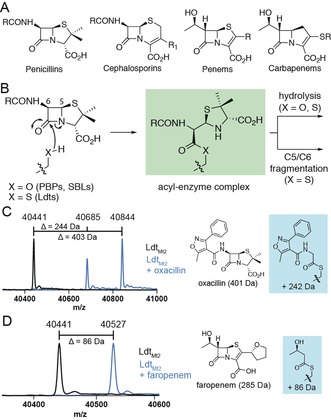
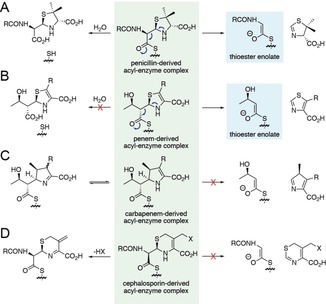
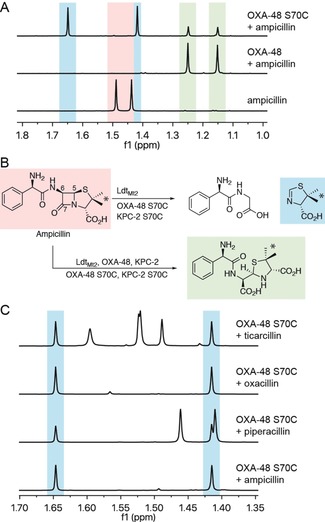
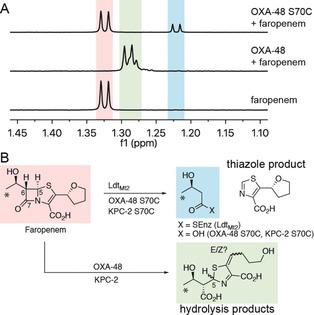
Enzymes often use nucleophilic serine, threonine, and cysteine residues to achieve the same type of reaction; the underlying reasons for this are not understood. While bacterial d,d-transpeptidases (penicillin-binding proteins) employ a nucleophilic serine, l,d-transpeptidases use a nucleophilic cysteine. The covalent complexes formed by l,d-transpeptidases with some β-lactam antibiotics undergo non-hydrolytic fragmentation. This is not usually observed for penicillin-binding proteins, or for the related serine β-lactamases. Replacement of the nucleophilic serine of serine β-lactamases with cysteine yields enzymes which fragment β-lactams via a similar mechanism as the l,d-transpeptidases, implying the different reaction outcomes are principally due to the formation of thioester versus ester intermediates. The results highlight fundamental differences in the reactivity of nucleophilic serine and cysteine enzymes, and imply new possibilities for the inhibition of nucleophilic enzymes.
酶常常利用亲核性的丝氨酸、苏氨酸和半胱氨酸残基来实现同类型反应;其背后的原因尚不清楚。虽然细菌的d,d-转肽酶(青霉素结合蛋白)利用亲核性丝氨酸,但l,d-转肽酶使用亲核性半胱氨酸。l,d-转肽酶与一些β-内酰胺抗生素形成的共价复合物会发生非水解断裂。青霉素结合蛋白或相关的丝氨酸β-内酰胺酶通常不会出现这种情况。用半胱氨酸取代丝氨酸β-内酰胺酶的亲核性丝氨酸会产生酶,这些酶通过与l,d-转肽酶类似的机制使β-内酰胺断裂,这意味着不同的反应结果主要是由于硫酯与酯中间体的形成。这些结果突出了亲核性丝氨酸酶和半胱氨酸酶反应性的根本差异,并暗示了抑制亲核酶的新可能性。