a Shanghai Baize Medical Laboratory , Shanghai Engineering Research Center for Cell Therapy , Shanghai , China.
b Department of Biotherapy, Eastern Hepatobiliary Surgery Hospital , The Second Military Medical University , Shanghai , China.
Cancer Biol Ther. 2019;20(4):546-551. doi: 10.1080/15384047.2018.1538000. Epub 2018 Dec 20.
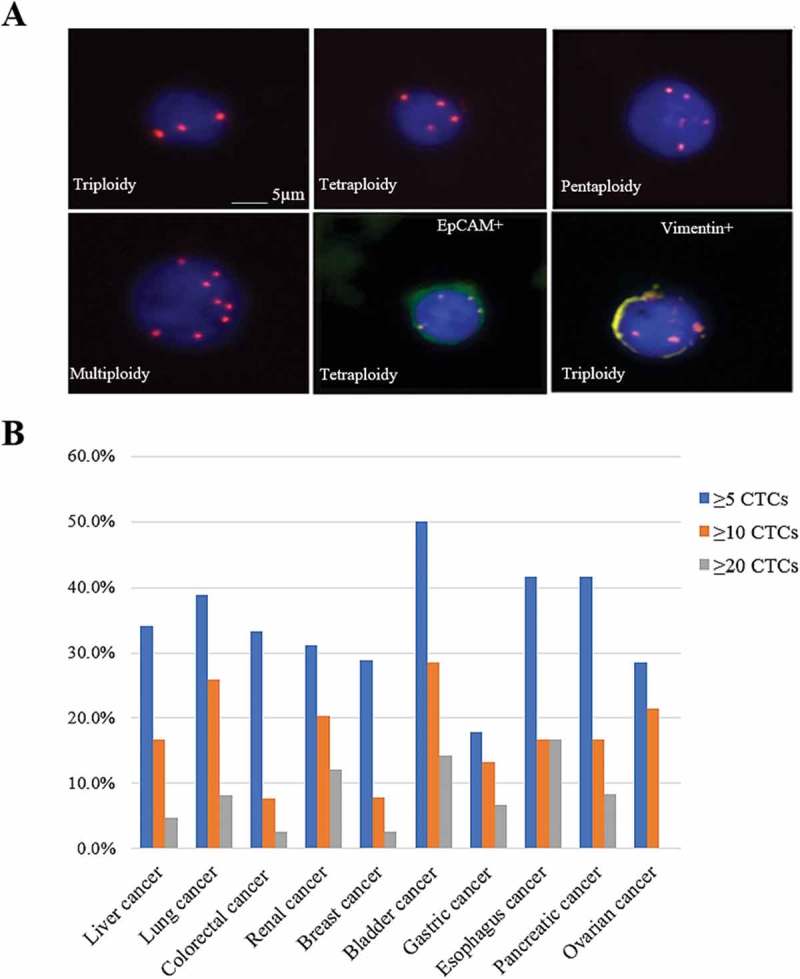
Circulating tumor cells (CTCs) have been exclusively studied and served to assess the clinical outcomes of treatments and progression of cancer. Most CTC data have mainly been derived from distinct cohorts or selected tumor types. In the present study, a total of 594 blood samples from 479 cases with 19 different carcinomas and 30 healthy samples were collected and analyzed by Subtraction enrichment method combined with immunostaining-fluorescence in situ hybridization (iFISH). Non-hematopoietic cells with aneuploid chromosome 8 (more than 2 copies) were regarded as positive CTCs. The results showed that none of CTCs was found in all 30 healthy samples. The overall positive rate of CTCs was 89.0% in diagnosed cancer patients (ranging from 75.0% to 100.0%). Average number of 11, 5, 8 and 4 CTCs per 7.5 mL was observed in lung cancer, liver cancer, renal cancer and colorectal cancer, respectively. Among 19 different carcinomas, the total number of CTCs, tetraploid chromosome 8, polyploid chromosome 8, CTM (Circulating tumor microemboli) and large CTCs in patients with stage Ⅲ and Ⅳ were statistically higher than patients with stage Ⅰ and Ⅱ (P < 0.05). Furthermore, EpCAM expression was more frequently found in most CTCs than vimentin expression, confirming that these CTCs were of epithelial origin. In addition, small and large CTCs were also classified, and the expression of vimentin was mostly observed in small CTCs and CTM. Our results revealed that there are higher numbers of CTCs, tetraploid, polyploid and large CTCs in patients with stage Ⅲ and Ⅳ, indicating that the quantification of chromosome ploidy performed by SE-iFISH for CTCs might be a useful tool to predict and evaluate therapeutic efficacy as well as to monitoring disease progression.
循环肿瘤细胞 (CTC) 一直是研究的重点,用于评估治疗效果和癌症进展。大多数 CTC 数据主要来源于不同的队列或特定的肿瘤类型。在本研究中,共采集了 479 例 19 种不同癌症和 30 例健康对照者的 594 份血样,采用减法富集法联合免疫荧光原位杂交 (iFISH) 进行分析。具有非整倍体 8 号染色体(超过 2 个拷贝)的非造血细胞被视为阳性 CTC。结果显示,30 例健康对照者的血样均未发现 CTC。确诊癌症患者的 CTC 总体阳性率为 89.0%(75.0%~100.0%)。肺癌、肝癌、肾癌和结直肠癌患者每 7.5ml 血样中平均分别有 11、5、8 和 4 个 CTC。在 19 种不同的癌症中,Ⅲ期和Ⅳ期患者的 CTC 总数、四倍体 8 号染色体、多倍体 8 号染色体、CTC 微栓子(CTM)和大 CTC 数量均明显高于Ⅰ期和Ⅱ期患者(P<0.05)。此外,大多数 CTC 中 EpCAM 的表达频率高于 vimentin,这证实了这些 CTC 来源于上皮组织。另外,还对小 CTC 和大 CTC 进行了分类,发现小 CTC 和 CTM 中主要表达 vimentin。本研究结果显示,Ⅲ期和Ⅳ期患者的 CTC 数量、四倍体、多倍体和大 CTC 数量均较多,提示 SE-iFISH 检测 CTC 染色体倍性可能是一种有用的预测和评估治疗效果以及监测疾病进展的工具。