• 文献检索
  • 文档翻译
  • 深度研究
  • 学术资讯
  • Suppr Zotero 插件Zotero 插件
  • 邀请有礼
  • 套餐&价格
  • 历史记录
应用&插件
Suppr Zotero 插件Zotero 插件浏览器插件Mac 客户端Windows 客户端微信小程序
定价
高级版会员购买积分包购买API积分包
服务
文献检索文档翻译深度研究API 文档MCP 服务
关于我们
关于 Suppr公司介绍联系我们用户协议隐私条款
关注我们

Suppr 超能文献

核心技术专利:CN118964589B侵权必究
粤ICP备2023148730 号-1Suppr @ 2026

文献检索

告别复杂PubMed语法,用中文像聊天一样搜索,搜遍4000万医学文献。AI智能推荐,让科研检索更轻松。

立即免费搜索

文件翻译

保留排版,准确专业,支持PDF/Word/PPT等文件格式,支持 12+语言互译。

免费翻译文档

深度研究

AI帮你快速写综述,25分钟生成高质量综述,智能提取关键信息,辅助科研写作。

立即免费体验

“我们寻找我们所寻找的,我们寻找我们所知道的”:在突尼斯,影响心理健康培训计划预期结果的相互作用因素。

"We find what we look for, and we look for what we know": factors interacting with a mental health training program to influence its expected outcomes in Tunisia.

机构信息

School of Public Health, IRSPUM, Université de Montréal, Montréal, Québec, H3N1X9, Canada.

School of Public Health, Université de Montréal, Montréal, Québec, Canada.

出版信息

BMC Public Health. 2018 Dec 20;18(1):1398. doi: 10.1186/s12889-018-6261-4.

DOI:10.1186/s12889-018-6261-4
PMID:30572941
原文链接:https://pmc.ncbi.nlm.nih.gov/articles/PMC6302293/
Abstract

BACKGROUND

Primary care physicians (PCPs) working in mental health care in Tunisia often lack knowledge and skills needed to adequately address mental health-related issues. To address these lacunas, a training based on the Mental Health Gap Action Programme (mhGAP) Intervention Guide (IG) was offered to PCPs working in the Greater Tunis area between February and April 2016. While the mhGAP-IG has been used extensively in low- and middle-income countries (LMICs) to help build non-specialists' mental health capacity, little research has focused on how contextual factors interact with the implemented training program to influence its expected outcomes. This paper's objective is to fill that lack.

METHODS

We conducted a case study with a purposeful sample of 18 trained PCPs. Data was collected by semi-structured interviews between March and April 2016. Qualitative data was analyzed using thematic analysis.

RESULTS

Participants identified more barriers than facilitators when describing contextual factors influencing the mhGAP-based training's expected outcomes. Barriers were regrouped into five categories: structural factors (e.g., policies, social context, local workforce development, and physical aspects of the environment), organizational factors (e.g., logistical issues for the provision of care and collaboration within and across healthcare organizations), provider factors (e.g., previous mental health experience and personal characteristics), patient factors (e.g., beliefs about the health system and healthcare professionals, and motivation to seek care), and innovation factors (e.g., training characteristics). These contextual factors interacted with the implemented training to influence knowledge about pharmacological treatments and symptoms of mental illness, confidence in providing treatment, negative beliefs about certain mental health conditions, and the understanding of the role of PCPs in mental health care delivery. In addition, post-training, participants still felt uncomfortable with certain aspects of treatment and the management of some mental health conditions.

CONCLUSIONS

Findings highlight the complexity of implementing a mhGAP-based training given its interaction with contextual factors to influence the attainment of expected outcomes. Results may be used to tailor structural, organizational, provider, patient, and innovation factors prior to future implementations of the mhGAP-based training in Tunisia. Findings may also be used by decision-makers interested in implementing the mhGAP-IG training in other LMICs.

摘要

背景

在突尼斯,从事精神卫生保健工作的初级保健医生(PCP)往往缺乏充分解决与精神卫生相关问题所需的知识和技能。为了解决这些空白,2016 年 2 月至 4 月期间,在大突尼斯地区为从事精神卫生保健工作的 PCP 提供了一项基于《精神卫生差距行动规划(mhGAP)干预指南》(IG)的培训。虽然 mhGAP-IG 已在中低收入国家(LMICs)广泛用于帮助建立非专业人员的精神卫生能力,但很少有研究关注情境因素如何与实施的培训计划相互作用,从而影响预期结果。本文旨在填补这一空白。

方法

我们对 18 名经过培训的 PCP 进行了一项案例研究,采用了有针对性的样本。数据收集于 2016 年 3 月至 4 月期间进行的半结构化访谈。使用主题分析对定性数据进行分析。

结果

参与者在描述影响基于 mhGAP 的培训预期结果的情境因素时,认为障碍多于促进因素。障碍分为五类:结构性因素(例如,政策、社会背景、当地劳动力发展和环境的物质方面)、组织性因素(例如,提供护理的后勤问题以及医疗机构内部和跨医疗机构的合作)、提供者因素(例如,先前的精神卫生经验和个人特征)、患者因素(例如,对卫生系统和卫生保健专业人员的信念以及寻求护理的动机)和创新性因素(例如,培训特点)。这些情境因素与实施的培训相互作用,影响了对药物治疗和精神疾病症状的了解、提供治疗的信心、对某些精神卫生状况的负面看法以及对 PCP 在精神卫生保健提供中的作用的理解。此外,培训后,参与者对某些治疗方面和某些精神卫生状况的管理仍感到不适。

结论

研究结果强调了实施基于 mhGAP 的培训的复杂性,因为其与情境因素相互作用,影响预期结果的实现。研究结果可用于突尼斯未来实施基于 mhGAP 的培训之前,对结构性、组织性、提供者、患者和创新性因素进行调整。对在其他 LMICs 实施 mhGAP-IG 培训感兴趣的决策者也可以使用这些结果。
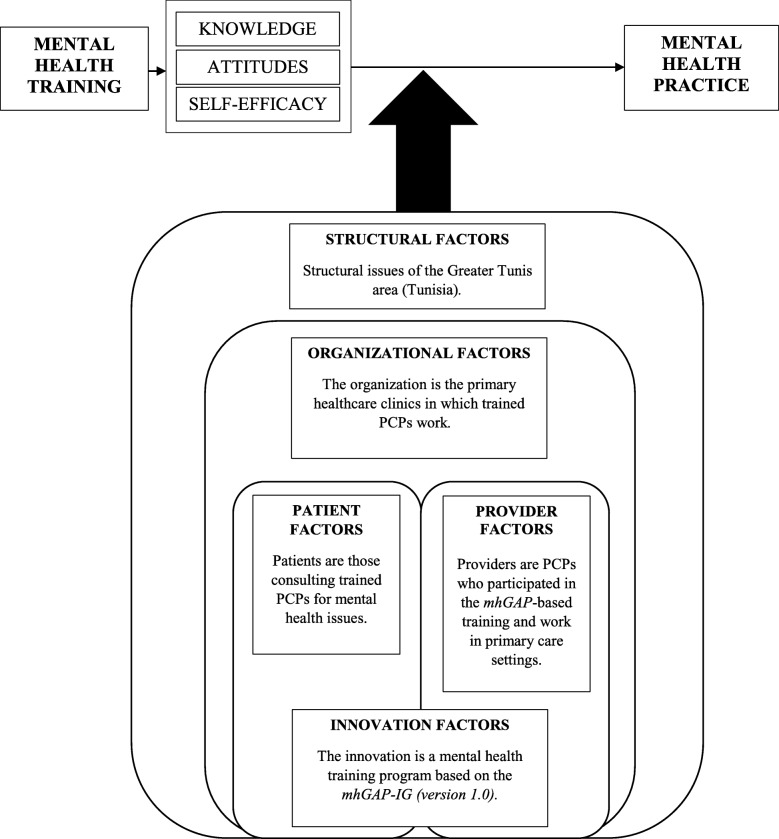
https://cdn.ncbi.nlm.nih.gov/pmc/blobs/e9a4/6302293/aa2f785d637b/12889_2018_6261_Fig1_HTML.jpg

相似文献

1
"We find what we look for, and we look for what we know": factors interacting with a mental health training program to influence its expected outcomes in Tunisia.“我们寻找我们所寻找的,我们寻找我们所知道的”:在突尼斯,影响心理健康培训计划预期结果的相互作用因素。
BMC Public Health. 2018 Dec 20;18(1):1398. doi: 10.1186/s12889-018-6261-4.
2
Building capacity in mental health care in low- and middle-income countries by training primary care physicians using the mhGAP: a randomized controlled trial.利用 mhGAP 通过培训初级保健医生在中低收入国家加强精神卫生保健能力:一项随机对照试验。
Health Policy Plan. 2020 Mar 1;35(2):186-198. doi: 10.1093/heapol/czz138.
3
Building system capacity for the integration of mental health at the level of primary care in Tunisia: a study protocol in global mental health.构建突尼斯初级保健层面心理健康整合的系统能力:一项全球心理健康研究方案
BMC Health Serv Res. 2017 Jan 17;17(1):38. doi: 10.1186/s12913-017-1992-y.
4
Implementation and use of the Mental Health Gap Action Programme Intervention Guide (mhGAP-IG): A review of the grey literature.《心理健康差距行动规划干预指南(mhGAP-IG)的实施和使用:灰色文献回顾》。
J Glob Health. 2021 Apr 17;11:04022. doi: 10.7189/jogh.11.04022.
5
Tailoring a training based on the to Tunisia: process and relevant adaptations.根据突尼斯的情况量身定制培训:过程及相关调整。 (你提供的原文不完整,“based on the”后面缺少内容)
Glob Ment Health (Camb). 2018 May 9;5:e17. doi: 10.1017/gmh.2018.8. eCollection 2018.
6
Implementation strategy in collaboration with people with lived experience of mental illness to reduce stigma among primary care providers in Nepal (RESHAPE): protocol for a type 3 hybrid implementation effectiveness cluster randomized controlled trial.与经历过精神疾病的人合作实施策略,以减少尼泊尔初级保健提供者中的污名化(RESHAPE):一种 3 型混合实施有效性集群随机对照试验的方案。
Implement Sci. 2022 Jun 16;17(1):39. doi: 10.1186/s13012-022-01202-x.
7
Mental health knowledge, attitudes, and self-efficacy among primary care physicians working in the Greater Tunis area of Tunisia.突尼斯大突尼斯地区基层医疗医生的心理健康知识、态度和自我效能感。
Int J Ment Health Syst. 2018 Oct 26;12:63. doi: 10.1186/s13033-018-0243-x. eCollection 2018.
8
Considering culture, context and community in mhGAP implementation and training: challenges and recommendations from the field.在精神、神经和物质使用障碍干预指导项目的实施与培训中考虑文化、背景和社区:来自实地的挑战与建议
Int J Ment Health Syst. 2019 Aug 24;13:58. doi: 10.1186/s13033-019-0312-9. eCollection 2019.
9
WHO Mental Health Gap Action Programme (mhGAP) Intervention Guide: a systematic review of evidence from low and middle-income countries.世界卫生组织心理健康差距行动规划(mhGAP)干预指南:来自中低收入国家的证据系统评价。
Evid Based Ment Health. 2018 Feb;21(1):30-34. doi: 10.1136/eb-2017-102750. Epub 2017 Sep 13.
10
WHO Mental Health Gap Action Programme Intervention Guide (mhGAP-IG): the first pre-service training study.世界卫生组织精神卫生差距行动规划干预指南(mhGAP-IG):首次职前培训研究
Int J Ment Health Syst. 2020 Jun 29;14:47. doi: 10.1186/s13033-020-00379-2. eCollection 2020.

引用本文的文献

1
Characterizing modifications to the mental health gap action programme (mhGAP) intervention guide during implementation in low- and middle-income countries using the framework for reporting adaptations and modifications to evidence-based interventions: a systematic review of reviews.使用循证干预措施的改编和修改报告框架,描述低收入和中等收入国家在实施心理健康差距行动方案(mhGAP)干预指南期间所做的修改:一项综述的系统评价
Int J Ment Health Syst. 2025 Jul 2;19(1):20. doi: 10.1186/s13033-025-00671-z.
2
Sleep Habits and Disturbances Among Tunisian Adults: A Cross-Sectional Online Survey [Letter].突尼斯成年人的睡眠习惯与睡眠障碍:一项横断面在线调查[信函]
Nat Sci Sleep. 2024 Jul 30;16:1119-1120. doi: 10.2147/NSS.S487326. eCollection 2024.
3

本文引用的文献

1
Mental health knowledge, attitudes, and self-efficacy among primary care physicians working in the Greater Tunis area of Tunisia.突尼斯大突尼斯地区基层医疗医生的心理健康知识、态度和自我效能感。
Int J Ment Health Syst. 2018 Oct 26;12:63. doi: 10.1186/s13033-018-0243-x. eCollection 2018.
2
The Management of Depressed Patients by the Tunisian General Practitioners: A Critical Trans-sectional Study.突尼斯全科医生对抑郁患者的管理:一项批判性横断面研究。
Community Ment Health J. 2019 Jan;55(1):137-143. doi: 10.1007/s10597-018-0335-8. Epub 2018 Sep 19.
3
Tailoring a training based on the to Tunisia: process and relevant adaptations.
Mental Health Gap Action Programme intervention Guide (mhGAP-IG) for Child and Adolescent Mental Health in Low- and Middle-Income Countries (LMIC): A Systematic Review.《中低收入国家儿童和青少年精神卫生心理健康差距行动方案干预指南(mhGAP-IG):系统评价》。
Community Ment Health J. 2023 Jan;59(1):192-204. doi: 10.1007/s10597-022-00981-3. Epub 2022 May 17.
4
Treatment Preferences for Pharmacological versus Psychological Interventions among Primary Care Providers in Nepal: Mixed Methods Analysis of a Pilot Cluster Randomized Controlled Trial.尼泊尔初级保健提供者对药物与心理干预治疗的偏好:一项试点性整群随机对照试验的混合方法分析。
Int J Environ Res Public Health. 2022 Feb 14;19(4):2149. doi: 10.3390/ijerph19042149.
5
Barriers and facilitators to implementation of evidence-based task-sharing mental health interventions in low- and middle-income countries: a systematic review using implementation science frameworks.在中低收入国家实施基于证据的任务分担精神卫生干预措施的障碍和促进因素:使用实施科学框架的系统评价。
Implement Sci. 2022 Jan 12;17(1):4. doi: 10.1186/s13012-021-01179-z.
6
WHO mental health gap action programme (mhGAP) intervention guide: updated systematic review on evidence and impact.世界卫生组织精神卫生差距行动规划(mhGAP)干预指南:关于证据和影响的最新系统评价
Evid Based Ment Health. 2021 Apr 26;24(3):124-30. doi: 10.1136/ebmental-2021-300254.
7
Implementation and use of the Mental Health Gap Action Programme Intervention Guide (mhGAP-IG): A review of the grey literature.《心理健康差距行动规划干预指南(mhGAP-IG)的实施和使用:灰色文献回顾》。
J Glob Health. 2021 Apr 17;11:04022. doi: 10.7189/jogh.11.04022.
8
[Mental Health Global Action Programme (mhGAP) in Chile: Lessons Learned and Challenges for Latin America and the CaribbeanPrograma de ação mundial para reduzir as lacunas em saúde mental (mhGAP) no Chile: aprendizados e desafios para América Latina e Caribe].智利的全球精神卫生行动计划(mhGAP):拉丁美洲和加勒比地区的经验教训与挑战 智利减少精神卫生差距全球行动计划(mhGAP):拉丁美洲和加勒比地区的经验教训与挑战
Rev Panam Salud Publica. 2021 Apr 6;45:e32. doi: 10.26633/RPSP.2021.32. eCollection 2021.
9
The influence of primary care physicians' mental health knowledge, attitudes and self-efficacy on referrals to specialised services: findings from a longitudinal pilot trial.基层医疗医生的心理健康知识、态度和自我效能对转介至专科服务的影响:一项纵向试点试验的结果
BJPsych Open. 2020 Oct 30;6(6):e130. doi: 10.1192/bjo.2020.115.
根据突尼斯的情况量身定制培训:过程及相关调整。 (你提供的原文不完整,“based on the”后面缺少内容)
Glob Ment Health (Camb). 2018 May 9;5:e17. doi: 10.1017/gmh.2018.8. eCollection 2018.
4
WHO Mental Health Gap Action Programme (mhGAP) Intervention Guide: a systematic review of evidence from low and middle-income countries.世界卫生组织心理健康差距行动规划(mhGAP)干预指南:来自中低收入国家的证据系统评价。
Evid Based Ment Health. 2018 Feb;21(1):30-34. doi: 10.1136/eb-2017-102750. Epub 2017 Sep 13.
5
Integrating mental health care into primary care systems in low- and middle-income countries: lessons from PRIME and AFFIRM.将精神卫生保健纳入低收入和中等收入国家的初级保健系统:来自PRIME和AFFIRM的经验教训。
Glob Ment Health (Camb). 2017 Apr 18;4:e7. doi: 10.1017/gmh.2017.3. eCollection 2017.
6
Mental Health Service Provision in Low- and Middle-Income Countries.低收入和中等收入国家的心理健康服务提供情况
Health Serv Insights. 2017 Mar 28;10:1178632917694350. doi: 10.1177/1178632917694350. eCollection 2017.
7
Building system capacity for the integration of mental health at the level of primary care in Tunisia: a study protocol in global mental health.构建突尼斯初级保健层面心理健康整合的系统能力:一项全球心理健康研究方案
BMC Health Serv Res. 2017 Jan 17;17(1):38. doi: 10.1186/s12913-017-1992-y.
8
Making Mental Health a Global Priority.将心理健康列为全球优先事项。
Cerebrum. 2016 Jul 1;2016. eCollection 2016 Jul-Aug.
9
Suicide by self-immolation in Tunisia: A 10 year study (2005-2014).突尼斯自焚自杀:一项十年研究(2005 - 2014年)
Burns. 2016 Nov;42(7):1593-1599. doi: 10.1016/j.burns.2016.04.019. Epub 2016 Jul 7.
10
Impact of the Tunisian Revolution on homicide and suicide rates in Tunisia.突尼斯革命对突尼斯凶杀率和自杀率的影响。
Int J Public Health. 2016 Dec;61(9):995-1002. doi: 10.1007/s00038-016-0834-8. Epub 2016 May 18.