Keynejad Roxanne, Spagnolo Jessica, Thornicroft Graham
Department of Health Service and Population Research, Institute of Psychiatry, Psychology and Neuroscience, King's College London, London, UK
Département des Sciences de la Santé Communautaire, Université de Sherbrooke, Sherbrooke, Quebec, Canada.
Evid Based Ment Health. 2021 Apr 26;24(3):124-30. doi: 10.1136/ebmental-2021-300254.
There is a large worldwide gap between the service need and provision for mental, neurological and substance use disorders. WHO's Mental Health Gap Action Programme (mhGAP) intervention guide (IG), provides evidence-based guidance and tools for assessment and integrated management of priority disorders. Our 2017 systematic review identified 33 peer-reviewed studies describing mhGAP-IG implementation in low-income and middle-income countries.
We searched MEDLINE, Embase, PsycINFO, Web of Knowledge, Scopus, CINAHL, LILACS, ScieELO, Cochrane, PubMed databases, 3ie, Google Scholar and citations of our review, on 24 November 2020. We sought evidence, experience and evaluations of the mhGAP-IG, app or mhGAP Humanitarian IG, from any country, in any language. We extracted data from included papers, but heterogeneity prevented meta-analysis.
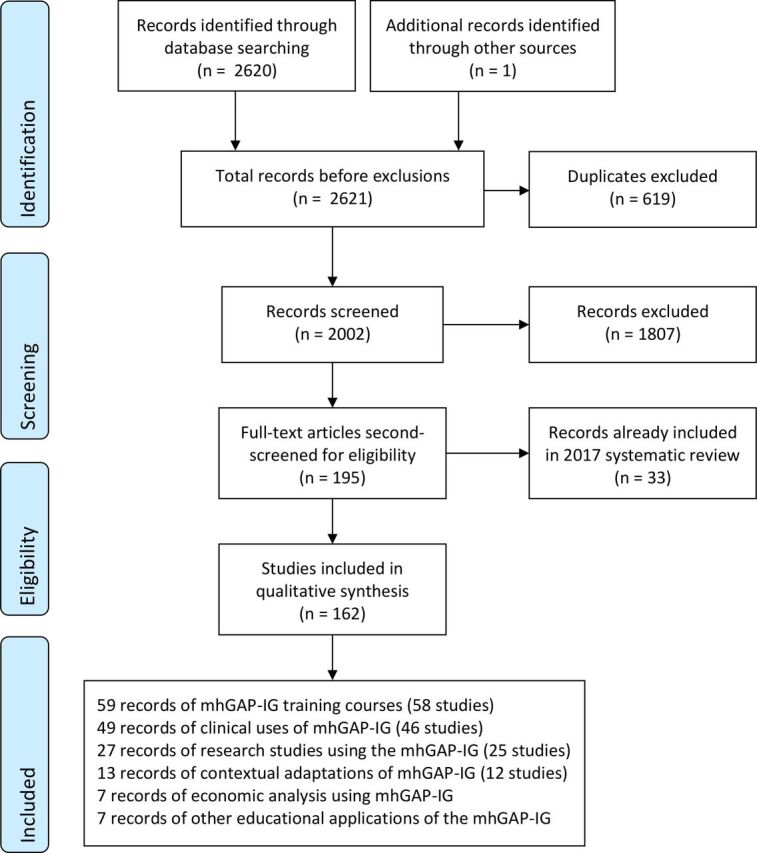
Of 2621 results, 162 new papers reported applications of the mhGAP-IG. They described mhGAP training courses (59 references), clinical applications (n=49), research uses (n=27), contextual adaptations (n=13), economic studies (n=7) and other educational applications (n=7). Most were conducted in the African region (40%) and South-East Asia (25%). Studies demonstrated improved knowledge, attitudes and confidence post-training and improved symptoms and engagement with care, post-implementation. Research studies compared mhGAP-IG-enhanced usual care with task-shared psychological interventions and adaptation studies optimised mhGAP-IG implementation for different contexts. Economic studies calculated human resource requirements of scaling up mhGAP-IG implementation and other educational studies explored its potential for repurposing.
The diverse, expanding global mhGAP-IG literature demonstrates substantial impact on training, patient care, research and practice. Priorities for future research should be less-studied regions, severe mental illness and contextual adaptation of brief psychological interventions.
在全球范围内,精神、神经和物质使用障碍的服务需求与供应之间存在巨大差距。世界卫生组织的精神卫生差距行动规划(mhGAP)干预指南(IG)为重点疾病的评估和综合管理提供了循证指导和工具。我们2017年的系统评价确定了33项经同行评审的研究,这些研究描述了mhGAP-IG在低收入和中等收入国家的实施情况。
我们于2020年11月24日检索了MEDLINE、Embase、PsycINFO、Web of Knowledge、Scopus、CINAHL、LILACS、ScieELO、Cochrane、PubMed数据库、3ie、谷歌学术以及我们综述的参考文献。我们寻找来自任何国家、任何语言的关于mhGAP-IG、应用程序或mhGAP人道主义IG的证据、经验和评价。我们从纳入的论文中提取数据,但异质性妨碍了荟萃分析。
在2621项结果中,162篇新论文报告了mhGAP-IG的应用情况。它们描述了mhGAP培训课程(59篇参考文献)、临床应用(n = 49)、研究用途(n = 27)、根据具体情况进行改编(n = 13)、经济学研究(n = 7)以及其他教育应用(n = 7)。大多数研究在非洲地区(40%)和东南亚(25%)进行。研究表明,培训后知识、态度和信心有所改善,实施后症状和接受治疗的情况有所改善。研究性研究将mhGAP-IG强化的常规治疗与任务分担的心理干预进行了比较,适应性研究针对不同情况优化了mhGAP-IG的实施。经济学研究计算了扩大mhGAP-IG实施规模所需的人力资源,其他教育研究探讨了其重新利用的潜力。
全球范围内关于mhGAP-IG的文献多样且不断扩展,表明其对培训、患者护理、研究和实践产生了重大影响。未来研究的重点应是研究较少的地区、严重精神疾病以及简短心理干预的情境适应性。