Kwon Miri, Kang Jiyeon
Samsung Changwon Hospital, South Korea.
Dong-A University, South Korea.
Health Psychol Open. 2018 Dec 12;5(2):2055102918817228. doi: 10.1177/2055102918817228. eCollection 2018 Jul-Dec.
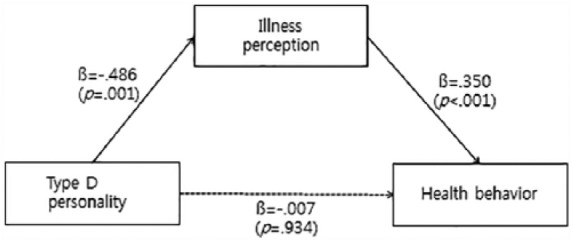
The aim of this study was to investigate the relationship between Type D personality and health behaviors of coronary artery disease patients and to determine the mediating effect of illness perception on this relationship. The participants were 142 coronary artery disease patients who underwent percutaneous coronary intervention in a university hospital in Korea. Type D personality, illness perception, and health behaviors were surveyed using structured questionnaires. The collected data were analyzed by a series of hierarchical multiple regressions. A total of 28.9 percent patients had Type D personality. Type D Patients were observed to have low illness perception and low health behaviors. There was a positive correlation between illness perception and health behaviors. The direct effect of Type D personality on health behaviors was significant ( = -.209, = .013). However, the indirect effect of Type D personality on health behaviors via illness perception became low and non-significant ( = .007, = .934). Based on the above results, it can be concluded that illness perception has a complete mediating effect on the relationship between Type D personality and health behaviors. The development of interventions that can improve illness perception is needed to improve health behaviors of Type D coronary artery disease patients.
本研究旨在探讨D型人格与冠心病患者健康行为之间的关系,并确定疾病认知在此关系中的中介作用。研究对象为142名在韩国一家大学医院接受经皮冠状动脉介入治疗的冠心病患者。使用结构化问卷对D型人格、疾病认知和健康行为进行调查。收集的数据通过一系列分层多元回归进行分析。共有28.9%的患者为D型人格。观察发现D型人格患者的疾病认知水平较低,健康行为也较差。疾病认知与健康行为之间存在正相关。D型人格对健康行为的直接效应显著(β = -0.209,p = 0.013)。然而,D型人格通过疾病认知对健康行为的间接效应变得较低且不显著(β = 0.007,p = 0.934)。基于上述结果,可以得出结论,疾病认知在D型人格与健康行为之间的关系中具有完全中介作用。需要开发能够改善疾病认知的干预措施,以改善D型冠心病患者的健康行为。