Department of Zoology and Developmental Biology, University of Osnabrück, Barbarastraße 11, 49076 Osnabrück, Germany.
Int J Mol Sci. 2018 Dec 20;20(1):2. doi: 10.3390/ijms20010002.
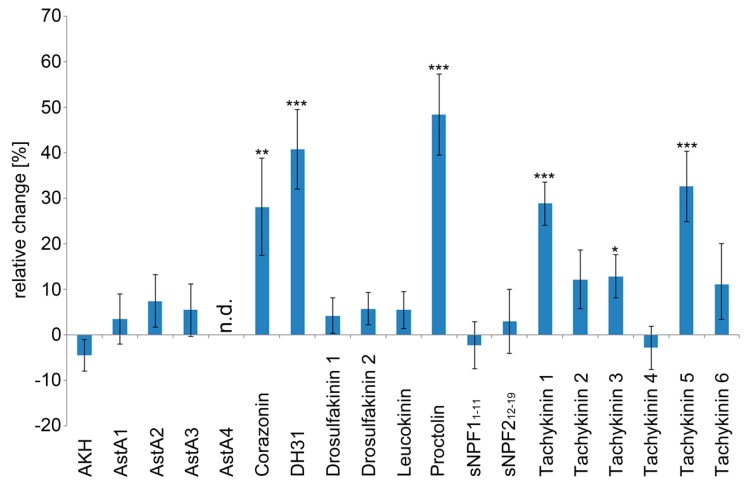
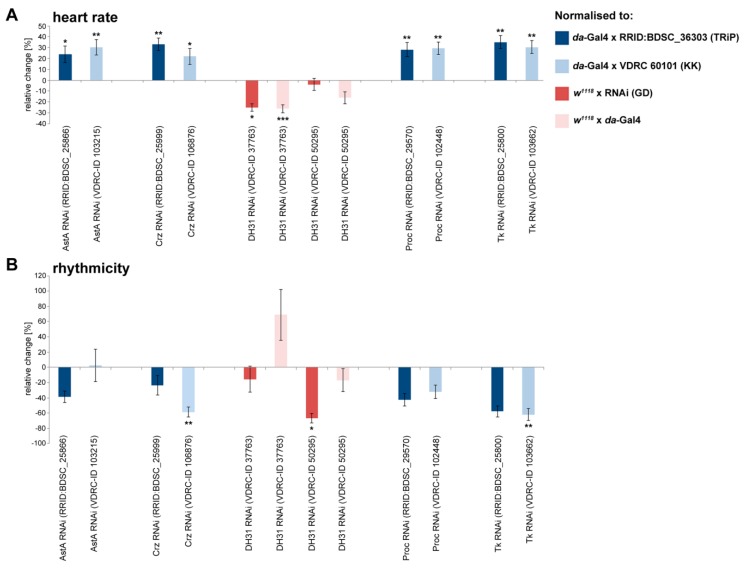
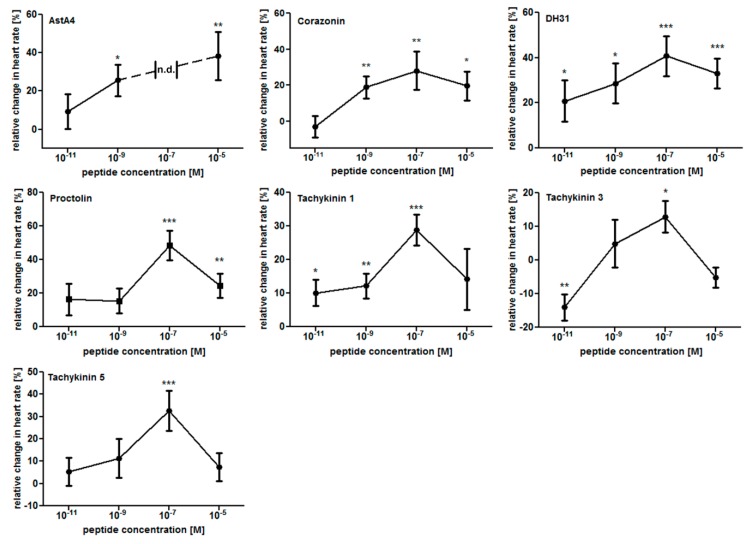
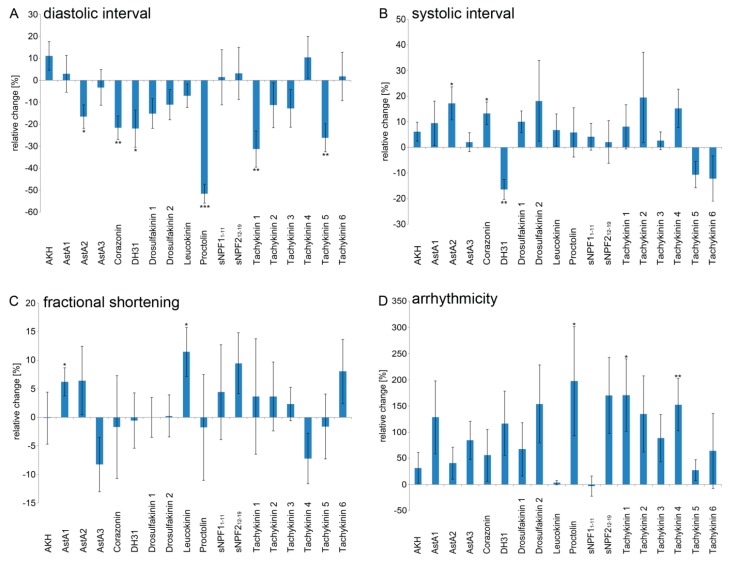
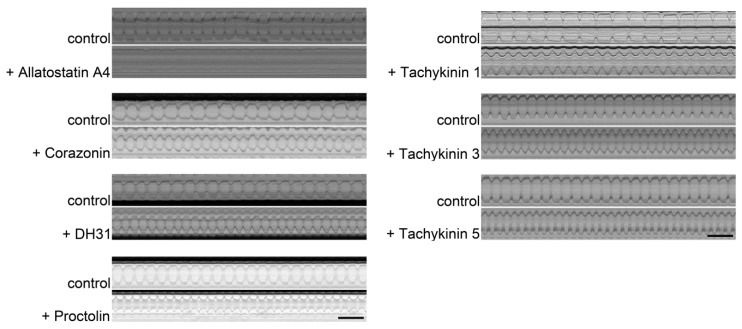
Neuropeptides and peptide hormones serve as critical regulators of numerous biological processes, including development, growth, reproduction, physiology, and behaviour. In mammals, peptidergic regulatory systems are complex and often involve multiple peptides that act at different levels and relay to different receptors. To improve the mechanistic understanding of such complex systems, invertebrate models in which evolutionarily conserved peptides and receptors regulate similar biological processes but in a less complex manner have emerged as highly valuable. represents a favoured model for the characterisation of novel peptidergic signalling events and for evaluating the relevance of those events . In the present study, we analysed a set of neuropeptides and peptide hormones for their ability to modulate cardiac function in semi-intact larval . We identified numerous peptides that significantly affected heart parameters such as heart rate, systolic and diastolic interval, rhythmicity, and contractility. Thus, peptidergic regulation of the heart is not restricted to chronotropic adaptation but also includes inotropic modulation. By specifically interfering with the expression of corresponding peptides in transgenic animals, we assessed the relevance of the respective peptidergic regulation. Based on the functional conservation of certain peptides throughout the animal kingdom, the identified cardiomodulatory activities may be relevant not only to proper heart function in , but also to corresponding processes in vertebrates, including humans.
神经肽和肽类激素是许多生物过程的关键调节剂,包括发育、生长、繁殖、生理和行为。在哺乳动物中,肽类调节系统非常复杂,通常涉及多种在不同水平起作用并传递给不同受体的肽。为了提高对这种复杂系统的机制理解,出现了具有进化保守肽和受体的无脊椎动物模型,这些模型以更简单的方式调节类似的生物过程,因此具有很高的价值。 是一个理想的模型,用于鉴定新型的肽信号事件,并评估这些事件的相关性。在本研究中,我们分析了一系列神经肽和肽类激素,以研究它们在半整体幼虫 中调节心脏功能的能力。我们发现了许多显著影响心率、收缩和舒张间隔、节律性和收缩性等心脏参数的肽。因此, 心脏的肽类调节不仅限于变时适应,还包括变力调节。通过在转基因动物中特异性干扰相应肽的表达,我们评估了各自的肽类调节的相关性。基于某些肽在整个动物界的功能保守性,鉴定出的心脏调节活性不仅与 心脏的正常功能有关,而且与脊椎动物(包括人类)的相应过程有关。