Appiah Kwame Sarpong, Oppong Clement Peprah, Mardani Hossein Korrani, Omari Richard Ansong, Kpabitey Sylvia, Amoatey Christiana Adukwei, Onwona-Agyeman Siaw, Oikawa Yosei, Katsura Keisuke, Fujii Yoshiharu
United Graduate School, Tokyo University of Agriculture and Technology, 3-5-8 Saiwaicho, Fuchu, Tokyo 183-8509, Japan.
Department of International and Environmental Agriculture Science, Tokyo University of Agriculture and Technology, 3-5-8 Saiwaicho, Fuchu, Tokyo 183-8509, Japan.
Medicines (Basel). 2018 Dec 20;6(1):1. doi: 10.3390/medicines6010001.
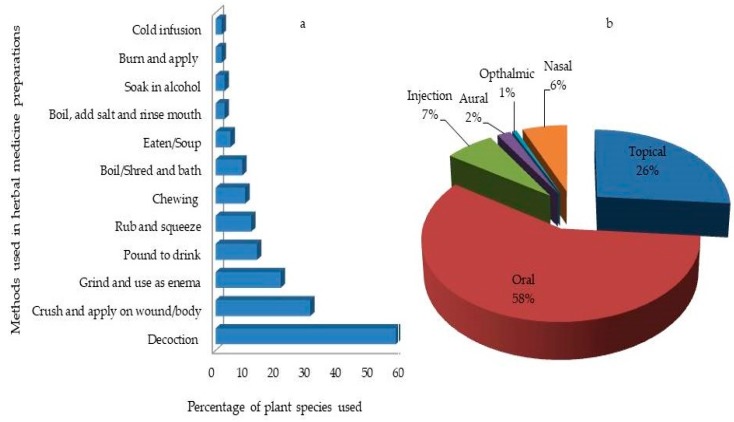
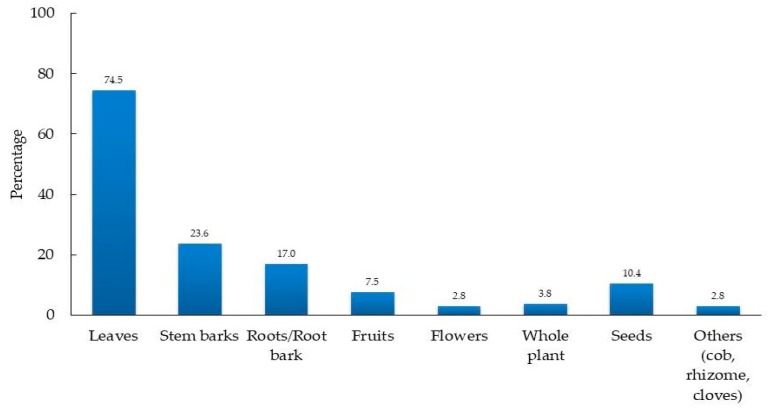
The in-depth traditional knowledge of medicinal plants is at risk of extinction due to the dependency on oral transmission, and as such, there is an urgent need to document such knowledge. This study aimed to document indigenous uses of medicinal plants among community members in the Ejisu-Juaben Municipality. Data was collected in 2016 from community members and local herbalists in the Ejisu-Juaben Municipality through a semi-structured questionnaire. Statistical tools and ethnobotanical indices, i.e., informant consensus factor (ICF), fidelity level (FL), and use value (UV) were used to analyse the data. One hundred and six medicinal plants belonging to 45 families were reported to cure 68 different human diseases. The most frequently used plant part in this study was the leaves (52%). Decoction (57.5%) and oral administration (58.3%) were the most utilised herbal preparation and administration route respectively. had the highest UV (0.54) with pain & fevers and skin diseases having the highest ICF values (0.88 and 0.85 respectively). Furthermore, new medicinal uses of and ten other species were recorded for the treatment of the traditional local disease, . : The current knowledge and uses of medicinal plants are still high in the study area based on the high degree of consensus among informants. This study could allow for the preservation of knowledge and biodiversity of medicinal plants, both of which are threatened with extinction.
由于依赖口头传承,药用植物的深入传统知识面临灭绝风险,因此迫切需要记录此类知识。本研究旨在记录埃吉苏-贾本市社区成员对药用植物的本土用途。2016年通过半结构化问卷从埃吉苏-贾本市的社区成员和当地草药师处收集数据。使用统计工具和民族植物学指标,即信息提供者共识因子(ICF)、保真度水平(FL)和使用价值(UV)来分析数据。据报告,45个科的106种药用植物可治疗68种不同的人类疾病。本研究中最常用的植物部位是叶子(52%)。煎煮剂(57.5%)和口服(58.3%)分别是最常用的草药制剂和给药途径。 的UV最高(0.54),疼痛和发烧以及皮肤病的ICF值最高(分别为0.88和0.85)。此外,还记录了 和其他十种植物用于治疗传统地方病 的新药用用途。:基于信息提供者之间的高度共识,研究区域内药用植物的现有知识和用途仍然很高。本研究有助于保护药用植物的知识和生物多样性,这两者都面临灭绝威胁。