College of Electronics and Information Engineering, Tongji University, Shanghai 200000, China.
Sensors (Basel). 2018 Dec 21;19(1):24. doi: 10.3390/s19010024.
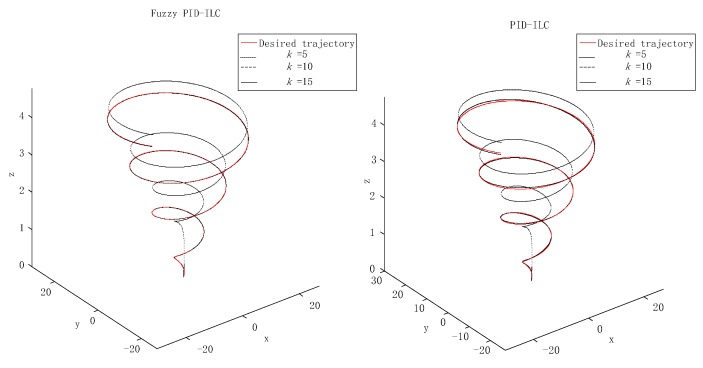
Due to the under-actuated and strong coupling characteristics of quadrotor aircraft, traditional trajectory tracking methods have low control precision, and poor anti-interference ability. A novel fuzzy proportional-interactive-derivative (PID)-type iterative learning control (ILC) was designed for a quadrotor unmanned aerial vehicle (UAV). The control method combined PID-ILC control and fuzzy control, so it inherited the robustness to disturbances and system model uncertainties of the ILC control. A new control law based on the PID-ILC algorithm was introduced to solve the problem of chattering caused by an external disturbance in the ILC control alone. Fuzzy control was used to set the PID parameters of three learning gain matrices to restrain the influence of uncertain factors on the system and improve the control precision. The system stability with the new design was verified using Lyapunov stability theory. The Gazebo simulation showed that the proposed design method creates effective ILC controllers for quadrotor aircraft.
由于四旋翼飞行器的欠驱动和强耦合特性,传统的轨迹跟踪方法控制精度低,抗干扰能力差。针对四旋翼无人机(UAV)设计了一种新颖的模糊比例-积分-微分(PID)型迭代学习控制(ILC)。该控制方法结合了 PID-ILC 控制和模糊控制,因此继承了 ILC 控制对干扰和系统模型不确定性的鲁棒性。引入了一种新的基于 PID-ILC 算法的控制律,以解决单独使用 ILC 控制时由于外部干扰引起的抖动问题。模糊控制用于设置三个学习增益矩阵的 PID 参数,以抑制不确定因素对系统的影响,提高控制精度。利用 Lyapunov 稳定性理论验证了系统的稳定性。Gazebo 仿真表明,所提出的设计方法为四旋翼飞行器创建了有效的 ILC 控制器。