Centre for Health Informatics, Australian Institute of Health Innovation, Macquarie University, Sydney, New South Wales, Australia.
Department of Sociology, Centre for Time Use Research, University of Oxford, Oxford, UK.
BMJ Open. 2018 Dec 22;8(12):e022163. doi: 10.1136/bmjopen-2018-022163.
Self-management is widely promoted but less attention is focused on the work required from patients. To date, many individuals struggle to practise self-management. 'Patient work', a concept that examines the 'work' involved in self-management, is an approach to understanding the tasks, effort, time and context from patient perspective. The purpose of our study is to use a novel approach combining non-obstructive observations via digital devices with in-depth qualitative data about health behaviours and motivations, to capture the full range of patient work experienced by people with type 2 diabetes and chronic comorbidities. It aims to yield comprehensive insights about 'what works' in self-management, potentially extending to populations with other chronic health conditions.
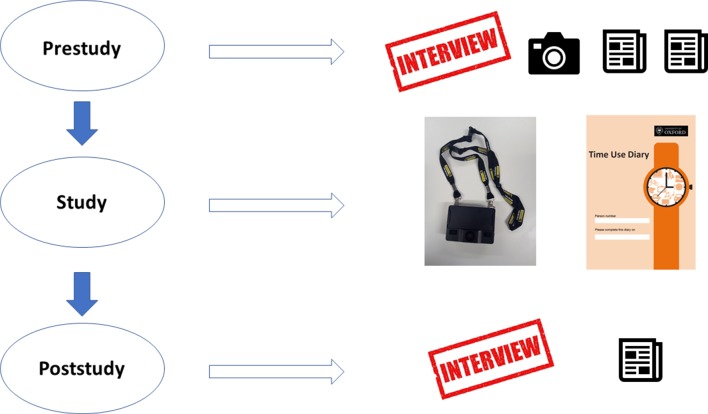
This mixed-methods observational study involves a (1) prestudy interview and questionnaires, (2) a 24-hour period during which participants wear a camera and complete a time-use diary, and a (3) poststudy interview and study feedback. Adult participants living with type 2 diabetes with at least one chronic comorbidity will be recruited using purposive sampling to obtain a balanced gender ratio and of participants using insulin and those using only oral medication. Interviews will be analysed using thematic analysis. Data captured by digital devices, diaries and questionnaires will be used to analyse the duration, time, context and patterns of health-related behaviours.
The study was approved by the Macquarie University Human Research Ethics Committee for Medical Sciences (reference number 5201700718). Participants will carry a wallet-sized card that explains the purpose of the study to third parties, and can remove the camera at any stage. Before the poststudy interview begins, participants will view the camera images in private and can delete any images. Should any images be used in future publications or presentations, identifying features such as human faces and names will be obscured.
自我管理已被广泛提倡,但人们对患者所需完成的工作关注较少。迄今为止,许多人在自我管理方面都遇到了困难。“患者工作”是一个从患者角度审视自我管理所涉及的“工作”的概念,是一种理解患者在任务、努力、时间和背景方面所面临的工作的方法。我们的研究目的是采用一种新方法,结合使用数字设备进行非干扰性观察以及有关健康行为和动机的深入定性数据,以捕捉 2 型糖尿病和合并慢性病患者所经历的全部患者工作。该方法旨在全面深入地了解自我管理的“有效措施”,并可能扩展到其他患有慢性健康状况的人群。
本混合方法观察性研究包括:(1)预研究访谈和问卷调查;(2)参与者佩戴摄像头并完成时间使用日记的 24 小时周期;以及(3)研究后访谈和研究反馈。将采用目的抽样法招募患有 2 型糖尿病且至少合并一种慢性病的成年参与者,以获得性别比例均衡的参与者,并招募使用胰岛素和仅使用口服药物的参与者。访谈将采用主题分析法进行分析。数字设备、日记和问卷中捕获的数据将用于分析与健康相关行为的持续时间、时间、背景和模式。
该研究已获得麦考瑞大学医学科学人类研究伦理委员会的批准(参考编号 5201700718)。参与者将携带一张名片大小的卡片,向第三方解释研究的目的,并可以在任何阶段取下摄像头。在进行研究后访谈之前,参与者将私下查看摄像头图像,并可以删除任何图像。如果将来的出版物或演示文稿中使用任何图像,将模糊人的面部和姓名等可识别特征。