• 文献检索
  • 文档翻译
  • 深度研究
  • 学术资讯
  • Suppr Zotero 插件Zotero 插件
  • 邀请有礼
  • 套餐&价格
  • 历史记录
应用&插件
Suppr Zotero 插件Zotero 插件浏览器插件Mac 客户端Windows 客户端微信小程序
定价
高级版会员购买积分包购买API积分包
服务
文献检索文档翻译深度研究API 文档MCP 服务
关于我们
关于 Suppr公司介绍联系我们用户协议隐私条款
关注我们

Suppr 超能文献

核心技术专利:CN118964589B侵权必究
粤ICP备2023148730 号-1Suppr @ 2026

文献检索

告别复杂PubMed语法,用中文像聊天一样搜索,搜遍4000万医学文献。AI智能推荐,让科研检索更轻松。

立即免费搜索

文件翻译

保留排版,准确专业,支持PDF/Word/PPT等文件格式,支持 12+语言互译。

免费翻译文档

深度研究

AI帮你快速写综述,25分钟生成高质量综述,智能提取关键信息,辅助科研写作。

立即免费体验

可穿戴相机作为增强慢性病自我管理工具的效用:范围综述。

Usefulness of Wearable Cameras as a Tool to Enhance Chronic Disease Self-Management: Scoping Review.

机构信息

Institute for Physical Activity and Nutrition, School of Exercise and Nutrition Sciences, Deakin University, Geelong, Australia.

Department of Epidemiology and Preventive Medicine, Monash University, Melbourne, Australia.

出版信息

JMIR Mhealth Uhealth. 2019 Jan 3;7(1):e10371. doi: 10.2196/10371.

DOI:10.2196/10371
PMID:30609985
原文链接:https://pmc.ncbi.nlm.nih.gov/articles/PMC6682294/
Abstract

BACKGROUND

Self-management is a critical component of chronic disease management and can include a host of activities, such as adhering to prescribed medications, undertaking daily care activities, managing dietary intake and body weight, and proactively contacting medical practitioners. The rise of technologies (mobile phones, wearable cameras) for health care use offers potential support for people to better manage their disease in collaboration with their treating health professionals. Wearable cameras can be used to provide rich contextual data and insight into everyday activities and aid in recall. This information can then be used to prompt memory recall or guide the development of interventions to support self-management. Application of wearable cameras to better understand and augment self-management by people with chronic disease has yet to be investigated.

OBJECTIVE

The objective of our review was to ascertain the scope of the literature on the use of wearable cameras for self-management by people with chronic disease and to determine the potential of wearable cameras to assist people to better manage their disease.

METHODS

We conducted a scoping review, which involved a comprehensive electronic literature search of 9 databases in July 2017. The search strategy focused on studies that used wearable cameras to capture one or more modifiable lifestyle risk factors associated with chronic disease or to capture typical self-management behaviors, or studies that involved a chronic disease population. We then categorized and described included studies according to their characteristics (eg, behaviors measured, study design or type, characteristics of the sample).

RESULTS

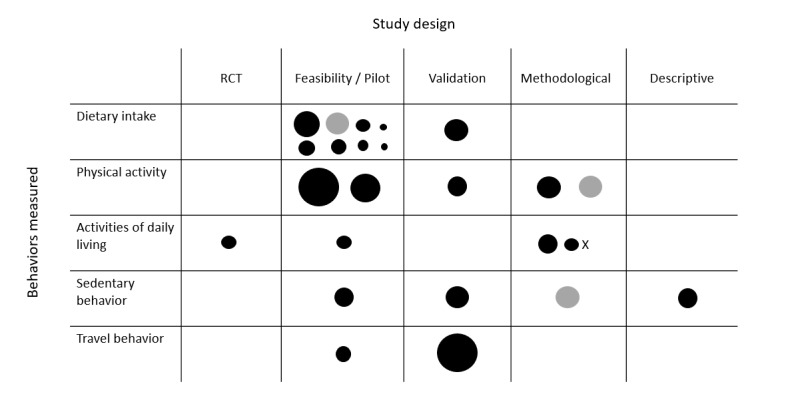
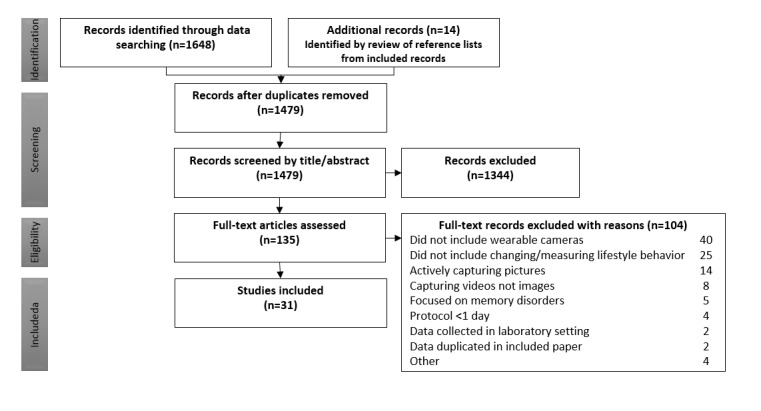
We identified 31 studies: 25 studies involved primary or secondary data analysis, and 6 were review, discussion, or descriptive articles. Wearable cameras were predominantly used to capture dietary intake, physical activity, activities of daily living, and sedentary behavior. Populations studied were predominantly healthy volunteers, school students, and sports people, with only 1 study examining an intervention using wearable cameras for people with an acquired brain injury. Most studies highlighted technical or ethical issues associated with using wearable cameras, many of which were overcome.

CONCLUSIONS

This scoping review highlighted the potential of wearable cameras to capture health-related behaviors and risk factors of chronic disease, such as diet, exercise, and sedentary behaviors. Data collected from wearable cameras can be used as an adjunct to traditional data collection methods such as self-reported diaries in addition to providing valuable contextual information. While most studies to date have focused on healthy populations, wearable cameras offer promise to better understand self-management of chronic disease and its context.

摘要

背景

自我管理是慢性病管理的重要组成部分,它可以包括一系列活动,如坚持服用规定的药物、进行日常护理活动、管理饮食摄入和体重、以及主动联系医疗从业者。医疗保健技术(手机、可穿戴摄像机)的兴起为人们在与治疗保健专业人员合作的情况下更好地管理疾病提供了潜在支持。可穿戴摄像机可用于提供有关日常活动的丰富背景数据和见解,并帮助回忆。然后可以使用这些信息来提示记忆回忆或指导开发干预措施以支持自我管理。应用可穿戴摄像机来更好地了解和增强慢性病患者的自我管理尚未得到研究。

目的

我们的综述目的是确定可穿戴摄像机在慢性病患者自我管理中的使用文献范围,并确定可穿戴摄像机协助人们更好地管理疾病的潜力。

方法

我们进行了范围界定综述,于 2017 年 7 月对 9 个数据库进行了全面的电子文献搜索。该搜索策略侧重于使用可穿戴摄像机捕获与慢性病相关的一个或多个可改变的生活方式风险因素或捕获典型的自我管理行为的研究,或涉及慢性病人群的研究。然后,我们根据研究的特点(例如,测量的行为、研究设计或类型、样本特征)对纳入的研究进行分类和描述。

结果

我们确定了 31 项研究:25 项研究涉及原始或二次数据分析,6 项为评论、讨论或描述性文章。可穿戴摄像机主要用于捕获饮食摄入、身体活动、日常生活活动和久坐行为。研究的人群主要是健康志愿者、学生和运动员,只有 1 项研究使用可穿戴摄像机检查了对脑损伤患者的干预措施。大多数研究都强调了使用可穿戴摄像机相关的技术或道德问题,其中许多问题已经得到解决。

结论

本范围界定综述强调了可穿戴摄像机捕捉慢性病相关行为和风险因素的潜力,如饮食、运动和久坐行为。从可穿戴摄像机收集的数据可以作为传统数据收集方法(如自我报告日记)的补充,除了提供有价值的背景信息外,还可以提供有价值的背景信息。虽然迄今为止的大多数研究都集中在健康人群上,但可穿戴摄像机为更好地了解慢性病的自我管理及其背景提供了希望。
https://cdn.ncbi.nlm.nih.gov/pmc/blobs/1292/6682294/f007af3d2505/mhealth_v7i1e10371_fig3.jpg
https://cdn.ncbi.nlm.nih.gov/pmc/blobs/1292/6682294/bac5bb94cc8e/mhealth_v7i1e10371_fig1.jpg
https://cdn.ncbi.nlm.nih.gov/pmc/blobs/1292/6682294/32103764899c/mhealth_v7i1e10371_fig2.jpg
https://cdn.ncbi.nlm.nih.gov/pmc/blobs/1292/6682294/f007af3d2505/mhealth_v7i1e10371_fig3.jpg
https://cdn.ncbi.nlm.nih.gov/pmc/blobs/1292/6682294/bac5bb94cc8e/mhealth_v7i1e10371_fig1.jpg
https://cdn.ncbi.nlm.nih.gov/pmc/blobs/1292/6682294/32103764899c/mhealth_v7i1e10371_fig2.jpg
https://cdn.ncbi.nlm.nih.gov/pmc/blobs/1292/6682294/f007af3d2505/mhealth_v7i1e10371_fig3.jpg

相似文献

1
Usefulness of Wearable Cameras as a Tool to Enhance Chronic Disease Self-Management: Scoping Review.可穿戴相机作为增强慢性病自我管理工具的效用:范围综述。
JMIR Mhealth Uhealth. 2019 Jan 3;7(1):e10371. doi: 10.2196/10371.
2
Folic acid supplementation and malaria susceptibility and severity among people taking antifolate antimalarial drugs in endemic areas.在流行地区,服用抗叶酸抗疟药物的人群中,叶酸补充剂与疟疾易感性和严重程度的关系。
Cochrane Database Syst Rev. 2022 Feb 1;2(2022):CD014217. doi: 10.1002/14651858.CD014217.
3
Mobile Health App With Social Media to Support Self-Management for Patients With Chronic Kidney Disease: Prospective Randomized Controlled Study.带社交媒体的移动健康应用程序支持慢性肾脏病患者的自我管理:前瞻性随机对照研究。
J Med Internet Res. 2020 Dec 15;22(12):e19452. doi: 10.2196/19452.
4
Feasibility and Acceptability of Wearable Cameras to Assess Self-care in People With Heart Failure: Pilot Study.可穿戴相机用于评估心力衰竭患者自我护理的可行性和可接受性:一项试点研究
JMIR Form Res. 2023 Feb 17;7:e40536. doi: 10.2196/40536.
5
Promoting and supporting self-management for adults living in the community with physical chronic illness: A systematic review of the effectiveness and meaningfulness of the patient-practitioner encounter.促进和支持社区中患有慢性身体疾病的成年人进行自我管理:对医患互动的有效性和意义的系统评价。
JBI Libr Syst Rev. 2009;7(13):492-582. doi: 10.11124/01938924-200907130-00001.
6
Identifying Objective Physiological Markers and Modifiable Behaviors for Self-Reported Stress and Mental Health Status Using Wearable Sensors and Mobile Phones: Observational Study.使用可穿戴传感器和手机识别自我报告的压力和心理健康状况的客观生理标志物及可改变行为:观察性研究
J Med Internet Res. 2018 Jun 8;20(6):e210. doi: 10.2196/jmir.9410.
7
Wearable Devices for Supporting Chronic Disease Self-Management: Scoping Review.支持慢性病自我管理的可穿戴设备:范围综述
Interact J Med Res. 2024 Dec 9;13:e55925. doi: 10.2196/55925.
8
Daily Activity Lifelogs of People With Heart Failure: Observational Study.心力衰竭患者的日常活动生活日志:观察性研究。
JMIR Form Res. 2024 Feb 21;8:e51248. doi: 10.2196/51248.
9
Using Video Technology and AI within Parkinson's Disease Free-Living Fall Risk Assessment.利用视频技术和人工智能进行帕金森病非卧床跌倒风险评估。
Sensors (Basel). 2024 Jul 29;24(15):4914. doi: 10.3390/s24154914.
10
Behavioural interventions for type 2 diabetes: an evidence-based analysis.2型糖尿病的行为干预:一项基于证据的分析。
Ont Health Technol Assess Ser. 2009;9(21):1-45. Epub 2009 Oct 1.

引用本文的文献

1
The Mediating Role of General Self-Efficacy in Health Self-Management and Psychological Stress Among Older Adults in Shanghai: A Structural Equation Modeling Analysis.一般自我效能感在上海老年人健康自我管理与心理压力中的中介作用:一项结构方程模型分析
Healthcare (Basel). 2024 Dec 30;13(1):46. doi: 10.3390/healthcare13010046.
2
Utilization of telemedicine in conjunction with wearable devices for patients with chronic musculoskeletal pain: a randomized controlled clinical trial.远程医疗结合可穿戴设备用于慢性肌肉骨骼疼痛患者:一项随机对照临床试验。
Sci Rep. 2025 Jan 9;15(1):1396. doi: 10.1038/s41598-024-85056-x.
3
Exploring the Applications of Explainability in Wearable Data Analytics: Systematic Literature Review.

本文引用的文献

1
Efficacy of self-monitored blood pressure, with or without telemonitoring, for titration of antihypertensive medication (TASMINH4): an unmasked randomised controlled trial.自我监测血压(无论是否结合远程监测)在调整降压药物剂量方面的疗效(TASMINH4):一项非盲随机对照试验。
Lancet. 2018 Mar 10;391(10124):949-959. doi: 10.1016/S0140-6736(18)30309-X. Epub 2018 Feb 27.
2
An Automatic Car Counting System Using OverFeat Framework.一种基于OverFeat框架的自动车辆计数系统。
Sensors (Basel). 2017 Jun 30;17(7):1535. doi: 10.3390/s17071535.
3
Kids'Cam: An Objective Methodology to Study the World in Which Children Live.
探索可解释性在可穿戴数据分析中的应用:系统文献综述
J Med Internet Res. 2024 Dec 24;26:e53863. doi: 10.2196/53863.
4
Identifying stakeholder priorities in use of wearable cameras for researching parent-child interactions.确定在使用可穿戴摄像头研究亲子互动时利益相关者的优先事项。
Front Child Adolesc Psychiatry. 2023 Jun 23;2. doi: 10.3389/frcha.2023.1111299.
5
Contextualizing remote fall risk: Video data capture and implementing ethical AI.情境化远程跌倒风险:视频数据采集与实施符合伦理的人工智能
NPJ Digit Med. 2024 Mar 6;7(1):61. doi: 10.1038/s41746-024-01050-7.
6
Daily Activity Lifelogs of People With Heart Failure: Observational Study.心力衰竭患者的日常活动生活日志:观察性研究。
JMIR Form Res. 2024 Feb 21;8:e51248. doi: 10.2196/51248.
7
Study on self-management of real-time and individualized support in stroke patients based on resilience: a protocol for a randomized controlled trial.基于韧性的脑卒中患者实时个体化支持自我管理研究:一项随机对照试验方案。
Trials. 2023 Aug 3;24(1):493. doi: 10.1186/s13063-023-07475-x.
8
Feasibility and Acceptability of Wearable Cameras to Assess Self-care in People With Heart Failure: Pilot Study.可穿戴相机用于评估心力衰竭患者自我护理的可行性和可接受性:一项试点研究
JMIR Form Res. 2023 Feb 17;7:e40536. doi: 10.2196/40536.
9
Factors Affecting the Usage of Wearable Device Technology for Healthcare among Indian Adults: A Cross-Sectional Study.影响印度成年人在医疗保健中使用可穿戴设备技术的因素:一项横断面研究。
J Clin Med. 2022 Nov 28;11(23):7019. doi: 10.3390/jcm11237019.
10
Sensor, Wearable, and Remote Patient Monitoring Competencies for Clinical Care and Training: Scoping Review.用于临床护理和培训的传感器、可穿戴设备及远程患者监测能力:范围综述
J Technol Behav Sci. 2021;6(2):252-277. doi: 10.1007/s41347-020-00190-3. Epub 2021 Jan 22.
儿童观察法:一种研究儿童生活世界的客观方法。
Am J Prev Med. 2017 Sep;53(3):e89-e95. doi: 10.1016/j.amepre.2017.02.016. Epub 2017 Apr 25.
4
Classifiers for Accelerometer-Measured Behaviors in Older Women.老年女性中通过加速度计测量行为的分类器
Med Sci Sports Exerc. 2017 Mar;49(3):610-616. doi: 10.1249/MSS.0000000000001121.
5
New mobile methods for dietary assessment: review of image-assisted and image-based dietary assessment methods.新的饮食评估移动方法:图像辅助和基于图像的饮食评估方法综述。
Proc Nutr Soc. 2017 Aug;76(3):283-294. doi: 10.1017/S0029665116002913. Epub 2016 Dec 12.
6
Engaging research participants to inform the ethical conduct of mobile imaging, pervasive sensing, and location tracking research.吸引研究参与者以指导移动成像、普适传感和位置跟踪研究的伦理行为。
Transl Behav Med. 2016 Dec;6(4):577-586. doi: 10.1007/s13142-016-0426-4.
7
Novel technology to help understand the context of physical activity and sedentary behaviour.有助于理解身体活动和久坐行为背景的新技术。
Physiol Meas. 2016 Oct;37(10):1834-1851. doi: 10.1088/0967-3334/37/10/1834. Epub 2016 Sep 21.
8
Advancing scoping study methodology: a web-based survey and consultation of perceptions on terminology, definition and methodological steps.推进范围界定研究方法:基于网络的关于术语、定义和方法步骤认知的调查与咨询
BMC Health Serv Res. 2016 Jul 26;16:305. doi: 10.1186/s12913-016-1579-z.
9
A pilot investigation of the potential for incorporating lifelog technology into executive function rehabilitation for enhanced transfer of self-regulation skills to everyday life.一项关于将生活记录技术纳入执行功能康复以增强自我调节技能向日常生活转移潜力的初步调查。
Neuropsychol Rehabil. 2018 Jun;28(4):589-601. doi: 10.1080/09602011.2016.1187630. Epub 2016 Jun 2.
10
Exploring the context of sedentary behaviour in older adults (what, where, why, when and with whom).探索老年人久坐行为的背景(是什么、在哪里、为什么、何时以及与谁一起)。
Eur Rev Aging Phys Act. 2015 Oct 7;12:4. doi: 10.1186/s11556-015-0146-7. eCollection 2015.