Tomescu Dana, Popescu Mihai, Vitin Alexander
"Carol Davila" University of Medicine and Pharmacy, Department of Anaesthesia and Critical Care Medicine, Bucharest, Romania.
Fundeni Clinical Institute, Anaesthesia and Critical Care Department III, Bucharest, Romania.
J Crit Care Med (Targu Mures). 2018 Jul 1;4(3):90-95. doi: 10.2478/jccm-2018-0012. eCollection 2018 Jul.
Cirrhotic patients have been considered for decades to have a pro-haemorrhagic pattern and were treated as such based on the results from standard coagulation tests. The aim of our study was to determine the effects of platelet count and fibrinogen levels on rotational thromboelastometry (ROTEM) parameters.
We prospectively included 176 patients with End-Stage Liver Disease (ESLD) admitted to our Intensive Care Unit prior to liver transplantation. Collected data consisted of severity scores, liver, renal and standard coagulation tests, fibrinogen levels, platelet counts and ROTEM parameters. Four ROTEM assays were performed (ExTEM, InTEM, ApTEM and FibTEM) and the following parameters included: CT - clotting time, CFT - clot formation time, MCF - maximum clot firmness, ML - maximum lysis, alpha angle, TPI - thrombin potential index, MaxV - maximum velocity of clot formation (MaxV), MaxVt - time to MaxV, MCE - maximum clot elasticity and AUC - area under the curve.
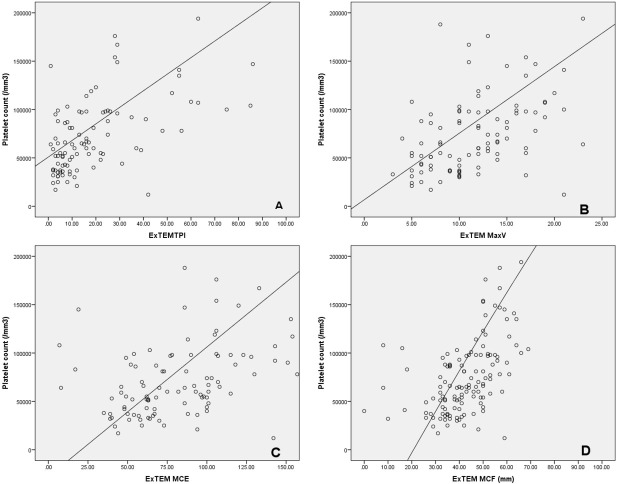
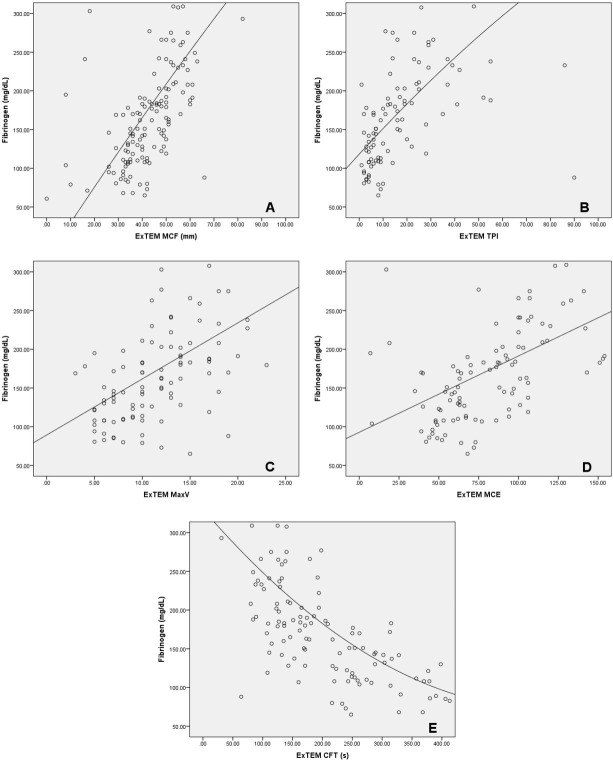
Statistical analysis demonstrated a linear correlation between platelet counts and ExTEM TPI (R2 linear =0.494), ExTEM MaxV (R2 linear =0.253), ExTEM MCE (R2 linear = 0.351) and ExTEM MCF (R2 cubic = 0.498). Fibrinogen levels correlated linearly with ExTEM MCF (R2 linear = 0.426), ExTEM TPI (R2 linear = 0.544), ExTEM MaxV (R2 linear = 0.332), ExTEM MCE (R2 linear = 0.395) and non-linearly with ExTEM CFT (R2 cubic = 0.475).
Fibrinogen levels and platelet counts had an important effect on both standard and derived ROTEM parameters. Further analysis is required in order to determine clinically oriented cut-off values below which severe coagulopathy would develop.
几十年来,肝硬化患者一直被认为具有促出血倾向,并根据标准凝血试验的结果进行相应治疗。我们研究的目的是确定血小板计数和纤维蛋白原水平对旋转血栓弹力图(ROTEM)参数的影响。
我们前瞻性纳入了176例在肝移植前入住我们重症监护病房的终末期肝病(ESLD)患者。收集的数据包括严重程度评分、肝脏、肾脏和标准凝血试验、纤维蛋白原水平、血小板计数和ROTEM参数。进行了四项ROTEM检测(ExTEM、InTEM、ApTEM和FibTEM),包括以下参数:CT - 凝血时间、CFT - 凝块形成时间、MCF - 最大凝块硬度、ML - 最大溶解、α角、TPI - 凝血酶潜能指数、MaxV - 凝块形成最大速度(MaxV)、MaxVt - 达到MaxV的时间、MCE - 最大凝块弹性和AUC - 曲线下面积。
统计分析表明,血小板计数与ExTEM TPI(线性R2 = 0.494)、ExTEM MaxV(线性R2 = 0.253)、ExTEM MCE(线性R2 = 0.351)和ExTEM MCF(三次方R2 = 0.498)之间存在线性相关性。纤维蛋白原水平与ExTEM MCF(线性R2 = 0.426)、ExTEM TPI(线性R2 = 0.544)、ExTEM MaxV(线性R2 = 0.332)、ExTEM MCE(线性R2 = 0.395)呈线性相关,与ExTEM CFT呈非线性相关(三次方R2 = 0.475)。
纤维蛋白原水平和血小板计数对标准和衍生的ROTEM参数均有重要影响。需要进一步分析以确定临床上严重凝血病发生时的临界值。