Leelarungrayub Jirakrit, Puntumetakul Rungthip, Sriboonreung Thanyaluck, Pothasak Yothin, Klaphajone Jakkrit
Department of Physical Therapy, Faculty of Associated Medical Sciences, Chiang Mai University, Chiang Mai, Thailand,
Research Center in Back, Neck, Other Joint Pain and Human Performance (BNOJPH), Khon Kaen University, Khon Kaen, Thailand.
Int J Chron Obstruct Pulmon Dis. 2018 Dec 5;13:3909-3921. doi: 10.2147/COPD.S181428. eCollection 2018.
Lung volume therapy with the Voldyne device can improve lung volume and has a nonsignificant benefit on respiratory muscle strength via the slow deep-breathing technique (SDBT); whereas respiratory muscle training with a respiratory muscle trainer via the fast deep-breathing technique (FDBT) has produced a significant improvement in people with COPD. Thus, the aim of this study was to compare the efficiency of lung volume therapy with the Voldyne device with the SDBT and FDBT on pulmonary function, respiratory muscle strength, oxidative stress, cytokines, walking capacity, and quality of life (QoL) in people with COPD.
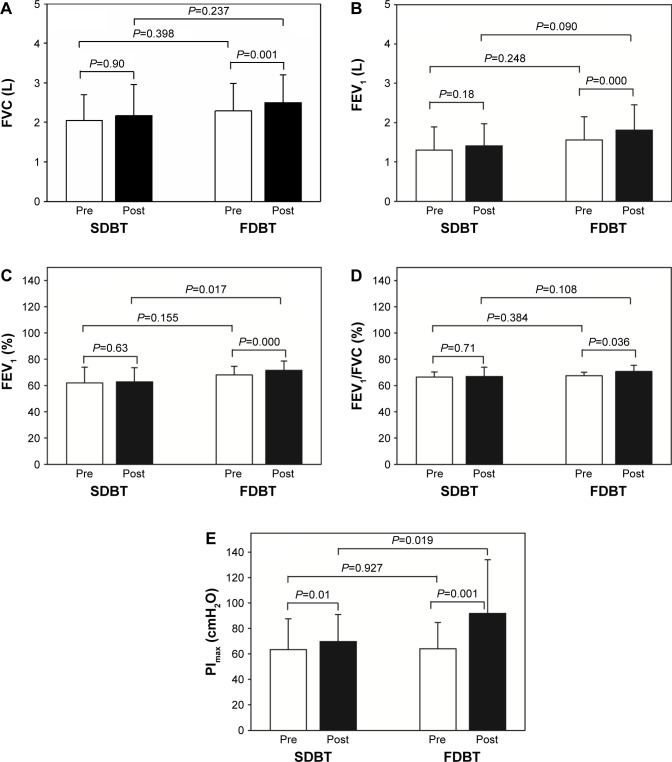
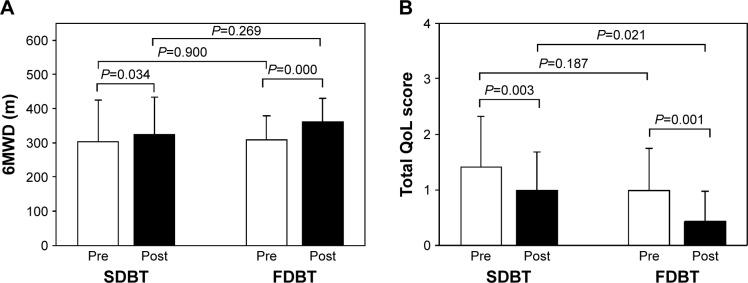
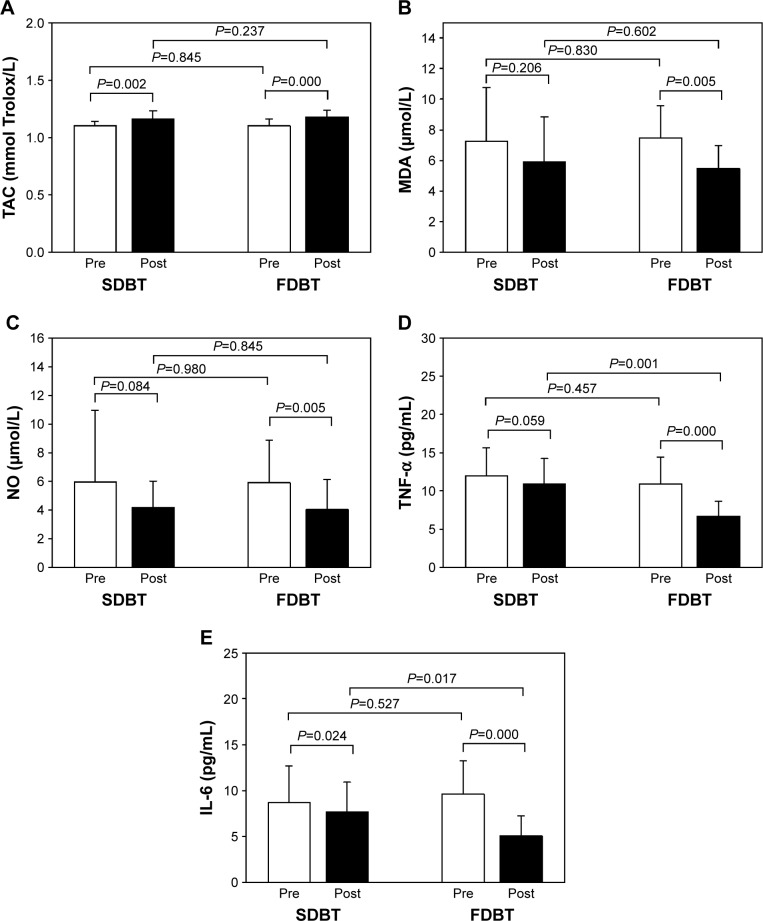
A total of 30 COPD patient volunteers with mild (stage I) to moderate (stage II) severity were randomized into two groups: SDBT (n=15) and FDBT (n=15). Pulmonary function (FVC, FEV, and FEV/FVC), maximal inspiratory mouth pressure (PI), oxidative stress status (total antioxidant capacity [TAC], glutathione [GSH], malondialdehyde [MDA], and nitric oxide [NO]), inflammatory cytokines (tumor necrosis factor-alpha [TNF-α] and IL-6), 6-minute walking distance (6MWD), and total clinical COPD questionnaire (CCQ) score were evaluated before and after 4 weeks of training.
All the parameters had no statistical difference between the groups before training. The PI, TAC, IL-6, total QoL score, and 6MWD changed significantly in the SDBT group after the 4-week experiment as compared to those in the pre-experimental period, whereas FVC, FEV, FEV%, FEV/FVC%, PI, TAC, MDA, NO, TNF-α, IL-6, 6MWD, and total CCQ score changed significantly in the FDBT group as compared to those in the pre-experimental period. The FEV%, PI, TNF-α, IL-6, and total CCQ score differed significantly in the FDBT group in the post-experimental period as compared to those in the SDBT group.
This preliminary study concluded that the application of incentive spirometry with the Voldyne device via fast deep breathing possibly improved respiratory muscle strength and QoL and reduced inflammatory cytokines, MDA, and NO better than that via slow deep breathing among people with COPD.
使用Voldyne装置进行肺容积治疗可增加肺容积,并通过慢深呼吸技术(SDBT)对呼吸肌力量产生不显著的益处;而使用呼吸肌训练器通过快深呼吸技术(FDBT)进行呼吸肌训练已使慢性阻塞性肺疾病(COPD)患者的呼吸肌力量得到显著改善。因此,本研究的目的是比较使用Voldyne装置通过SDBT和FDBT进行肺容积治疗对COPD患者肺功能、呼吸肌力量、氧化应激、细胞因子、步行能力和生活质量(QoL)的效果。
总共30名轻度(I期)至中度(II期)严重程度的COPD患者志愿者被随机分为两组:SDBT组(n = 15)和FDBT组(n = 15)。在训练4周前后评估肺功能(用力肺活量[FVC]、第一秒用力呼气容积[FEV]和FEV/FVC)、最大吸气口腔压力(PI)、氧化应激状态(总抗氧化能力[TAC]、谷胱甘肽[GSH]、丙二醛[MDA]和一氧化氮[NO])、炎性细胞因子(肿瘤坏死因子-α[TNF-α]和白细胞介素-6[IL-6])、6分钟步行距离(6MWD)以及慢性阻塞性肺疾病临床问卷(CCQ)总分。
训练前两组之间所有参数均无统计学差异。与实验前相比,SDBT组在4周实验后PI、TAC、IL-6、总生活质量评分和6MWD有显著变化;而与实验前相比,FDBT组FVC、FEV、FEV%、FEV/FVC%、PI、TAC、MDA、NO、TNF-α、IL-6、6MWD和CCQ总分有显著变化。与SDBT组相比,FDBT组在实验后FEV%、PI、TNF-α、IL-6和CCQ总分有显著差异。
这项初步研究得出结论,对于COPD患者,使用Voldyne装置通过快深呼吸进行激励肺活量测定可能比通过慢深呼吸更好地改善呼吸肌力量和生活质量,并降低炎性细胞因子、MDA和NO。