Huang Yichen, Shi Xing, Li Zhiyong, Shen Yang, Shi Xinxin, Wang Liying, Li Gaofei, Yuan Ye, Wang Jixiang, Zhang Yongchao, Zhao Lei, Zhang Meng, Kang Yu, Liang Ying
National Clinical Research Center for Mental Disorders, Peking University Sixth Hospital, Institute of Mental Health, Key Laboratory of Mental Health, Ministry of Health, Peking University, Beijing, China,
CAS Key Laboratory of Genome Sciences and Information, Beijing Institute of Genomics, Chinese Academy of Sciences, Beijing, China,
Neuropsychiatr Dis Treat. 2018 Dec 3;14:3329-3337. doi: 10.2147/NDT.S188340. eCollection 2018.
Gut microbiota can affect human behavior and mood in many ways. Several studies have shown that patients with depression were also accompanied with gut microbiota disorder, in which Firmicutes are related to the protective function of intestinal barrier. In this study, we explore the changes and effects of Firmicutes in the patients with major depressive disorder (MDD).
We recruited 54 subjects, including 27 patients with MDD. Fecal samples were collected for identification by 16S rRNA sequencing and bioinformatics analysis.
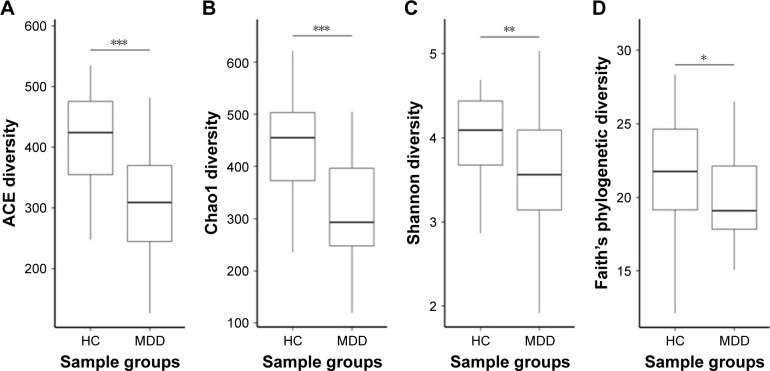
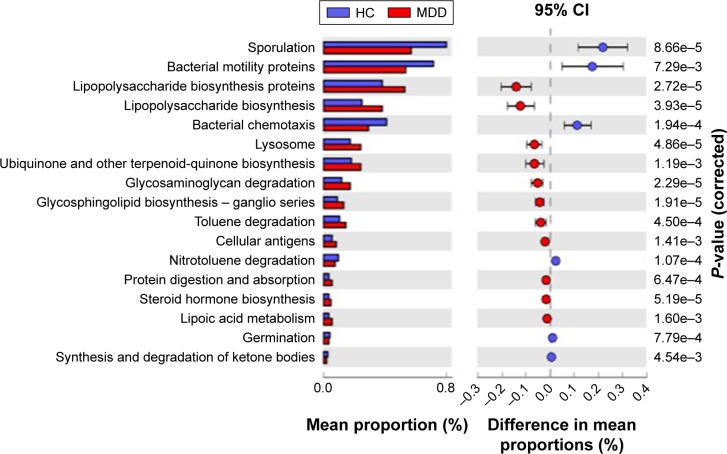
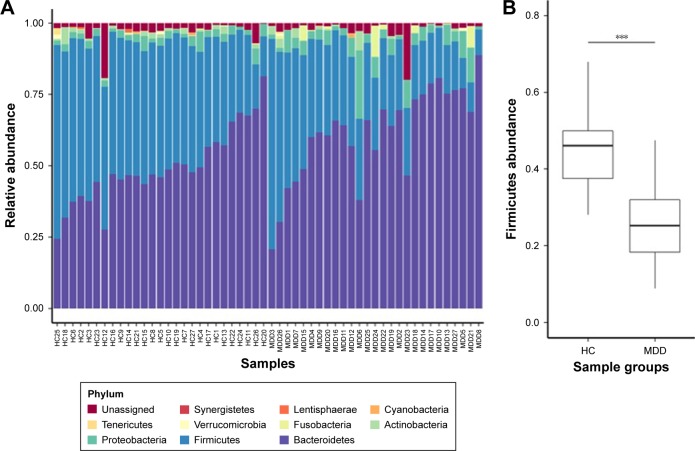
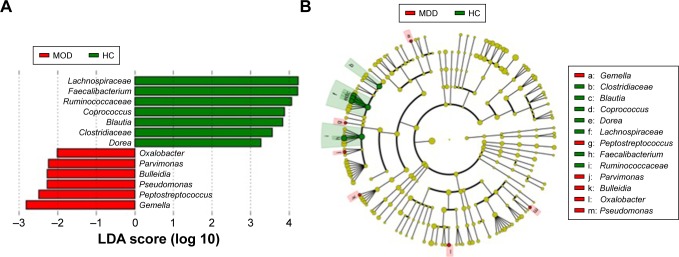
The study shows that the alpha diversity indices of MDD patients are lower than those of the healthy controls. Firmicutes is the most significantly decreased phylum in the MDD samples. There are totally 13 taxonomic biomarkers with -value <0.01 from Firmicutes. There are differences in 17 KEGG pathways between the two groups.
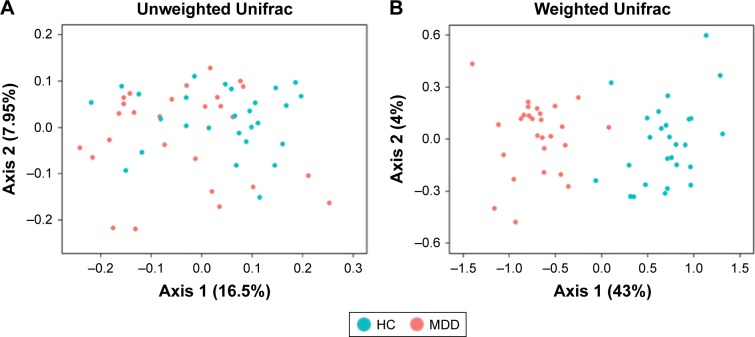
This study found that there is a significant disorder of gut microbiota in the patients with depression, in which the Firmicutes decreased significantly. Defects of the Firmicutes may lead to the depression in short-chain fatty acids, which could account for the physiological basis of low-level inflammation of depression.
This is a cross-sectional study and the sample size is comparatively small. Though several diet-related factors were controlled in the study, there is no quantified assessment of it.
肠道微生物群可通过多种方式影响人类行为和情绪。多项研究表明,抑郁症患者也伴有肠道微生物群紊乱,其中厚壁菌门与肠道屏障的保护功能有关。在本研究中,我们探讨了重度抑郁症(MDD)患者中厚壁菌门的变化及其影响。
我们招募了54名受试者,其中包括27名MDD患者。收集粪便样本,通过16S rRNA测序和生物信息学分析进行鉴定。
研究表明,MDD患者的α多样性指数低于健康对照组。厚壁菌门是MDD样本中下降最显著的菌门。厚壁菌门共有13个分类生物标志物,其P值<0.01。两组之间有17条KEGG通路存在差异。
本研究发现抑郁症患者存在明显的肠道微生物群紊乱,其中厚壁菌门显著减少。厚壁菌门的缺陷可能导致短链脂肪酸减少,这可能是抑郁症低水平炎症的生理基础。
这是一项横断面研究,样本量相对较小。尽管研究中控制了几个与饮食相关的因素,但未对其进行量化评估。