Institute of Computer Science, Masaryk University, Brno, Czech Republic.
Faculty of Informatics, Masaryk University, Brno, Czech Republic.
PLoS One. 2018 Dec 26;13(12):e0208744. doi: 10.1371/journal.pone.0208744. eCollection 2018.
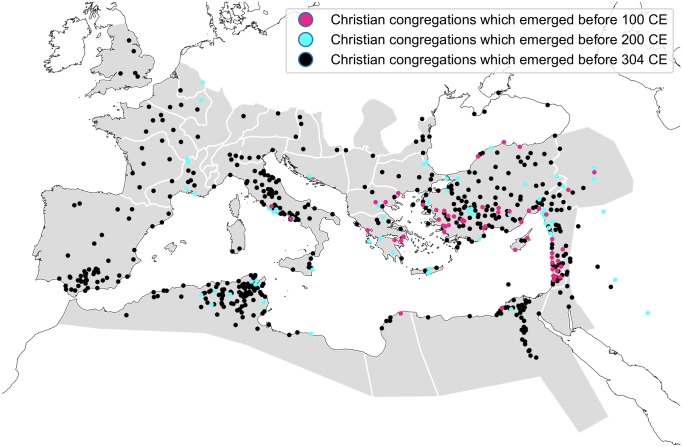
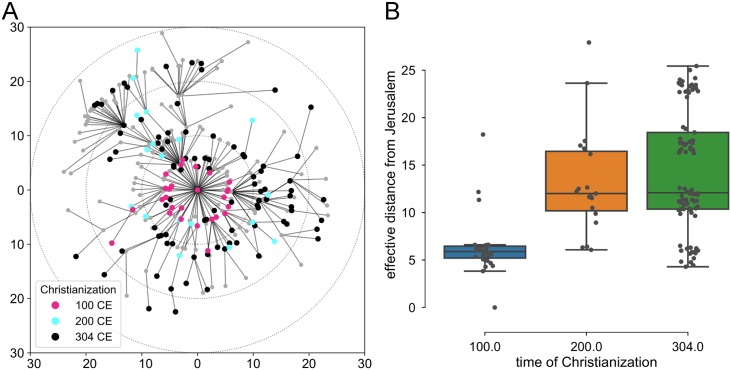
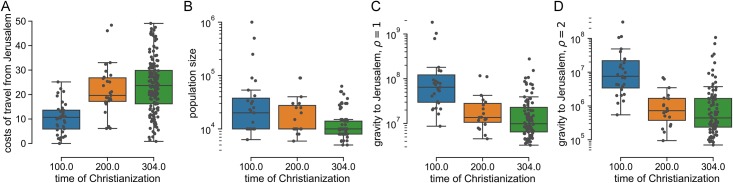
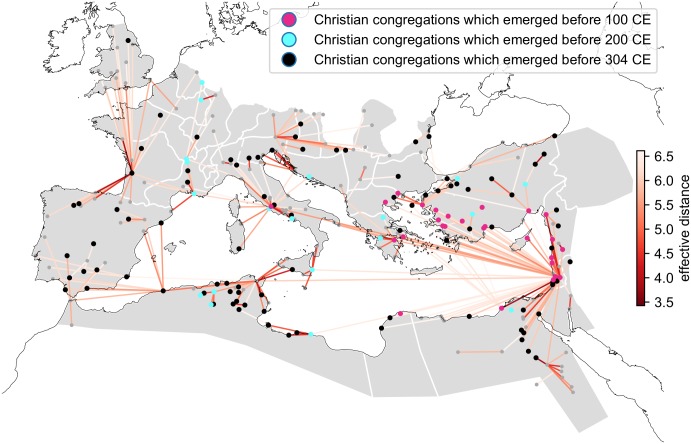
Christianity emerged as a small and marginal movement in the first century Palestine and throughout the following three centuries it became highly visible in the whole Mediterranean. Little is known about the mechanisms of spreading innovative ideas in past societies. Here we investigate how well the spread of Christianity can be explained as a diffusive process constrained by physical travel in the Roman Empire. First, we combine a previously established model of the transportation network with city population estimates and evaluate to which extent the spatio-temporal pattern of the spread of Christianity can be explained by static factors. Second, we apply a network-theoretical approach to analyze the spreading process utilizing effective distance. We show that the spread of Christianity in the first two centuries closely follows a gravity-guided diffusion, and is substantially accelerated in the third century. Using the effective distance measure, we are able to suggest the probable path of the spread. Our work demonstrates how the spatio-temporal patterns we observe in the data can be explained using only spatial constraints and urbanization structure of the empire. Our findings also provide a methodological framework to be reused for studying other cultural spreading phenomena.
基督教在公元一世纪的巴勒斯坦作为一个小而边缘的运动出现,在接下来的三个世纪中,它在整个地中海地区变得非常引人注目。关于过去社会中创新思想传播的机制知之甚少。在这里,我们研究了基督教的传播可以在多大程度上被解释为受罗马帝国物理旅行限制的扩散过程。首先,我们将先前建立的交通网络模型与城市人口估计相结合,评估传播的时空模式在多大程度上可以用静态因素来解释。其次,我们应用网络理论方法利用有效距离来分析传播过程。我们表明,基督教在头两个世纪的传播紧密遵循重力引导的扩散,并且在第三个世纪大大加速。利用有效距离度量,我们能够推测出传播的可能路径。我们的工作表明,仅使用帝国的空间约束和城市化结构,就可以解释我们在数据中观察到的时空模式。我们的研究结果还为研究其他文化传播现象提供了一个可重复使用的方法框架。