Institutes of Biomedical Sciences and Shanghai Institute of Cardiovascular Diseases, Zhongshan Hospital, Fudan University, Shanghai, China.
J Cell Mol Med. 2019 Mar;23(3):2248-2250. doi: 10.1111/jcmm.14127. Epub 2018 Dec 27.
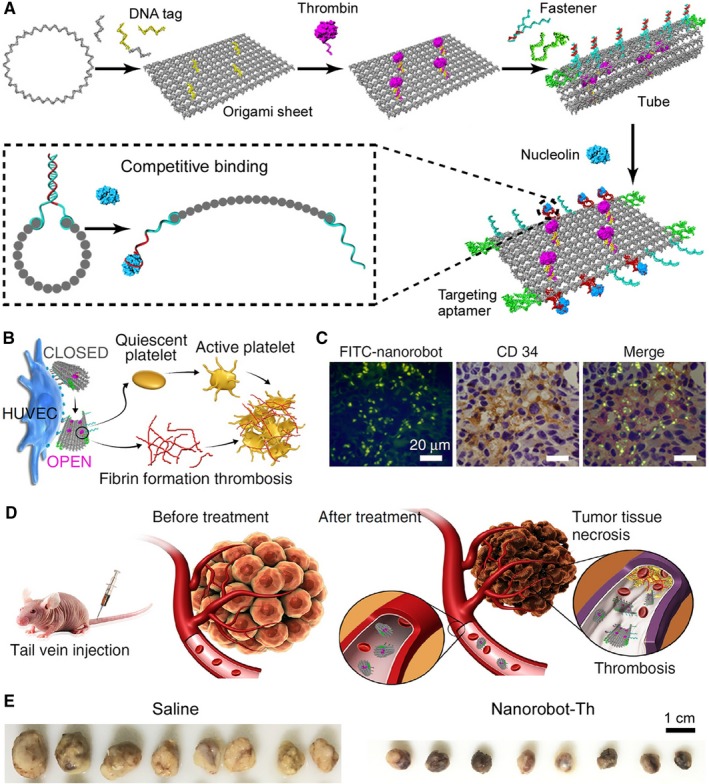
A prototype of DNA nanorobot with the ability to transport molecular payloads was designed to target cancer cells in tissue culture. Moreover, a further step was taken to succeed in the first in vivo application of the DNA nanorobot for cancer therapy. The robot was constructed using aptamer and DNA origami to fold a 90-nm tubular device to carry the blood coagulation protease thrombin inside, shielded from circulating platelets and plasma fibrinogen. The recognition and binding of the aptamer to its tumour-specific target molecule triggered the robot unfolding to expose thrombin to the blood, which in turn activated coagulation at the local tumour site, resulting in tumour necrosis and inhibition of tumour growth. Since all solid-tumour feeding vessels are virtually the same, this strategy could be effective against many types of malignant diseases.
一种具有输送分子有效载荷能力的 DNA 纳米机器人原型被设计用于靶向组织培养中的癌细胞。此外,还进一步成功地将 DNA 纳米机器人首次应用于癌症治疗的体内应用。该机器人使用适体和 DNA 折纸技术构建,可折叠成一个 90nm 的管状装置,将凝血蛋白酶凝血酶包裹在内部,防止其与循环血小板和血浆纤维蛋白原接触。适体与肿瘤特异性靶分子的识别和结合触发机器人展开,将凝血酶暴露于血液中,进而在局部肿瘤部位激活凝血,导致肿瘤坏死和抑制肿瘤生长。由于所有实体肿瘤的滋养血管几乎相同,因此这种策略可能对多种恶性疾病有效。