Hou Gonglin, Wang Fei, Shi Jieyan, Chen Weijiang, Yu Jie
Department of Psychological Research, Zhejiang Sci-Tech University, Hangzhou, China.
Department of Economics, Claremont Graduate University, Claremont, California, USA.
Psych J. 2019 Jun;8(2):212-231. doi: 10.1002/pchj.259. Epub 2018 Dec 27.
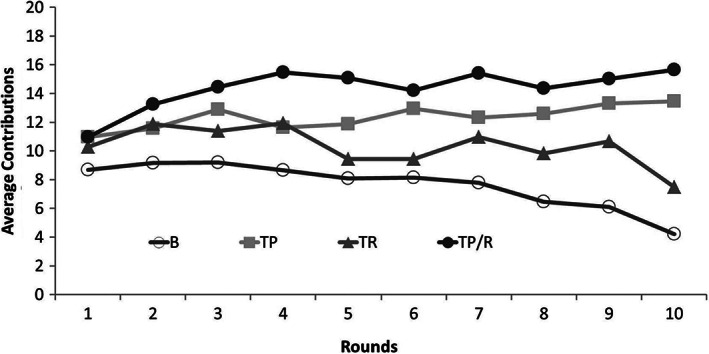
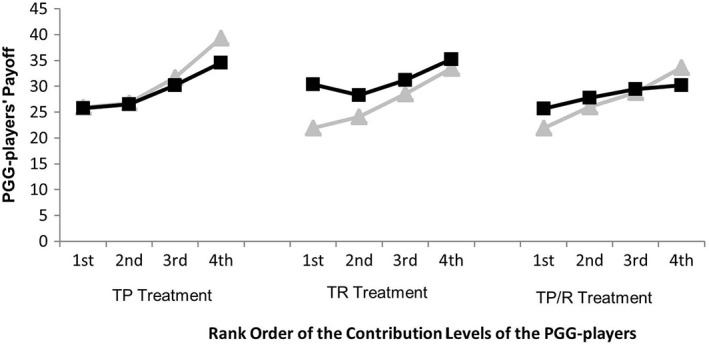
Cooperation is the crux of many social problems, thus third-party sanction, as one of the most important ways to promote cooperation, is worth studying. The present study compared the effects of third-party punishment alone, third-party reward alone, and the combination of third-party reward and third-party punishment on cooperation in the context of a public goods experiment. In addition, we explored the characteristics of third-party sanctioning behaviors. A total of 280 students participated in the present study. The results showed that the operation of third-party sanctions did raise the level of cooperation and changed the discrete trend of cooperation-specifically, the differences between the cooperation level of every group member and the average level of the whole group. Furthermore, when third-party rewards and third-party punishments were used simultaneously in the public goods game (PGG), the level of cooperation was greatly enhanced, which meant that in the context of the third party, when punishment opportunities and reward opportunities coexist, they may have a "compensatory effect." In terms of the characteristics of sanctioning behaviors, the frequency of third-party sanctions did not differ significantly under different conditions (third-party punishment alone, third-party reward alone, and a combination of third-party reward and third-party punishment), and neither did expenditures on third-party sanctions, but the strategies that third parties used changed under different conditions, thus their effects on other group members' cooperative behavior varied under different conditions. The present study provides a comprehensive picture of how third parties behave in different conditions of third-party sanctions and how these sanctions exert influence on cooperation. Understanding these mechanisms can help us build more effective institutions.
合作是许多社会问题的关键所在,因此第三方制裁作为促进合作的最重要方式之一,值得研究。本研究在公共物品实验的背景下,比较了单独的第三方惩罚、单独的第三方奖励以及第三方奖励与第三方惩罚相结合对合作的影响。此外,我们还探究了第三方制裁行为的特征。共有280名学生参与了本研究。结果表明,第三方制裁的运作确实提高了合作水平,并改变了合作的离散趋势——具体而言,是每个小组成员的合作水平与整个小组平均水平之间的差异。此外,当在公共物品博弈(PGG)中同时使用第三方奖励和第三方惩罚时,合作水平得到了极大提高,这意味着在第三方情境下,当惩罚机会和奖励机会并存时,它们可能会产生“补偿效应”。就制裁行为的特征而言,在不同条件下(单独的第三方惩罚、单独的第三方奖励以及第三方奖励与第三方惩罚相结合),第三方制裁的频率没有显著差异,第三方制裁的支出也没有显著差异,但第三方使用的策略在不同条件下发生了变化,因此它们对其他小组成员合作行为的影响在不同条件下也有所不同。本研究全面呈现了第三方在不同第三方制裁条件下的行为方式以及这些制裁如何对合作产生影响。了解这些机制有助于我们建立更有效的制度。