Wu Chunxiao, Liu Peihui, Fu Huaili, Chen Wentao, Cui Shaoyang, Lu Liming, Tang Chunzhi
Medical College of Acu-Moxi and Rehabilitation.
Shenzhen Hospital of Guangzhou University of Chinese Medicine, Shenzhen, Guangdong Province, PR China.
Medicine (Baltimore). 2018 Dec;97(52):e13845. doi: 10.1097/MD.0000000000013845.
Transcutaneous auricular vagus nerve stimulation (taVNS), as a noninvasive intervention, has beneficial effects on major depressive disorder based on clinical observations. However, the potential benefits and clinical role of taVNS in the treatment of major depressive disorder are still uncertain and have not been systematically evaluated. Therefore, we performed a systematic review and meta-analysis to evaluate the effectiveness and safety of taVNS in treating major depressive disorder.
Four electronic databases, namely, Embase, MEDLINE, the Cochrane Library and PsycINFO, were searched for all related trials published through May 1, 2018. We extracted the basic information and data of the included studies and evaluated the methodological quality with the Cochrane risk of bias tool and the nonrandomized studies-of interventions (ROBINS-I) tool. A meta-analysis of the comparative effects was conducted using the Review Manager 5.3 software.
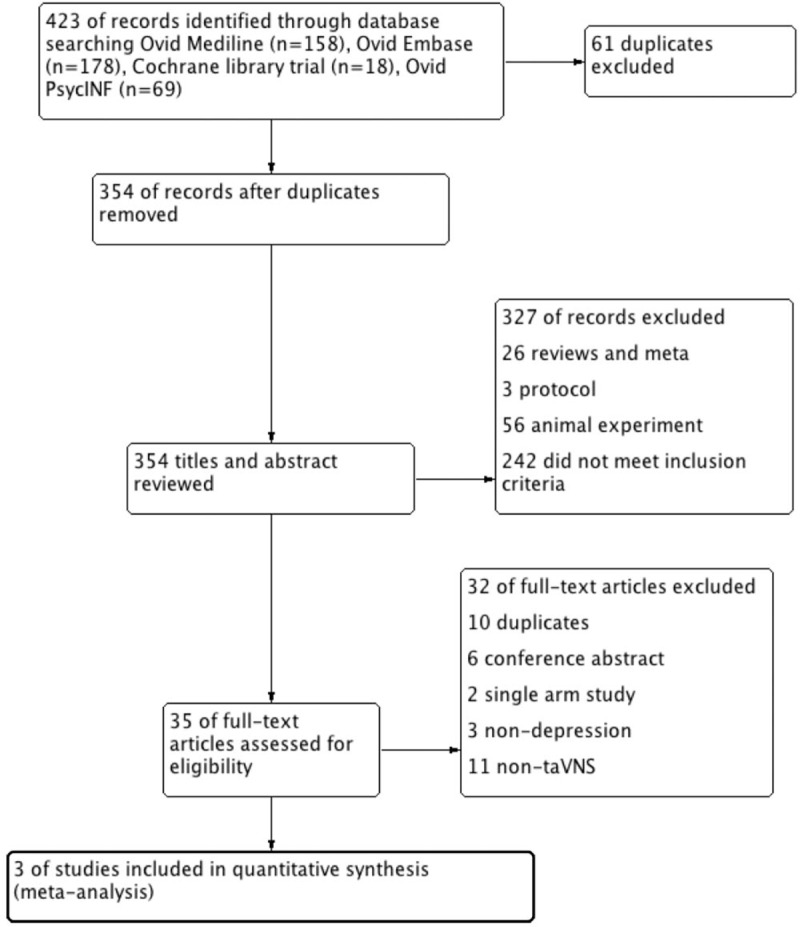
A total of 423 citations from the databases were searched, and 4 studies with 222 individuals were included in the meta-analysis. The taVNS technique could decrease 24-item HAMD scores more than the sham intervention (MD: -4.23, 95% CI: -7.15, -1.31; P = .005) and was also more effective in decreasing Self-Rating Depression Scale scores ((MD: -10.34, 95% CI: -13.48, -7.20; P < .00001), Beck Depression Inventory scores (MD: -10.3, 95% CI: -18.1, -2.5; P = .01) and Self-Rating Anxiety Scale scores (MD: -6.57, 95% CI: -9.30, -3.84; P < .00001). However, there was no significant difference in the Hamilton Anxiety Rating Scale scores between the taVNS and sham taVNS groups (MD: -1.12, 95% CI: -2.56, 0.32; P = .13). No obvious adverse effects of taVNS treatment were reported in the included studies.
The results of the analysis preliminarily demonstrated that taVNS therapy can effectively ameliorate the symptoms of major depressive disorder, providing an alternative technique for addressing depression. However, more well-designed RCTs with larger sample sizes and follow-ups are needed in future studies to confirm our findings.
经皮耳迷走神经刺激(taVNS)作为一种非侵入性干预措施,基于临床观察,对重度抑郁症具有有益效果。然而,taVNS在重度抑郁症治疗中的潜在益处和临床作用仍不明确,尚未得到系统评估。因此,我们进行了一项系统评价和荟萃分析,以评估taVNS治疗重度抑郁症的有效性和安全性。
检索了四个电子数据库,即Embase、MEDLINE、Cochrane图书馆和PsycINFO,以查找截至2018年5月1日发表的所有相关试验。我们提取了纳入研究的基本信息和数据,并使用Cochrane偏倚风险工具和干预性非随机研究(ROBINS-I)工具评估方法学质量。使用Review Manager 5.3软件对比较效果进行荟萃分析。
共检索到数据库中的423篇引文,荟萃分析纳入了4项研究,共222名个体。与假干预相比,taVNS技术能更显著降低24项汉密尔顿抑郁量表(HAMD)评分(MD:-4.23,95%CI:-7.15,-1.31;P = 0.005),在降低自评抑郁量表评分(MD:-10.34,95%CI:-13.48,-7.20;P < 0.00001)、贝克抑郁量表评分(MD:-10.3,95%CI:-18.1,-2.5;P = 0.01)和自评焦虑量表评分(MD:-6.57,95%CI:-9.30,-3.84;P < 0.00001)方面也更有效。然而,taVNS组和假taVNS组在汉密尔顿焦虑量表评分上无显著差异(MD:-1.12,95%CI:-2.56,0.32;P = 0.13)。纳入研究中未报告taVNS治疗有明显不良反应。
分析结果初步表明,taVNS疗法可有效改善重度抑郁症症状,为治疗抑郁症提供了一种替代技术。然而,未来研究需要更多设计良好、样本量更大且有随访的随机对照试验来证实我们的发现。