Second Department of Spine Surgery, Changzheng Hospital, Shanghai, China (mainland).
Department of Orthopedics, Chinese People's Liberation Army 113 Hospital, Ningbo, Zhejiang, China (mainland).
Med Sci Monit. 2018 Dec 30;24:9479-9487. doi: 10.12659/MSM.912650.
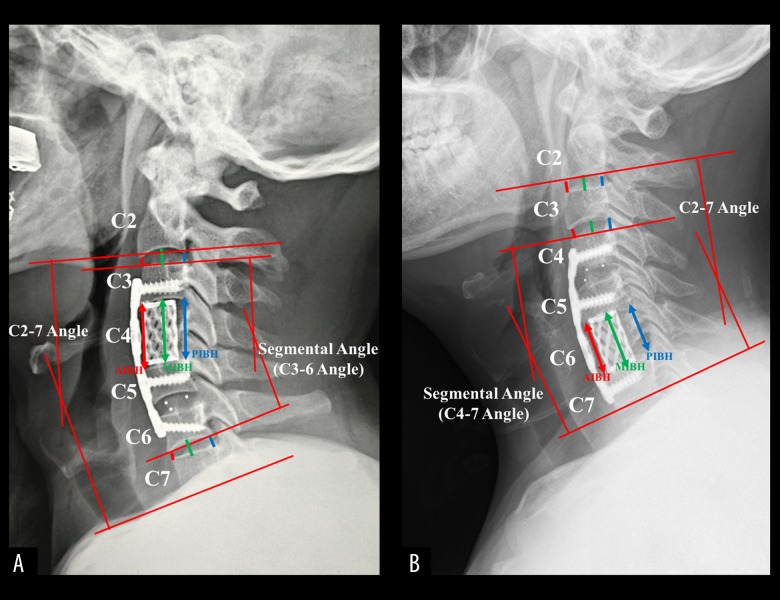
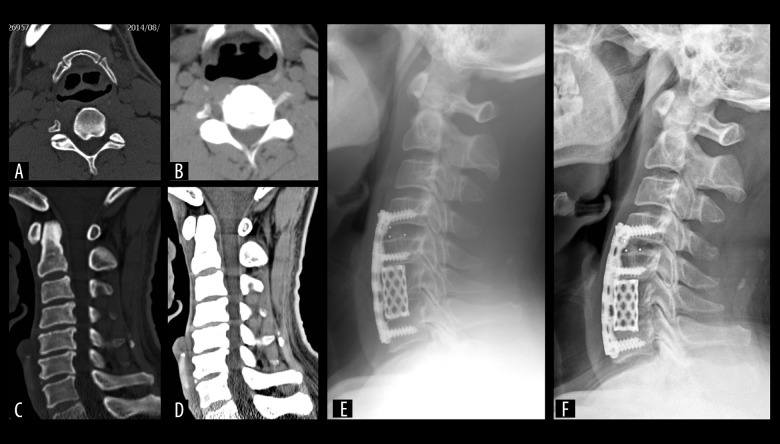
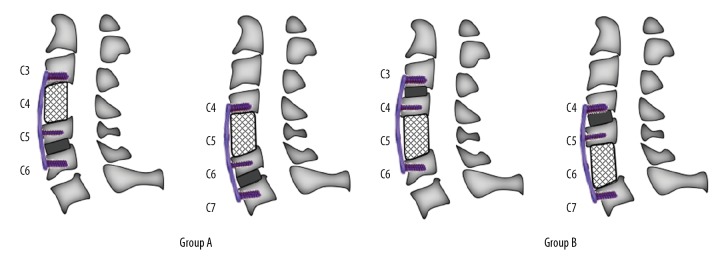
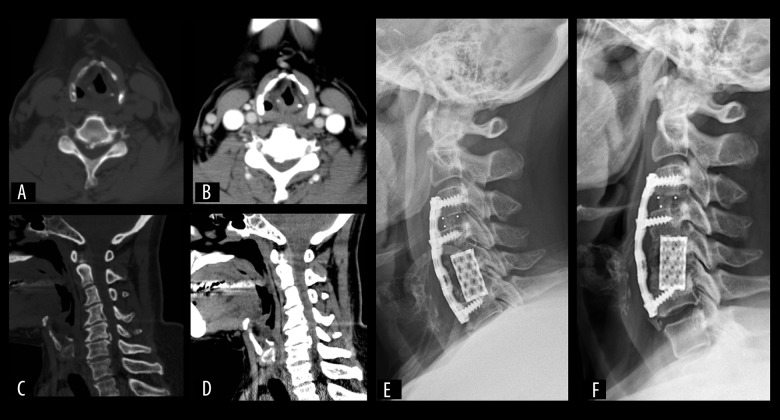
BACKGROUND Hybrid decompression has been used to treat patients with cervical spondylotic myelopathy (CSM). However, no published study has investigated the effect of titanium mesh (TM) located cephalad or caudal in hybrid decompression surgery on the graft subsidence in treatment of three-level CSM. MATERIAL AND METHODS Forty-eight cases with three-level CSM who underwent the procedure of hybrid decompression from Jan 2014 to Jan 2017 were retrospectively reviewed. Radiological outcomes immediately postoperatively and at the final follow-up were compared between cases from group A (TM located cephalad, n=21) and group B (TM located caudal, n=27). RESULTS No differences were observed in the 2 groups in terms of number, sex, or duration of follow-up. The average follow-up was 4.38±0.439 months in group A and 4.81±0.509 months in group B (p>0.05). The index loss of anterior (AIBH), middle (MIBH), and posterior interbody height (PIBH) in group A were 0.857±0.448/1.00±0.525/1.33±0.608, respectively, which were all lower than that in group B (P<0.05), as was the occurrence of TM subsidence. However, there was no significance difference in height loss of adjacent intervertebral space between groups. All angles were decreased at the final follow-up in both groups (p<0.05). More decrease of C2-C7 angle occurred in group B (p>0.05), and segmental angle in group A decreased more than in group B (p>0.05). CONCLUSIONS TM inferior to intervertebral cage (IC) in hybrid decompression has a higher risk for developing subsidence, and when the choice of the position of TM is available in hybrid decompression surgery, TM located cephalad was recommend to alleviate TM subsidence.
杂交减压术已用于治疗颈椎病(CSM)患者。然而,尚无研究调查杂交减压术中钛网(TM)置于颈椎上方或下方对治疗 3 节段 CSM 移植物下沉的影响。
回顾性分析 2014 年 1 月至 2017 年 1 月期间接受杂交减压术的 48 例 3 节段 CSM 患者的资料。比较 A 组(TM 位于颈椎上方,n=21)和 B 组(TM 位于颈椎下方,n=27)患者术后即刻和末次随访时的影像学结果。
两组患者的例数、性别或随访时间无差异。A 组平均随访时间为 4.38±0.439 个月,B 组为 4.81±0.509 个月(p>0.05)。A 组前路(AIBH)、中路(MIBH)和后路椎间高度(PIBH)指数丢失分别为 0.857±0.448/1.00±0.525/1.33±0.608,均低于 B 组(P<0.05),TM 下沉发生率也较低。但两组间邻近节段椎间高度丢失无差异。两组患者终末随访时各角度均减小(p<0.05)。B 组 C2-C7 角减小更明显(p>0.05),A 组节段角减小大于 B 组(p>0.05)。
在杂交减压术中,TM 位于椎间笼下方发生下沉的风险更高。当选择 TM 位置时,建议 TM 位于颈椎上方以减轻 TM 下沉。