Cao Xin-Xin, Cai Hao, Mao Yue-Ying, Wu Qi, Zhang Lu, Zhou Dao-Bin, Li Jian
Department of Hematology, Peking Union Medical College Hospital, Chinese Academy of Medical Sciences & Peking Union Medical College, 1 Shuai Fu Yuan Hu Tong, Dongcheng District, Beijing, 100730 People's Republic of China.
Cancer Cell Int. 2018 Dec 22;18:215. doi: 10.1186/s12935-018-0716-7. eCollection 2018.
Acute myeloid leukemia (AML) is a clinically and biologically heterogeneous disease. The survival of older patients is generally poor. In the current study, we sought to investigate the differences in molecular gene mutations between younger and older AML patients, and to identify those newly diagnosed AML patients who are more likely to respond to standard cytarabine and daunorubicin induction chemotherapy.
We retrospectively evaluated 179 patients who were newly diagnosed with non-M3 AML. A next-generation sequencing assay covering 34 genes was used to investigate recurrently mutated genes. The mutational status of fusion genes was determined by real time PCR.
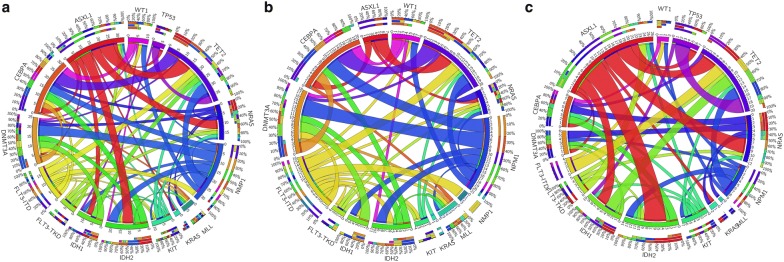
The median age at diagnosis was 53 years (range 18-88 years). Sixty-eight patients were 60 years or older with a median age of 67 years (range 60-88 years). Eighteen patients (10.1%) carried t(8;21)(q22;q22.1) or - gene fusion, and there was a significantly higher incidence in younger patients (p = 0.019). At least one non-synonymous gene mutation was detected in 159 patients (88.8%). The median number of gene mutations was two (range 0-6). The mean number of molecular gene mutations at diagnosis was higher in older patients than younger patients (2.5 vs 1.83, p = 0.003). Older patients had significantly higher incidences of (22.1% vs 13.5%, p = 0.025) and mutations (13.2% vs 3.6%, p = 0.034). In total, 78 patients received DA60 (daunorubicin 60 mg/m per day on days 1-3 and cytarabine 100 mg/m twice per day on days 1-7) as the induction therapy, and information was available on their response to induction treatment. Patients with - gene fusion were significantly more likely to achieve complete remission (CR) after DA60 induction therapy (p = 0.026), as were patients without the mutation (p = 0.007).
Older AML patients had a lower incidence of favorable cytogenetics and higher frequencies and burdens of molecular mutations that are associated with poor prognosis compared to younger patients. Patients with - gene fusion or without the gene mutation had a better chance of achieving CR when treated with cytarabine and daunorubicin induction chemotherapy.
急性髓系白血病(AML)是一种临床和生物学上具有异质性的疾病。老年患者的生存率通常较差。在本研究中,我们试图调查年轻和老年AML患者分子基因突变的差异,并确定那些更有可能对标准阿糖胞苷和柔红霉素诱导化疗产生反应的新诊断AML患者。
我们回顾性评估了179例新诊断为非M3 AML的患者。使用覆盖34个基因的二代测序检测方法来研究反复突变的基因。通过实时PCR确定融合基因的突变状态。
诊断时的中位年龄为53岁(范围18 - 88岁)。68例患者年龄在60岁及以上,中位年龄为67岁(范围60 - 88岁)。18例患者(10.1%)携带t(8;21)(q22;q22.1)或 - 基因融合,在年轻患者中的发生率显著更高(p = 0.019)。159例患者(88.8%)检测到至少一个非同义基因突变。基因突变的中位数为两个(范围0 - 6)。诊断时老年患者分子基因突变的平均数高于年轻患者(2.5对1.83,p = 0.003)。老年患者 (22.1%对13.5%,p = 0.025)和 基因突变(13.2%对3.6%,p = 0.034)的发生率显著更高。共有78例患者接受DA60(柔红霉素60 mg/m²每天第1 - 3天,阿糖胞苷100 mg/m²每天两次第1 - 7天)作为诱导治疗,且有关于他们诱导治疗反应的信息。携带 - 基因融合的患者在DA60诱导治疗后更有可能达到完全缓解(CR)(p = 0.026),没有 - 基因突变的患者也是如此(p = 0.007)。
与年轻患者相比,老年AML患者预后良好的细胞遗传学发生率较低,分子突变的频率和负担较高,这些与预后不良相关。携带 - 基因融合或没有 - 基因突变的患者在接受阿糖胞苷和柔红霉素诱导化疗时达到CR的机会更大。