Department of Family Medicine, Faculty of Medicine Ljubljana, University of Ljubljana, Ljubljana, Slovenia.
Department of Psychiatry and Behavioral Sciences, Stanford University School of Medicine, Stanford, California.
Cancer Med. 2019 Jan;8(1):363-373. doi: 10.1002/cam4.1895. Epub 2019 Jan 1.
Currently, there are eight meta-analyses that address the question whether psychosocial intervention can prolong survival with widely disparate conclusions. One reason for inconsistent findings may be the methods by which previous meta-analyses were conducted.
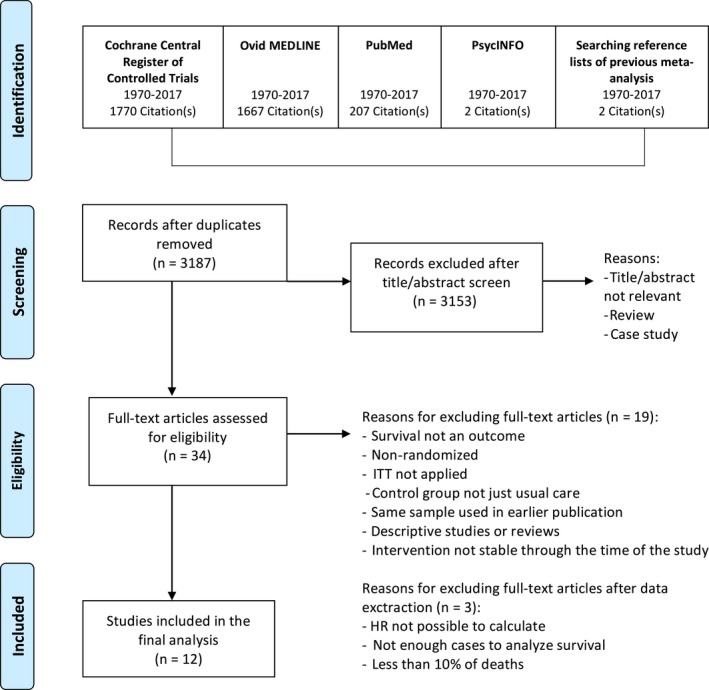
Databases were searched to identify valid randomized controlled trials that compared psychosocial intervention with usual care. Hazard ratios (HRs) and their confidence intervals were pooled to estimate the strength of the treatment effect on survival time, and z-tests were performed to assess possible heterogeneity of effect sizes associated with different patient and treatment characteristics.
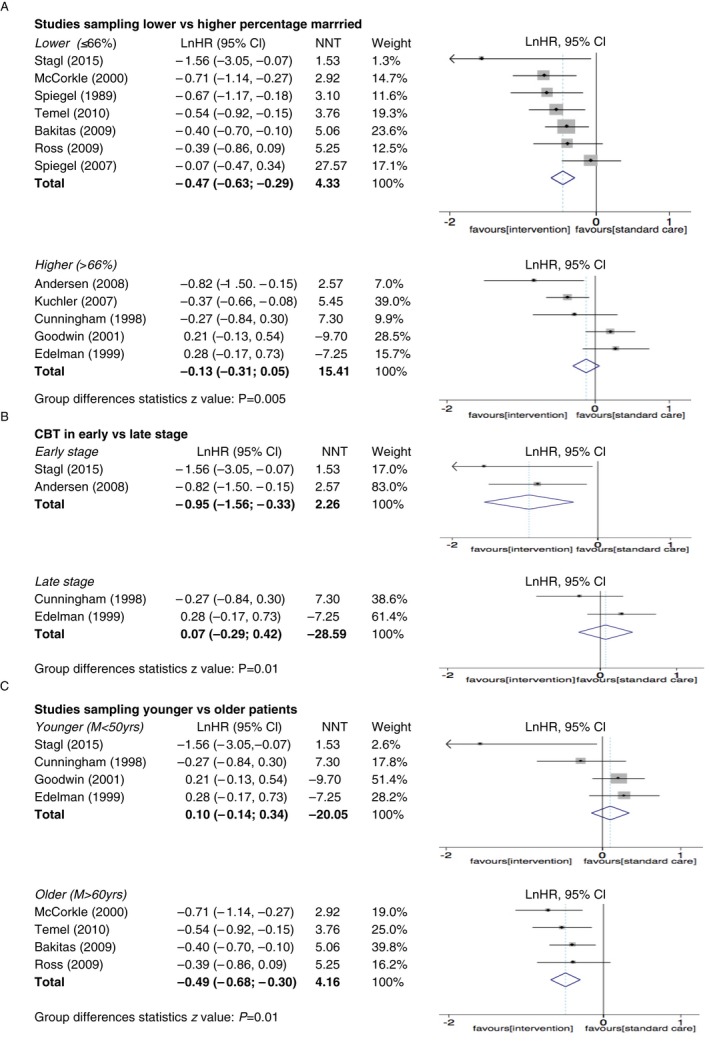
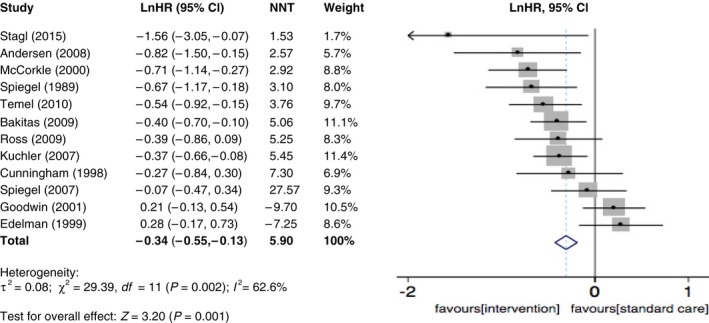
Twelve trials involving 2439 cancer patients that met screening criteria were included. The overall effect favored the treatment group with a HR of 0.71 (95% Cl 0.58-0.88; P = 0.002). An effect size favoring treatment group was observed in studies sampling lower vs higher percentage of married patients' (NNT = 4.3 vs NNT = 15.4), when Cognitive-Behavioral Therapy was applied at early vs late cancer stage (NNT = 2.3 vs NNT = -28.6), and among patients' older vs younger than 50 (NNT = 4.2 vs NNT = -20.5).
Psychosocial interventions may have an important effect on survival. Reviewed interventions appear to be more effective in unmarried patients, patients who are older, and those with an early cancer stage who attend CBT. Limitations of previous meta-analysis are discussed.
目前有八项荟萃分析探讨了心理社会干预是否可以延长生存时间,但结论存在很大差异。导致研究结果不一致的原因之一可能是之前荟萃分析的方法不同。
检索数据库以确定比较心理社会干预与常规护理的有效随机对照试验。合并危险比(HR)及其置信区间,以估计治疗对生存时间的影响强度,并进行 z 检验以评估与不同患者和治疗特征相关的效应大小的异质性。
纳入了 12 项符合筛选标准的涉及 2439 例癌症患者的试验。总体效果有利于治疗组,HR 为 0.71(95%Cl 0.58-0.88;P=0.002)。在研究中,当对婚姻比例较低的患者进行认知行为疗法时(NNH=4.3,NNH=15.4),对婚姻比例较高的患者进行治疗的效果更好;当将认知行为疗法应用于癌症早期阶段时(NNH=2.3,NNH=-28.6),效果比晚期治疗更好;对于年龄大于或小于 50 岁的患者,治疗效果更好(NNH=4.2,NNH=-20.5)。
心理社会干预可能对生存有重要影响。已审查的干预措施似乎对未婚患者、年龄较大的患者和患有早期癌症且接受认知行为疗法的患者更有效。讨论了先前荟萃分析的局限性。